

Press Release
Appointment of Nick Molden as Honorary Research Fellow at Imperial College London
Oxford 9 October 2020
Appointment of Nick Molden as Honorary Research Fellow at Imperial College London
Emissions Analytics and Imperial College London are pleased to announce the appointment from 14 September 2020 of Nick Molden as an Honorary Research Fellow in the Department of Civil and Environmental Engineering, Faculty of Engineering.

Nick Molden is the founder of Emissions Analytics (www.emissionsanalytics.com), a company that pioneered the use of real-world, on-road testing of vehicles to understand their actual levels of pollutant and carbon dioxide emissions. Through the largest programme of independent testing so far conducted, it became possible to understand the true background to and consequences of the ‘Dieselgate’ scandal.
This appointment to Honorary Research Fellow will lead to an increased number of research studies utilising Emissions Analytics’ extensive emissions database. In parallel, new innovative test methodologies will be developed in collaboration, in particular around the study of non-exhaust emissions, which has become a policy priority as vehicles become ever heavier.
Professor Washington Ochieng, Head of the Centre for Transport Studies at Imperial College London, says: “Nick has been collaborating with Imperial for many years on research and teaching around real-world emissions from transport, and this appointment reflects a commitment on both sides to expand and deepen that work.”
Nick Molden says: “Transportation and its emissions is at a crucial juncture with the new challenges being thrown up by electrification, while almost all vehicles on the road remain traditional internal combustion engines. Understanding real-world performance of both is crucial to developing the best solutions and most effective policy.”
Nick Molden is also co-founder of the not-for-profit AIR Alliance (www.airindex), which has a mission to put real-world ratings into the hands of vehicle buyers and to influence policy that can bring about cleaner air and lower greenhouse gas emissions. As chairman of two European CEN Workshops (www.cen.eu), Nick has been instrumental in developing new standards for real-world emissions and air quality.
Nick Molden is a graduate of Christ Church, University of Oxford, with a Masters in Philosophy, Politics and Economics.
Press contacts
Dr Richard Lofthouse, Emissions Analytics
richard.lofthouse@emissionsanalytics.com
+44 (0)7790 902982
Caroline Brogan, Imperial College London
caroline.brogan@imperial.ac.uk
+44(0)20 7594 3415

Eight principles of decarbonisation
Elimination of carbon dioxide from transport must be real not artefact
Elimination of carbon dioxide from transport must be real not artefact
The United Kingdom has enacted a law for net-zero carbon dioxide (CO2) emissions across the economy from 2050, and other countries will likely follow. This has spawned a policy of targeting zero emissions from transportation, which is often spoken about interchangeably with the idea of replacing the vehicle fleet with battery electric vehicles (BEVs). A further benefit of this change is claimed to be improvement in air quality, due to the absence of a tailpipe, and the resulting health benefits. But is this apparent panacea as simple as it sounds?

Slowing climate change is now widely regarded to be of such importance that all ideas need to be robustly tested not just for the glamour of their ambition, but whether they can deliver. Admitting the existence of risk, a mix of approaches may be more robust than gambling all on red. Unintended consequences must also be considered for fear of achieving the goal but at an unacceptable price. As The Economist said in August 2020, “…Mr Xi is shifting to a sharp focus on supply-chain choke-points where China is either vulnerable to foreign coercion or where it can exert influence abroad. That means building up self-sufficiency in key technologies, including semiconductors and batteries.” The reality is that there is already, and will continue to be, a widely predicted global supply constraint on batteries for the rest of this decade if take-up of BEVs is as healthy as it needs to be to fulfil zero carbon transportation.
For transport, then, the right policy could be expressed as delivering zero carbon dioxide (including other gases with equivalent greenhouse gas effects) emissions with no worsening in other pollutants and no vexatious secondary effects. At least, any trade-offs should be understood scientifically and communicated politically. This newsletter will consider what would be necessary and sufficient to achieve this, and the implications.
So, let us set out Emissions Analytics’ Eight Principles of Decarbonisation – the material things that need to be delivered to achieve the stated policy:

Principles 1 and 2 are a significant enough challenge in themselves, but progress is being made in that direction by many countries. There remains a significant issue in the intermittency of many renewable energy sources, especially where there is no nuclear baseload. This newsletter will not go into these further, but unless they are achieved, the advantages of BEVs will be seriously compromised, whatever else is achieved in respect of the other principles.
Principle 3 arises from carbon being a global problem: the total matters, not the source. Reducing upstream CO2 emissions is a very serious challenge given the lack of control that governments can apply to foreign mining and manufacturing operations. It is also material, due to the higher CO2 emissions currently from BEV compared to ICE manufacture, like-for-like. Efforts are being made by manufacturers, including recent reports from BMW and others, to assert some control and transparency, but it remains a significant challenge. Even the transportation of vehicles by sea would need to be completely decarbonised to achieve this, which may conceivably be achieved with alternative fuels such as ammonia produced with zero carbon electricity.
Principle 4 is a growing challenge, with the need to recycle various rare earth metals from drive motors and batteries, or give them a second life before eventual recycling. This is a business opportunity that is already attracting entrants, yet achieving this with zero-carbon energy remains a stretching goal.
Principle 5, means that other emissions that have a global warming effect – often expressed in CO2-equivalence – should be included in analysis, to ensure one climate-charge-relevant emission is not swapped for another, through singular focus on CO2. This could include, for example, methane emissions from gas vehicles or nitrous oxide (N2O) from certain after-treatment systems.
Principle 6 is an important but complex one. This could mean that vehicles should not ‘crowd out’ the use of batteries from existing non-transportation uses. For example, where batteries may be used as static power sources or for powering handheld tools, if demand from transportation made battery prices too high, these uses may switch back to combustion engines. It could also mean that old ICEs that are replaced with BEVs in developed countries are exported to expand fleets in developing countries as their values fall.
Recalling the Dieselgate crisis, where nitrogen oxide (NOx) emissions were found to be insufficiently regulated in a way that led to damagingly high emissions in the real world, there is a big risk from the non-exhaust emissions from BEVs, especially in regard to tyre wear. Due to the weight of batteries, BEV vehicles are significantly heavier that like-for-like ICE vehicles. As a result, for the same grade of tyre and driving patterns, non-exhaust emissions from wear on those tyres will be higher for the BEV. The regenerative braking for BEVs may lead to lower brake wear emissions compared to ICEs, but this is unlikely to counterbalance the increased tyre wear emissions. Therefore, the risk is that the CO2 reduction from BEVs is traded for a degradation in air quality and other microplastic pollution.
Through our work on measuring pollution inside the vehicle cabin, we have observed that hybrid vehicles often have worse interior particle concentrations, which may lead to worse exposures and health effects for occupants. The hypothesis is that, due to the energy requirements, filtration is minimised as these vehicles are sold for their fuel efficiency. Therefore, CO2 may be traded off against human health in this additional dimension.
While carbon credits, Principle 7, may act as a positive incentive mechanism for carbon reduction, inherent in the system is their trading effectively permits the continued use of combustion engines by the purchasers. Therefore, while they may be expedient in the short run, they must be phased out permanently.
Principle 8 is simple: to achieve zero carbon, the whole ICE and hybrid fleet on the road must be replaced. It is likely that the last few percent of vehicles will be hard to shift due to stubborn owners, and therefore the incentives needed may be high. In conjunction with Principle 6, old ICE vehicles should be responsibly recycled, not exported to developing economies, to avoid the scandals associated with the scrappage scheme following the financial crash of 2008, when dirty diesels were ‘scrapped’ at the expense of taxpayers only to be found to have been exported to Eastern Europe and beyond.

Last year, we published this newsletter which showed that hybrids were the best way to reduce CO2 in a world of limited battery capacity. Full hybrids deliver around 30% CO2 reduction compared to the nearest equivalent ICE, compared to the 100% tailpipe reduction of BEVs; but 14 times more hybrids can be built for the same battery capacity, meaning hybrids could actually deliver four times more CO2 reduction than BEVs while the battery constraint remains.
While limited battery capacity remains true for now, let us project forward to a hypothetical world of unconstrained and cost-competitive battery supply. In addition, we also make the critical assumption that all electricity will be zero carbon (Principles 1 and 2). We assume that complete grid decarbonisation will be achieved. We also assume that manufacturing CO2 emissions (Principle 3) remains the same as currently, but also that there is no improvement in ICE efficiency. Further, we are putting no negative value on the utility limitation of the reduced range of BEVs compared to ICEs, which may well persist even when batteries are plentiful in supply and cost competitive due to the weight they add to the vehicle.
To assess these effects, Emissions Analytics has created its own model of the CO2 effects of electrification. Three scenarios were modelled: complete switched to BEVs and full hybrids compared to the ICE baseline.
The manufacture emissions of ICEs, full hybrids (FHEVs; for clarity these exclude mild hybrids and plug-in hybrids, but sit between them in terms of battery size, and rely only on on-board gasoline or diesel for energy) and BEVs are 5.8, 6.2 and 11.4 tonnes per unit1. In use, the average CO2 emissions are 111, 78 and 0 g/km. Assumed annual usage of all three are 16,000km over a lifetime of 200,000km. On the switch-to-BEV strategy, the new car sales mix is assumed to be 100% BEV by 2040, and the whole fleet by early 2050s.
Crucially, as CO2 is cumulative in the atmosphere – it lasts between 300 and 1,000 years once emitted – we must consider cumulative emissions in our analysis. This is the basis of the Paris agreement and countries’ carbon budgets.
On this BEV scenario, cumulative total CO2 emissions emitted are higher for over a decade due to the front-loaded emissions in the manufacture of the BEVs. From 2034, the cumulative CO2 is lower than the benchmark ICE strategy as the benefits of zero in-use emissions begin to outweigh the higher embedded emissions from manufacturing and batteries. By 2070, cumulative emissions are 811m tonnes lower from BEVs. However, this is only 47% down on the ICE strategy; in 2050 it is only 23% down. So, unless you can eliminate manufacture emissions, we are not even close to zero emissions – even ignoring Principles 5 to 8.
If you double average battery size, and therefore double the CO2 in their manufacture, to compensate for the bounded utility of BEVs and bring range more in line with ICEs, then the reduction by 2070 is just 11%, and it is 1% worse still in 2050.
Revisiting the potential for hybrids set out last year, the BEV strategy can also be compared in this model to a FHEV strategy of switching the whole vehicle fleet to FHEVs by the earlier 2050s, and it yields dramatic results.
The BEV strategy is still superior, but the total CO2 reduction by 2050 is just 11% and by 2070 it is 26%. Good, but far from zero. Less good is if you double average battery size, when cumulative CO2 emissions are 5% worse from BEVs than FHEVs.
These results stem from the higher manufacturing emissions of BEVs, which are true not just in the initial switch to BEVs but on subsequent future vehicle replacement, together with the lower in-use CO2 from hybrids. This will only change if Principle 3 is delivered – hence its vital importance. The cynic may think that net vehicle importing countries may be quite content to ‘off-shore’ rather than genuinely reduce the emissions.

Although the legal position is that net zero must be achieved by 2050, from the point of view of climate change, what happens in the next twenty years is just as important. Carbon dioxide has no discount rate. Every gram of CO2 that is reduced now makes the challenge post-2050 easier. Therefore, inaction today on the promise of a miracle solution tomorrow is not a robust policy.
Unless a more robust policy is developed, delivering real and measurable CO2 reduction soon, it is likely around 2035 that BEVgate will break, where much of the promised reduction will have proved illusory and air quality may be worse. As it took 15 years from the introduction of explicit NOx reduction under the ill-fated Euro regulations until Dieselgate, it may be 15 years from now that the folly of dogma rather than facts becomes clear. And our carbon budgets will by then be spent.
Footnotes:
- Derived from https://www.volkswagen-newsroom.com/en/press-releases/electric-vehicles-with-lowest-co2-emissions-4886; in-use emissions for FHEVs applies 30% efficiency estimated by Emissions Analytics

What's the problem with biofuels?
Why is the use of biofuels, promising environmentally friendly reductions in emissions especially for heavy-duty vehicles, not taking off faster and attracting only limited policy focus?
One of the many conundra in transportation emissions is why the use of biofuels, promising environmentally friendly reductions in emissions especially for heavy-duty vehicles, is not taking off faster and attracting only limited policy focus. Compare that to the excited talk around battery electrification of trucks, which generously could be described as a challenging solution.
Across the range of biofuels that Emissions Analytics has tested, some patterns become clear. The first observation is that, on average, they tend to lead to very little change in emissions at the tailpipe. Second, within that average, there tends to be significant variability between vehicle models on the same fuel. Therefore, if comparing tailpipe performance, it is difficult to generalise about the benefits of a particular biofuel, and the expected benefit in any case may be small.

A corollary of the first point is that the proposed benefit of these fuels relies on emissions reduction – often but not always focusing on carbon dioxide (CO2) – located upstream in the fuel production and distribution. This part of the supply chain is often opaque, and not easily subject to independent verification or regulation, as is possible with tailpipe measurement. Therefore, even if the benefits of a biofuel sound attractive, but cannot be verified, it would be right to take a sceptical position. On top of that, there may be secondary, unintended consequences due to competition for scarce resources as biofuel production is scaled, for example by the earlier effects on food supply and prices where raw materials were crops.
Rightly, therefore, many governments have been cautious in incentivising biofuels too categorically. For example, E10 – gasoline containing up to 10% ethanol – has been long proposed in the United Kingdom (UK) and other European countries, yet its adoption has been slow. Natural (fossil) gas, familiar at the pump as either Liquefied Petroleum Gas (LPG) or Autogas, attracts a significant tax advantage in the UK and other countries, yet there is limited forward visibility because the tax advantage is always at risk of withdrawal. Fleets, consequently, have been cautious in converting to natural gas.
To illustrate the dilemma, we can consider test results from two programmes Emissions Analytics has conducted, one covering E10 gasoline, the other compressed natural gas (CNG) and liquefied natural gas (LNG).
Switching from E5 to the higher ethanol E10 gasoline in Europe is often held out as a quick way to deliver large aggregate CO2 reductions as it can be distributed at scale through the existing refuelling infrastructure, to be used both in light- and heavy-duty applications.
To investigate this, we tested E10 on 17 gasoline vehicles in Europe from a wide range of manufacturers. On average, CO2 emissions fell by 0.5%, but this varied at the model level from an increase of 7.1% to a decrease of 6.3%. All were relatively new Euro 5 or Euro 6 vehicles, tested on our standardised on-road cycle made up of urban, rural and motorway elements. Due to the lower energy content of E10, the fuel economy worsened on average by 1.2%, with a similarly wide variation. Perhaps unexpectedly, emissions of nitrogen oxides (NOx) increased by 16.6% on average, from an initial level of 59 mg/km. Carbon monoxide (CO) fell on average by 4.5%.
Therefore, at the tailpipe, the reduction in CO2 was negligible overall. The value of the reduction in CO did not outweigh the effects of the increased NOx emissions, as non-compliant urban air quality is generally caused by excessive NO2 concentrations. For the introduction of E10 to be valuable, the upstream CO2 reduction would need to be large enough to outweigh that increase in NOx emissions. Sufficient transparency around those upstream emissions and any secondary consequences, is not offered by the supply chain and therefore the overall benefit of E10 should rightly be treated with scepticism.
Turning to natural gas, we were invited to be part of the first extensive UK study to assess real-world performance of heavy freight vehicles fuelled by this alternative. The two-year test ending in 2019 was led by biomethane supplier Air Liquide, with three transport operators (Howard Tenens, Asda and Kuehne + Nagel) and three technical partners: Cenex (data monitoring), Microlise (telematics) and Emissions Analytics (real-world testing). The project was supported by Innovate UK.
The goal was to consider the overall performance of gas as a fuel for heavy freight, compared to diesel. A secondary aim was to only use 100% biomethane, which in this case was derived from food waste and supplied by Air Liquide.

Biomethane is chemically similar to its fossil gas counterpart, although the product of a different refining process that starts with biogas that is then improved to increase the methane content and purge it of impurities. Biogas is the raw product of anaerobic decomposition of waste ranging from human and livestock excreta to food waste. Whether from a renewable feedstock or not, gas can be packaged in compressed but gaseous form, or as liquid; it can also be combusted in both spark ignition and compression ignition engines.
Heavy freight vehicles have been produced by different manufacturers to run off both CNG and LNG derivatives. Why the industry has both variants reflects sector immaturity, but also different strengths and weaknesses. For example, when liquefied at minus 160 degrees Celsius, LNG has a higher calorific value for its volume and thereby requires less space for its storage, an important consideration for road freight; but refuelling with LNG requires more safety procedures.
The broader primary energy market is now over 20% gas, following a big rise in recent years, but is dominated by fossil gas drawn from deposits of natural and shale gas, or syngas and coal gas from industrial processes. Of the overall gas market, biomethane, which is renewable as it is made from waste, constitutes just 0.1%, but is growing rapidly1.
In our consortium test, three different models of gas-fuelled heavy goods vehicle were pitted against their nearest diesel counterparts: rigid/CNG/spark ignition, articulated/LNG/spark ignition and articulated/LNG/compression ignition. The vehicles were drawn from three different fleets and three different manufacturers. The test covered urban, rural and motorway driving to reflect typical duty cycles. While different payloads were tested, we will focus on the 60% payload results here.
On average the gas vehicles emitted 8% less tailpipe CO2 than their diesel pairs, but this disguises variation from a 15% reduction to a 4% increase. It was only the switch to biomethane that delivered consistent, material reductions in well-wheel (WTW) greenhouse gas (GHG) savings: of around 80%, and not less than 76% compared to the diesels. The missing 20% reflects various inefficiencies, losses and a small amount of measured methane slippage, while the CO2 benefits rest heavily on the upstream, energy grid benefits of the fuel itself.
Turning now to air quality, particle number emissions were on average 5.4 x 10¹⁰ #/km (23%) lower on the gas vehicles compared to the diesel counterparts. However, the results were sensitive to payload and duty cycle, variable between vehicles as shown in the chart below.

In contrast, NOx emissions were on average 0.02 g/km (59%) higher on the gas vehicles compared to the diesels. Yet again, however the results were variable between vehicles and conditions, as shown below.

Therefore, there is no consistent pattern in the tailpipe emissions between vehicles and fuels and, consequently, the advantage of gas-powered vehicles rests heavily on the upstream CO2 benefits. With a supplier such as Air Liquide, those characteristics are more open to scrutiny and verification, but scaling and diversification of the supply of biomethane would need to adhere to the same standards to ensure those benefits were delivered.
Recently, UK retailer the John Lewis Partnership announced that it will replace 600 of its heaviest freight trucks with biomethane-powered gas alternatives, prioritising overall GHG emissions while retaining a wide array of options for the rest of its 4,800-strong fleet where electrification may begin to play a serious role for vehicles with a gross vehicle weight (GVW) below 10 tonnes.
In this instance the retailer plans to install its own fuelling infrastructure to guarantee that the gas used is 100% renewable, whereas more broadly it is more typical that governments incentivise the addition of renewable gas to the existing gas supply, highly efficient in that it takes advantage of existing infrastructure, but also subject then to confusion about what proportion of the gas is actually renewable, the fossil and non-fossil components comingling.
The John Lewis example appears to show that the climate-advantage of 100% biogas is now strong enough for management to overcome other drawbacks associated with an immature sector where fuelling infrastructure remains patchy, and where the true business case rests on the need for long-term tax incentives that are by nature uncertain.
Another broader question with no clear answer yet is the exact scalability of renewable gas feedstocks, the typical candidates being food, municipal and sewage waste. As soon as the feedstock becomes biomass from crops or wood products there is the risk of unintended consequence, if those feedstocks might have been put to better use – the subject is hugely complex but supply-chain transparency is an imperative where the climate-benefitting value of the fuel is its primary attraction.
All in all, these complexities may lead to greater focus on synthetic liquid fuels rather than biofuels, as proposed by some academics and industry representatives, and which may have application beyond road transportation such as in aviation. This approach may prove to be more transparent and scalable, and the greater control of the manufacturing process may deliver reductions in air pollutant emissions. In both cases, the results from these test programmes show the essential need for independent real-world testing at the vehicle model level, to avoid policy being based on generalities, hunches and good marketing.
Footnotes:
- See: IEA, Outlook for biogas and biomethane: Prospects for organic growth
World Energy Outlook special report
Fuel report — March 2020
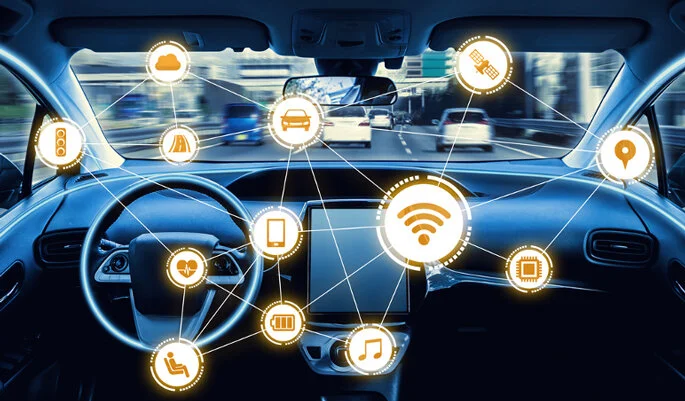
Could vehicle automation make carbon dioxide emissions and air quality worse?
Declarations by the European Union (EU), United Nations, vehicle manufacturers and others, have left the widespread impression that connected and autonomous vehicles will reduce the environmental footprint of vehicles. But is this true?
This newsletter is jointly authored by representatives of Emissions Analytics and RDW, the Netherlands Vehicle Authority, bringing together work from each body on this topic of significant ongoing policy and investment interest.
Autonomous driving holds out the promise of improved road safety and mobility, and a cleaner environment. In fact, the European Commission in 2018 asserted that transport “…will be safer, cleaner, cheaper…” as a result of fully automated and connected mobility systems1. Other declarations by the European Union (EU), United Nations, vehicle manufacturers and others, have left the widespread impression that connected and autonomous vehicles will reduce the environmental footprint of vehicles. But is this true?
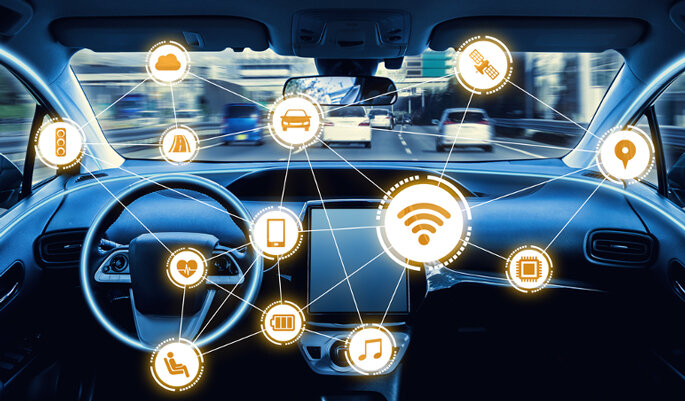
The claim is based upon more efficient operation, primarily as the result of smoother driving in the widest sense, including less aggressive accelerations and decelerations, better traffic engineering such as intelligent traffic light phasing, and inter-vehicle communications. Emissions Analytics considered these benefits in a study conducted with the Centre for Transport Studies at Imperial College London in 2017, called ‘Optimised Vehicle Autonomy for Ride and Emissions (OVARE)’ and part funded by Innovate UK.
But this study omitted consideration of the internal and external devices required to power the automation, and their energy consumption. Could it be that the benefits of automation are reduced or even eliminated when the whole system is considered? This newsletter will review the OVARE findings, and puts them together with analysis of the latest research on the energy requirement to determine what the net benefit is.
The OVARE project involved creating a traffic micro-simulation using the PTV-VISSIM software, coupled with instantaneous emissions factors derived from data from Emissions Analytics collected using Portable Emissions Measurement Systems (PEMS). Pollutants included were carbon dioxide (CO2), carbon monoxide (CO) and nitrogen oxides (NOx), together with fuel consumption derived using the carbon balance method.
The model was configured to use traffic volumes that reflect typical real-world conditions, with vehicles introduced to the simulated zone at five different entry points. Scenarios for 0%, 20%, 50% and 100% penetration of connected and autonomous vehicles (CAVs) were modelled. The results are shown in the table below2 for peak time traffic scenarios. The reductions during off-peak times were lower – typically 5% or less.

The potential 18% reduction in fuel usage and CO2 emissions is material in the context of the cost of transportation for consumers, energy security and climate change emissions. In the EU, CO2 emissions from passenger cars must be reduced by 37.5% between 2021 and 2035 – CAVs could therefore in principle achieve half of this reduction. Reducing NOx emissions by 21% would reduce the number of cities across Europe with non-compliant concentrations of nitrogen dioxide under the Ambient Air Quality Directive – CAVs could therefore lead to health benefits and reduce the need for costly interventions such as clean air zones. But, to reiterate, these outcomes do not factor in the potential impacts of the connectivity or automation systems themselves.
Now switching to the energy consumption side of the equation, we need to consider both the consumption by the on-board electronic devices required to run the automation and data processing that might take place in the vehicle, on the infrastructure side or in the cloud. For the purposes of the following calculations it is assumed that all vehicles are fully automated at SAE Level 5.
The devices required by this may include ECUs, cameras, lidar and radar – typically over 20 devices in total. With power ranges of between 1W and 80W each, an approximate total power requirement per vehicle would be 200W3. Based on data from the Netherlands – as an advanced European economy – the average number of driving hours per passenger car per year is 440 hours4, which implies an average electricity consumption from automation of 88kWh. Based on the Netherlands’ current energy mix5, with 1kWh resulting in 400g of CO2 emissions, the average battery electric vehicle would emit 35,200g per year. Taking an average distance travelled per car per year of 13,000km, this implies CO2 emissions of 2.7g/km, just from running the on-board devices. If the power were drawn from liquid fuel in an internal combustion engine, 1kWh would result in around 780g6, implying CO2 emissions of 5.3g/km.
More significant is energy required for data processing. Volvo has stated that autonomous driving requires “…a few GB [gigabytes] per second…”7. Other estimates vary, from 1.4 to 19TB [terabytes]/hour, so let’s be cautious and assume 0.4GB/second8. This would imply 634TB/year. Taking a cautious estimate of energy consumption from that data processing rate, we use 0.1kWh per gigabyte from Pihkola et al (2018)9. This conversion factor is subject to significant uncertainty, as set out in Aslan et al (2017)10, ranging from 0.023 to 7.1kWh. Using the same conversion of grid electrical energy to CO2 and distance travelled per year, the resulting estimate of CO2 emissions from data processing is an astonishing 1,950g/km. This compares to current average tailpipe CO2 emissions in the Netherlands of 121g/km and the 95g/km EU fleet average target – automation asks for at least 16 times more. Put another way, with an implied value of €95 per g/km from the EU fines for exceeding the 95g/km target, the ‘cost’ of automation would be around €185,000 per vehicle.

For illustration, if 25% of the processing happens on the vehicle, that would reduce the range of an average European internal combustion vehicle to around 160km. A battery electric vehicle with a 100kWh battery and 400km range would only be able to travel about 70km. This may well not even be physically possible, if the engine is not powerful enough to run the electronic systems and move the vehicle adequately at the same time.
This would clearly render automation unviable from both an emissions and cost point of view. The CO2 and fuel consumption benefits forecast by the OVARE project would be wiped out, as too would the NOx benefits in all likelihood. If the global supply of energy were to increase to the point of cheap, surplus renewable (zero carbon) energy, the CO2 issue would theoretically disappear, although there may still be too little power on board to move the vehicle. Increases in data processing efficiency would reduce the energy requirement and may solve this power problem, as would reducing the amount of data transfer between vehicles and with the infrastructure. On the other hand, increasing requirements around data security and vehicle safety may lead to ever-increasing power demands.
One solution may be to develop processor chips better designed for this type of computation, and thereby more efficient. This could become a significant differentiator between producers, analogous to the differences in battery design. A further solution may be to restrict the domain of automation, accepting that autonomous driving may only be viable within certain situations or geographic locations, rather than covering every conceivable case.

This analysis does not attempt to evaluate the secondary effects of automation on traffic volumes. If automation proves to be an attractive consumer proposition, especially if it accelerates the trends away from some forms of public transport and towards private options, this could make congestion worse. Not only would this waste productive time, but would have the risk of making air quality worse due to legacy internal combustion engines being forced to drive in a more stop-start fashion, and higher tyre and brake wear emissions from all types of vehicle.
In short, the prospect offered by autonomous vehicles has been asserted by many to be “cleaner”, and this generally has been believed without in-depth scrutiny. As with tailpipe emissions, and as with battery electric vehicles, the message must be that independent, real-world data is vital to inform the debate and policy formation, to ensure that consumers and the market are not led down another avenue that in practice makes air quality or carbon emissions worse, often fertilised by large amounts of taxpayer money.
Nevertheless, we acknowledge the uncertainties in the above analysis and potential future efficiency improvements. We would welcome contributions of recent test data from OEMs or suppliers for a follow-up newsletter. However, if these findings even broadly reflect the reality, they could lead to a rapid reassessment of the realistic potential and timing of fully automated driving for passenger vehicles.
As a first step, it would be helpful to move beyond a narrative that uses ‘autonomous’ and ‘low emission’ as almost interchangeably good things. They are not. They more likely trade off against one another.
Nick Molden, Emissions Analytics, United Kingdom
Peter Striekwold, RDW, The Netherlands
Footnotes:
https://ec.europa.eu/growth/content/europe-move-commission-completes-its-agenda-safe-clean-and-connected-mobility_en
Su, K. (2017) IMPACTS OF AUTONOMOUS VEHICLES ON EMISSIONS AND FUEL CONSUMPTION IN URBAN AREAS. MSc Dissertation, Imperial College London, and Hu, S. Stettler, M.E.J., Angeloudis, P. Karamanis, R. Molden, N. (2017). Impact of vehicle automation on emissions and ride comfort. Microsimulation for Connected and Autonomous Vehicles Workshop, Loughborough UK, 2017.
https://www.osti.gov/biblio/1474470
https://hblankes.home.xs4all.nl/Oud/snelheid.htm
https://www.cbs.nl/-/media/_excel/2018/04/tabelvoorartikelrendementco2emissieelekrtriciteit2017.xls
260g of CO2 in gasoline or diesel with 1kWh of embedded energy, adjusted for 33% combustion efficiency
https://www.vpro.nl/programmas/tegenlicht/kijk/afleveringen/2018-2019/De-rijdende-robot.html
https://www.tuxera.com/blog/autonomous-cars-300-tb-of-data-per-year/
https://pdfs.semanticscholar.org/be83/e9a9a7e10a7f29a846fc54d62f08ebe9e884.pdf
https://onlinelibrary.wiley.com/doi/full/10.1111/jiec.12630

The Eclectic Highway podcast: The Fastest Route to CO2 Reduction
Listen to our Founder & CEO Nick Molden on Episode 4 of The Eclectic Highway podcast in a discussion with Kelly Senecal about the fastest route to CO2 reduction in transportation.

Our Founder & CEO Nick Molden was delighted to be invited on to Episode 4 of The Eclectic Highway podcast to take part in a discussion with Kelly Senecal about the fastest route to CO2 reduction in transportation.
Click below to hear the podcast:
You can also:
Listen on Apple
Listen on Spotify

WEBINAR REPLAY: RDE Surveillance and Compliance
Watch a replay of our recent webinar where Nick Molden explains how we can support with critical competitive benchmarking and off-cycle evaluations.

Title: RDE Surveillance and Compliance - - Independent data to enhance competitiveness and manage risk
First Shown: Tuesday 28th April - 16:30 GMT / 17:30 CET / 12:30 EST / 08:30 PST
Running time: 30 minutes + Q&A up to maximum of further 30 minutes
Content Overview:
The relentless intensity of RDE certification diverts resources away from critical competitive benchmarking and off-cycle evaluations. In a challenging market, such investigations can become a luxury.
We have a solution.
Emissions Analytics' independent EQUA database provides a cost-effective tool for certification, powertrain and emissions teams to understand their market position, the real risks of non-compliance and see which vehicles are setting new standards for emissions control.
With over 2,000 vehicles tested to date and hundreds more lined up for 2020, EQUA is the world’s largest commercially available real-world emissions database, with a unique bank of PEMS & OBD data. Over the years it has become an integral tool for vehicle manufacturers in Europe and North America to gather benchmarking intelligence and support R&D activities at the click of a button.
Join our Founder & CEO, Nick Molden, as he covers:
EQUA test process and methodology including cold-start, high load and hard acceleration
Database size, scope and detail
NEW – Technology supplier info including; engine, transmission, fuel injection, turbocharger
Ammonia (NH3) measurement data, ahead of Euro 7
European market update: WLTP, NOx and exceedance risk
US market update: emissions performance and real-world CO2 trends
Access to our data

Emissions Analytics Wins Environmental Excellence in Transportation Award
Emissions Analytics has been awarded SAE International's Environmental Excellence in Transportation Award for developing a Cabin Air Quality Index method.

We’re delighted to announce that Emissions Analytics has won an Environmental Excellence in Transportation Award.
In honour of Earth Day, SAE International announced the winners of its Environmental Excellence in Transportation Award. This award showcases the work of individuals and teams who through their ingenuity and dedication have made significant innovations in reducing the environmental impact caused by the transportation industry.
Emissions Analytics was successful in the New Methods and Tools category for the Development of Fractional Cabin Air Recirculation System, Standard Testing Method for Vehicle Cabin Air Quality, and Cabin Air Quality Index.
You can read more about the awards here.
You can find our more about our Pollution In-Cabin Measurement System (PIMS) capabilities here.

What else is coming out of our tailpipes?
Tightening tailpipe regulations is a natural impulse in a post-Dieselgate world. However, we are in danger of over-regulating familiar, easy-to-measure emissions such as CO2 and NOx while ignoring a wide range of other, potentially harmful substances that can now be measured but have previously been ignored.
Unregulated volatile organic compounds
Tightening tailpipe regulations is a natural impulse in a post-Dieselgate world. However, we are in danger of over-regulating familiar, easy-to-measure emissions such as CO2 and NOx while ignoring a wide range of other, potentially harmful substances that can now be measured but have previously been ignored.
As European legislators move beyond the Euro 6 tailpipe emissions standard, they are beginning to grapple with this, at the same time that non-tailpipe emissions are rapidly coming into focus as a major concern.
Previous newsletters focused on two types of non-exhaust emissions – tyre wear and vehicle interior air quality focusing on volatile organic compounds (VOCs) produced by the car’s own interior. Today we turn back to tailpipe emissions but with the same mindset – what substances are emitted but not regulated, and are they harmful?

For tailpipe VOCs, some laboratory regulations exist around the world, but only on a limited basis, and averaged over a test cycle. Here, we look at real-time data we gathered with Cambridge, UK-based Anatune, which show a richer picture and some unexpected results.
In the previous newsletter on VOCs (https://bit.ly/2xyzyZa) we showed that it is possible to identify different analytes in real time, measure the rate at which they are emitted and reveal unexpected spikes in some analytes that surpassed regulated limits.
Turning to tailpipe emissions, we worked with Anatune again to use the SIFT-MS to sample the tailpipes of a 2011 model-year Volkswagen Golf (diesel); a 2019 model-year Peugeot 2008 (gasoline) and a 2019 model-year Renault Captur (diesel). The cars were soaked in a controlled environment prior to testing. During the first 100 seconds the probe, positioned in the tailpipe, measured the prevailing ambient air; From 100-400 seconds ignition and idle; from 400-800 seconds at 1,500 rpm; from 800-1,100 seconds at 3,000 rpm and then back to idle for the last 100 seconds.
We conducted the analysis for hydrocarbons, sulphurs and oxygenates. Hydrocarbons are the product of combustion and include butadiene, heptane, styrene, benzene, hexane, toluene, butane, methane and xylenes + ethylbenzene.
Anatune Senior Application Chemist and SIFT-MS Specialist Dr Mark Perkins notes that they all have a degree of toxicity and are all regulated in respect of occupational exposure limits (OEL). Heptane is a marker for unburnt fuel.
The outstanding result of the test is the unanticipated initial spike in heptane and other hydro-carbons xylenes + ethylbenzene, methane, styrene and toluene, observed in the only petrol vehicle we tested, the Peugeot.

In particular, the spike in heptane in the first few seconds after ignition reached a concentration of over 6,000 micrograms per cubic metre. This was sixty times more than the highest reading for the older diesel Golf, while the Renault never produced more than 25 micrograms of heptane.
The peak heptane production occurred differently in both diesel vehicles, at the 800 second juncture when engine revolutions were doubled from 1,500 to 3,000.
The newer, diesel Renault had very low emissions of all hydrocarbons except for an initial peak of methane upon ignition, of 200 μg/m3; the older VW had a peak methane emission of 80 μg/m3, while butane emissions tracked methane emissions and styrene rose and fell proportionately to engine load.

Moving on to sulphurs, which include ammonia, carbonyl sulphide, dimethyl sulphide and hydrogen sulphide, we observed a sudden spike at 750 seconds from a baseline of nil to over 400 μg/m3 of ammonia, again for the gasoline-powered Peugeot. We can only assume here that there was a ‘burp’ from the catalytic converter which was momentarily overwhelmed, but there is no clear or definite explanation.

Once again the overwhelming thing to note is the scale of the gasoline car’s emissions compared to the diesels’. The average ammonia emissions from the Peugeot at 3,000 rpm are over 50 μg/m3, compared to a maximum of 0.6 μg/m3 in the Renault and 0.4 μg/m3 in the VW.
Moving on to oxygenates, these are volatile organic compounds such as methacrolein, acetone, butanal, butanone, ethanol, hexanal and methanol.
The important thing to remember about these VOCs is that they may not be toxic in isolation, and in tiny amounts. But they are not being emitted in isolation and have a direct impact on broader categories of pollution.
Under sunlight, VOCs react with vehicle-emitted nitrogen oxides to form ozone, which in turn helps the formation of fine particulates. The accumulation of ozone, fine particulates and other gaseous pollutants results in smog.
The VW Golf produced methacrolein at over 6 μg/m3 when the engine was stepped up to 3,000 rpm. Exposure to methacrolein is highly irritating to the eyes, nose, throat and lungs. The VW also produced just below 5 μg/m3 of acetone, less toxic than methacrolein but causing irritation to eyes and throat.

The Renault also produced noticeable amounts of acetone, peaking at almost 6 μg/m3, but never breached 3 μg/m3 for methacrolein.
The gasoline Peugeot offered a completely different map. Mirroring the hydro-carbon results, it shows a spike on first ignition in hexanal to nearly 140 μg/m3, and between 4-500 seconds two spikes in butanal of 80 and 50 μg/m3 respectively. Butanal (N-butyraldehyde) is an organic compound which is the aldehyde derivative of butane. It is judged to be of low toxicity to humans unless inhaled at high concentrations, causing chronic headaches and ataxia.

By way of summary, many of the observed measurements followed the dynamic that any vehicle engineer would anticipate. Immediately following a step-up in rpm there is a spike in emissions before a steep fall. This represents the time gap between more fuel being sent to combust and control mechanisms responding, upon which a new equilibrium is reached.
But the take-away result here is the very high emissions of some hydrocarbons and other VOCs from the gasoline-engined Peugeot upon ignition from cold. Heptane, a marker for unburned fuel, spiked momentarily to over 6,000 μg/m3, almost 60 times the highest level observed throughout the test from the older diesel, the Volkswagen.
Similar spikes are seen from methane, xylenes and ethylbenzene, hexane and styrene – all measured in quantities 10-40 times higher than the two diesels.
Using the SIFT-MS approach has shown that beneath the more familiar time-weighted average of total emissions, whether of VOCs or hydrocarbons, is a dynamic and unexpectedly ‘spiky’ reality that can result in rapid accumulations of some chemicals well above their permissible, regulated maximums.

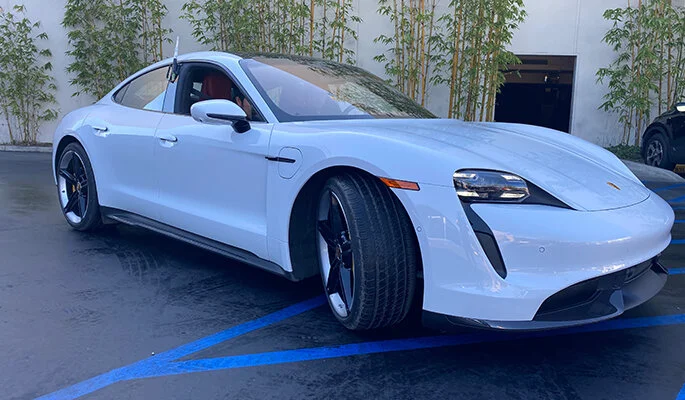
New Porsche Taycan Turbo S electrical vehicle testing in partnership with Motor Trend
In our quest to understand the real-world emissions and efficiency of motor vehicles, we were pleased to be able to test the new Porsche Taycan Turbo S electric vehicle (EV) in California, with our partners Motor Trend.
The recurrent scourge of technology preference
and the fallacy of zero emission
In our quest to understand the real-world emissions and efficiency of motor vehicles, we were pleased to be able to test the new Porsche Taycan Turbo S electric vehicle (EV) in California, with our partners Motor Trend www.motortrend.com
The punchline was a range, on our EQUA Real Mpg test, of 254 miles, reflecting a combined efficiency of 2.2 miles per kWh or 73.4 Mpg-equivalent (converting the electricity to a gasoline equivalent based on energy content). The test route is made up a of a combination of city and highway driving over approximately 100 miles, and includes measurement of charging losses in the efficiency calculation. So, the Taycan does not have best-in-class EV efficiency, but it exceeded its official figure by an impressive 32%, and is arguably a striking looking and beautifully made vehicle.

But does efficiency in an EV matter? Is an EV always so much better, and its carbon dioxide (CO2) commensurately so much lower, than a typical internal combustion engines (ICE), that efficiency is of secondary importance?
Considering a recent paper in Nature Sustainability from March 2020 by Florian Knobloch et al entitled ‘Net emission reductions from electric cars and heat pumps in 59 world regions over time’, a typical EV in the US emits CO2 of around 354 g/mile (over an average life of around 93,000 miles), of which approximately half is accounted for by the electricity in the usage phase. So, 177 g/mile can be put down to electricity production, distribution, consumption and attendant storage and charging losses. Let’s assume for the purposes of this document that the Taycan is similar to this average vehicle.
A near equivalent pure ICE is the Porsche Panamera 4, which has tailpipe CO2 of 407 g/mile from the US Environmental Protection Agency’s (EPA) fueleconomy.gov website. According to ‘Understanding the life cycle GHG emissions for different vehicle types and powertrain technologies’ by Ricardo from August 2018, the tank-to-wheel CO2 of a typical ICE is 65% of total lifecycle CO2 (taking the middle of the 60-70% range quoted), implying total CO2 over the life of the vehicle of 626 g/mile. Therefore, the EV emits approximately 57% less during usage and 43% less total CO2 than the ICE, based on typical emissions from electricity production.
In addition to this, the EV is undoubtedly superior to the ICE on tailpipe nitrogen oxides (NOx), carbon monoxide (CO) and particulate mass (PM) for an obvious reason. Even so, from Emissions Analytics’ testing the ICE would only emit 21 mg/mile of NOx, 2.5 g/mile of CO and typically about 0.5 g/mile of PM, well below the regulated limits.

If we then factor in non-tailpipe emissions, the picture begins to change. Of these, the large majority, perhaps up to 90%, comes from tyre wear abrasion, so we will focus on these. Brake wear should not be completely ignored due to the chemical composition of the particles, but the regenerative braking advantage of EVs will decline as hybridisation makes such braking widespread among ICEs. Previous Emissions Analytics’ newsletters on tyre wear (https://bit.ly/39UHbX4 and https://bit.ly/3c36urq) have shown that this can be a combination of coarse and ultrafine particles. According to ‘Wear and Tear of Tyres: A Stealthy Source of Microplastics in the Environment’ published in the International Journal of Environmental Research and Public Health in 2017, a large car (with a mass of around 3,300 lbs) will typically emit 26 mg/mile of PM. Further, this paper suggests that PM emissions increase proportionately with vehicle weight.
Therefore, we can deduce the total (tailpipe and non-tailpipe) PM emissions for both Porsches, as show in the table below. To this, for comparison, we have also added the Porsche Panamera 4 e-Hybrid and Tesla Model S. The basis of the calculations are described in the footnote.

It is clear that non-tailpipe PM emissions exceed those from the tailpipe, which is not surprising as tyre wear increases with the weight of the vehicle, other things being equal, and EVs are heavy. Meanwhile, tailpipe PM from ICE vehicles has fallen greatly, whether they have unfiltered gasoline or filtered diesel engines.
So, if a buyer switches from the Panamera ICE to the Taycan, the 43% reduction in CO2 emissions and zero tailpipe emissions is balanced by an 19% increase in PM emissions and a doubling in purchase price ($185,000 compared to $91,800). The hybrid occupies the intermediate position, delivering a 25% reduction in CO2 for the price of 17% higher PM and an extra $12,000 purchase price. The higher efficiency and slightly lower weight of the Tesla means that it delivers a reduction in CO2 of 60% for only a 14% rise in PM emissions and a 13% reduction in purchase price, although it concedes on maximum power and torque.
This analysis does not include the effect on particle number (PN). However, the report from the UK Government’s Air Quality Expert Group (AQEG) in July 2019 suggested that PN emissions could increase by up to 1.8% points for every 10 kg increase in the vehicle weight. That would imply that the Taycan would have 50% higher PN emissions than the Panamera ICE. If true, it would have a significant air quality impact because PN highlights the ultrafine particles that mass measurement misses, and it is ultrafines that may prove to be more problematic for human health.
The trade-off between lifecycle (LCA) CO2 and PM is shown in the chart below.

In summary, we can see a clear trade-off between climate-change-related and air pollutant emissions, and cost, which is reminiscent of the historical trade-offs between different ICEs. We also can see that there are material differences between different electrified vehicles. What this means is that discrimination between vehicles should be based on total real-world emissions and fuel economy, rather than asserting blanket technology preferences. The coming battle between EVs will be on the basis of energy efficiency, vehicle weight and tyre quality, which, in combination, will allow shifts towards Pareto superior combinations of CO2 and pollutant emissions. We accept that this is only a snapshot, but chosen to illustrate what we believe is a much wider pattern.
Emissions Analytics has been considering all these different elements to give a rounded view on environmental footprint. The first point to make is that the result differs materially between different models, so working at the level of generic groups can be hazardous. Second, many of the areas suffer from limited available data, either through scarcity or it being proprietary to manufacturers or suppliers. Specifically, we are conducting more testing to quantify both the PM and PN emissions – tailpipe and non – from a range of vehicles of different weights in real-world conditions.
If the first modern internal combustion engine spluttered into a smoky existence in 1876 (Nikolaus Otto), equally it is true that the first lithium ion batteries only made it to a commercially viable form in 1991, following intensive investment by Japan’s Sony corporation over ten years, under the leadership of 2019 Nobel Laureate Dr Akira Yoshino.
The rapid rise of electric vehicles, whether battery or hydrogen fuel cell, is indisputably the most important technology change occurring since the advent of the car over a century ago, and amounts to no less than its reinvention for the coming century.
Yet the revolution remains youthful and the technologies are comparatively new in any meaningful sense (we take account of pioneering EVs over one century ago – but they were not pursued as Ford got going and liquid fuels prevailed). Exxon developed fully scaled electric cars in the 1970s in response to the oil price shock, but they never took off. This is worth remembering in 2020.
The Exxon battery programme was led by M. Stanley Whittingham (also a 2019 Nobel Laureate), but the batteries proved unstable. However, what killed the programme off wasn’t just vehicle fires but the oil price, which fell after its calamitous rise earlier in the decade.
In light of the very recent oil price collapse, governments and car makers alike are about to be tested as never before for their commitment to electrification, a timely reminder that young and comparatively expensive technologies do not succeed in a bubble protected by virtue but have to fight for their existence against incumbent technologies that are proven and comparatively cheap.
Against that, the few moving parts of EVs and the existing experience of fleet operators point to exceptionally low maintenance costs and enhanced longevity.

What makes a great car is a question that has been blown wide open with competing technologies, but you can rest assured that Emissions Analytics is committed to technology neutrality, real-world testing of the many variables that define overall vehicle performance and dispassionate assessment for consumers and industry alike. The rapidly developing EV landscape is a source of intense interest to us and we welcome it. But, please, let us once and for all agree: there is no such thing as a zero emission vehicle.
*Footnote
The calculation of LCA CO2 emissions for the Panamera ICE and the Taycan are described in the main text. The value for the Panamera hybrid is approximated by calculating an average of the construction/battery phase of the Panamera ICE and the Taycan, weighted 85%/15% reflecting the relative battery size of the hybrid compared to the EV. In other words, the hybrid is considered a mixture of ICE and EV. To this, the EPA tailpipe CO2 value is added. The LCA CO2 of the Model S is calculated by adjusting the usage phase of the Taycan according to the greater efficiency of the Model S, with unchanged construction/battery phase. The calculation of the non-tailpipe PM is also covered in the main text. The values for the four vehicles are calculated as linear and proportionate extrapolations from the benchmark 3,300 lb large car with 26 mg/mile tyre wear emissions.

Fueling the Future podcast: Tires Not Tailpipe
Our Founder & CEO Nick Molden was delighted to be invited onto the Fueling The Future podcast to take part in a discussion with Tammy Klein of Future Fuel Strategies about non-exhaust emissions in vehicles.

Our Founder & CEO Nick Molden was delighted to be invited onto the Fueling The Future podcast to take part in a discussion with Tammy Klein of Future Fuel Strategies about non-exhaust emissions in vehicles.
Click below to hear the podcast:
You can also subscribe to the Fueling The Future podcast on iTunes by clicking here.
Construction: the neglected source of urban emissions?
Emissions data on construction equipment is scarce, often out-of-date and gathered in unrealistic conditions. These machines fall within the generic category of non-road mobile machinery (NRMM), or ‘off-road’.
Real-world emissions test results from building sites
Emissions data on construction equipment is scarce, often out-of-date and gathered in unrealistic conditions. These machines fall within the generic category of non-road mobile machinery (NRMM), or ‘off-road’.
This segment of machinery is often overlooked in preference for passenger cars or heavy goods vehicles, but, like non-exhaust emissions, it is a source of growing importance to urban emissions. As wider exhaust emissions are brought down, so the share from construction sites may well rise as a proportion of the whole. Regulations in this area have lagged behind heavy-duty goods vehicles, while there remain many older engines in service – 25% of the registered London fleet in 2019.

To understand the situation better, Emissions Analytics, together with Kings College London, conducted an extensive real-world field test on 30 different construction machines, including nine different types ranging from static generators to telehandlers and excavators.
The 2016 London atmospheric emissions inventory estimates that the construction sector contributes 34% of the total PM10 (including fugitive dust), 15% of PM2.5 and 7% of the total nitrogen oxides (NOx) – the largest, third largest and fifth largest sources, respectively.
It can be seen immediately that construction sites are an important part of any regulatory effort to improve urban air quality.
The purpose of our field test mirrored the approach we have taken with other classes of vehicle, namely to compare regulatory standards with real-world emissions, premised on the possibility that real-world emissions are typically higher than their laboratory counterparts.
The results of our extensive field test can be summarised as follows:
Absolute improvements are clear from construction equipment certified to the latest regulatory stage, resulting mostly from deployment of better engine management and after-treatment technology.
Exceedances of certification values were observed, although were not as widespread as with light-duty vehicles before the introduction of Real Driving Emissions testing.
Significant variability exists between machines.
Emissions are sensitive to engine load.
Across the board we found that the highest NOx emissions were from older construction machines, typically Stage III-A and III-B, but which reduced in the newer Stage IV engines owing to more advanced engine management systems and exhaust after-treatment, as shown in the left-hand chart below. Average Stage VI emissions are down 78% on the prior stage.

However, we also found that Selective Catalytic Reduction (SCR) systems could be better. They perform poorly when an engine is left to idle for longer than ten minutes, whereupon the exhaust temperature falls below 200 degrees Celsius, which explains many of the high conformity factors among Stage IV machines shown in the right-hand chart above. However, it should be emphasised that a conformity factor above 1.0 does not necessarily entail any non-compliance as these tests were undertaken on machines performing routine work rather than according to the mandated test cycle for certification.

The issue of falling exhaust temperature can be seen in this example of a 129kW excavator operating with regular 15-minute idling periods. The instantaneous NOx emissions and exhaust temperature are shown in the graph below. During idling, the exhaust temperature falls and then on resumption of work there is a large spike in NOx emissions. Overall, the exhaust temperature is below 200 degrees Celsius for 42% of the time. This demonstrates the importance of careful thermal management of after-treatment systems to ensure low real-world emissions.

Another aspect concerns generators, which typically being ‘static’ are overlooked as NRMM. In fact they comprise 5% of the London fleet of NRMM and have a fundamental role to play on almost every construction site. While in London they only needed to be type-approved to Euro Stage III-A historically, with no exhaust after-treatment to control for NOx or particle emissions, approval to the new Stage V is required from 2020.
We also found that numerous generators exceeded their regulated limits for NOx emissions. The 80, 200, 320 and 500 kVA generators were 1.25, 1.08, 1.58 and 1.46 times their respective EU Stage III-A NOx emission standards. The 320 and 500 kVA generators emitted above their standards at all loads, while the others showed the worst performance at low and high loads.
On a positive note, the generator we tested that had been retrofitted with SCR yielded an 85% reduction in NOx emissions. While this wasn’t good enough to comply with Stage V emissions, it represented a strong reduction in emissions at all engine loads: on the ISO 8178 test cycle they fell from 6.03 g/kWh to 0.95 g/kWh. We found that the introduction of an exhaust filter reduced particle number by two orders of magnitude and to within the future Stage V particle number limit of 1 x 10¹² # per kWh.
By the nature of the ISO 8178 test, it is possible to plot the NOx emissions against the load demand on the generator, as shown in the chart below.

In all cases, there is a characteristic U-shaped relationship, with the lowest emissions per unit of work done occurring between 25% and 50% of maximum load. The lowest emissions on average were seen on the mid-size, 200kVA, generator, although it obviously had power limits at the top end. These results illustrate the benefit in choosing the best sized generator for a given task: too small and the emissions are higher as well as the lack of top-end power; too large are the emissions are also higher.

In summary, there are some echoes, but less extreme, of the issues of NOx exceedances for passenger cars in this test work on construction equipment and generators. Overly-downsized engines and poor after-treatment calibration in both cases can lead to elevated emissions. However, these results show significant progress in NOx reduction at Stage IV, and early evidence is showing further improvements at Stage V. The focus here has been on NOx as our results show few exceedances on particle emissions – again similar to passenger cars since the Euro 5 regulatory stage.
Putting this in the wider context of greenhouse gas emissions, although there are no CO2 standards for non-road machinery, cities are likely to be conscious of any trade-offs between better air quality and climate change effects. Indeed, our tests show a 9% increase in CO2 emissions from Stage III-B to Stage IV, although that comes after a 40% reduction from Stage III-A to III-B. This shows that the perennial tension and trade-offs in controlling different pollutants, and will continue to provide policy dilemmas that can only be resolved by use of real-world testing.

Press Release: Pollution From Tyre Wear 1,000 Times Worse Than Exhaust Emissions
Pollution from tyre wear can be 1,000 times worse than what comes out of a car’s exhaust, Emissions Analytics has found.

Tight regulation of exhaust emissions by the EU has meant that new cars emit very little particle pollution
But tyre wear pollution is unregulated and can be 1,000 times worse, finds independent real-world testing experts Emissions Analytics
Increased popularity of SUVs, larger and heavier than standard vehicles, exacerbates this problem – as does growing sales of heavy EVs and widespread use of budget tyres
Fitting only high-quality tyres and lowering vehicle weight are routes to reducing these ‘non-exhaust emissions’
Oxford, 6th March 2020: Pollution from tyre wear can be 1,000 times worse than what comes out of a car’s exhaust, Emissions Analytics has found.
Harmful particle matter from tyres – and also brakes – is a very serious and growing environmental problem, one that is being exacerbated by the increasing popularity of large, heavy vehicles such as SUVs, and growing demand for electric vehicles, which are heavier than standard cars because of their batteries.
What’s more, vehicle tyre wear pollution is completely unregulated, unlike exhaust emissions which have been rapidly reduced by car makers thanks to the pressure placed on them by European emissions standards. New cars now emit very little in the way of particulate matter but there is growing concern around ‘non-exhaust emissions’.
Non-exhaust emissions (NEE) are particles released into the air from brake wear, tyre wear, road surface wear and resuspension of road dust during on-road vehicle usage. No legislation is in place to limit or reduce NEE, but they cause a great deal of concern for air quality.
NEEs are currently believed to constitute the majority of primary particulate matter from road transport, 60 percent of PM2.5 and 73 percent of PM10 – and in its 2019 report ‘Non-Exhaust Emissions from Road Traffic’ by the UK Government’s Air Quality Expert Group (AQEG), it recommended that NEE are immediately recognised as a source of ambient concentrations of airborne particulate matter, even for vehicles with zero exhaust emissions of particles – such as EVs.
To understand the scale of the problem, Emissions Analytics – the leading independent global testing and data specialist for the scientific measurement of realworld emissions – performed some initial tyre wear testing. Using a popular family hatchback running on brand new, correctly inflated tyres, we found that the car emitted 5.8 grams per kilometer of particles.
Compared with regulated exhaust emission limits of 4.5 milligrams per kilometer, the completely unregulated tyre wear emission is higher by a factor of over 1,000. Emissions Analytics notes that this could be even higher if the vehicle had tyres which were underinflated, or the road surfaces used for the test were rougher, or the tyres used were from a budget range – all very recognisable scenarios in ‘real world’ motoring.
Richard Lofthouse, Senior Researcher at Emissions Analytics said: “It’s time to consider not just what comes out of a car’s exhaust pipe but particle pollution from tyre and brake wear. Our initial tests reveal that there can be a shocking amount of particle pollution from tyres – 1,000 times worse than emissions from a car’s exhaust.
“What is even more frightening is that while exhaust emissions have been tightly regulated for many years, tyre wear is totally unregulated – and with the increasing growth in sales of heavier SUVs and battery-powered electric cars, non-exhaust emissions (NEE) are a very serious problem.”
Nick Molden, CEO of Emissions Analytics said: “The challenge to the industry and regulators is an almost complete black hole of consumer information, undone by frankly out of date regulations still preoccupied with exhaust emissions. In the short term, fitting higher quality tyres is one way to reduce these NEEs and to always have tyres inflated to the correct level.
“Ultimately, though, the car industry may have to find ways to reduce vehicle weight too. What is without doubt on the horizon is much-needed regulation to combat this problem. Whether that leads to specific types of low emission, harder wearing tyres is not for us to say – but change has to come.”
ENDS
Media contact
For all media inquiries please contact Sam Hardy on +44 (0)7815 863968, or via media@emissionsanalytics.com
About Emissions Analytics
Emissions Analytics is the leading independent global testing and data specialist for the scientific measurement of real-world emissions and fuel efficiency for passenger and commercial vehicles and non-road mobile machinery. Emissions Analytics seeks to bring transparency to a confused market sector. It publishes the EQUA Index of real-world driving emissions, and works with clients around the world to establish accurate emissions measurement and data requirements.

Low Emission Bus Trial in the Republic of Ireland
One of the big contributors to poor urban quality, both for nitrogen oxides (NOx) and particulates has historically been bus fleets.

One of the big contributors to poor urban quality, both for nitrogen oxides (NOx) and particulates has historically been bus fleets. However, Emissions Analytics’ experience across multiple types of vehicle, from light- to heavy-duty, has been that performance can differ markedly from model to model of seemingly similar technologies, and also between official figures and the reality of performance on the road.
To improve urban quality, Ireland’s National Development Plan committed the country to stop purchasing diesel-only buses for the urban public fleet by July 2019. To ensure that it make the best purchasing decisions in order to achieve that objective in the most effective way, the Irish Department for Transport, Tourism and Sport (DTTAS) commissioned Emissions Analytics to test eleven different types of bus in realistic conditions in Dublin and Cork. Emissions Analytics’ independence ensured that unbiased, real-world data could be gathered, rather than relying on existing third-party information.
The test equipment proposed by Emissions Analytics, largely relied on a Portable Emissions Measurement System (PEMS) from Sensors, Inc of the USA. The unit was certified to the standards required when used for official certification in Europe, even though these tests were not regulatory tests. The equipment passively measures both the flow of gas and pollutant concentrations from the bus tailpipe.
The buses tested ranged from existing diesels on the fleet such as the 2008 and 2013 Volvo B9TL, and the 2018 Mercedes-Benz Citaro BlueTEC 6, through to a new diesel Wrightbus Streetdeck Hybrid and a new Scanio Enviro 400 CBG powered by natural gas. Also covered were retrofits to these existing Volvos to understand the effectiveness of the after-market installations of Selective Catalytic Reduction (SCR) systems aimed at reducing NOx emissions.
Together with DTTAS and consultants Byrne Ó’Cléirigh (BOC), Emissions Analytics designed test cycles on the road of Dublin and Cork, based closely on existing bus routes. As the buses were tested when not in public operation with passengers, it was necessary to mimic the behaviour around regular bus stops to ensure that the average speeds and dynamicity of the cycles mirrored as closely as possible the reality of typical live operation. Taking this one step further, results were gathered for ‘cold start’ operation, where emissions are typically higher as the bus is warming up from cold, and also during regeneration of the diesel particulate filter, which similar leads to heightened emissions.
While the focus was on reducing pollution from NOx and particle emissions, the test programme covered a wider range of measurements to give a more holistic view. Other pollutants measured were carbon monoxide and, where relevant, total hydrocarbons. Relevant to the greenhouse gas agenda, carbon dioxide was measured, from which, using the carbon balance methods, the fuel consumption was derived. In this way, a rounded view on pollution and operation cost was formed, thereby ensuring that decisions around reduction of certain pollutants did not lead to unintended other consequences.
The final report detailing the findings from the trial has now been published.
Tyres Not Tailpipe
Why low tailpipe particle emissions may now be dominated by tyre wear.
Why low tailpipe particle emissions may now be dominated by tyre wear.
When you think of vehicle emissions, you naturally think of the exhaust pipe. Think again.
The newest internal combustion engine vehicles are achieving pollutant emission levels so low they are hard to measure. Yes, significant carbon dioxide still comes from the exhaust, but this does not affect urban air quality.
Arguably the biggest source of pollutant emissions from new vehicles now comes from non-exhaust sources, especially brake and tyre wear. This newsletter concentrates on the latter, as tyres are likely to be a large and growing source as consumers switch to bigger and heavier cars. Research shows they contribute to microplastic marine pollution, as well as air pollution from finer particles.
And this source of pollution is currently unregulated.
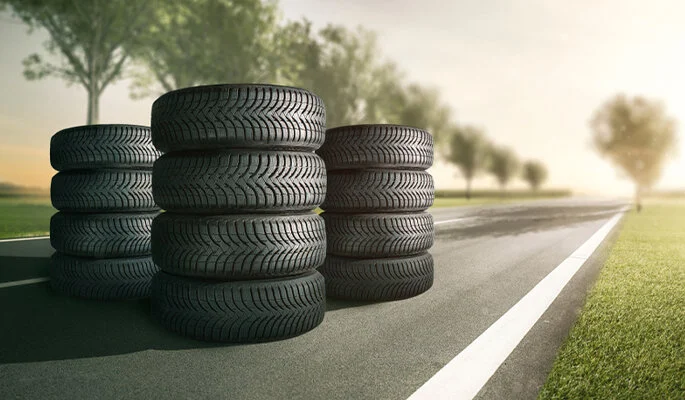
The 2019 report Non-Exhaust Emissions from Road Traffic by the UK Government’s Air Quality Expert Group (AQEG) recommends “…as an immediate priority that non-exhaust emissions (NEEs) are recognised as a source of ambient concentrations of airborne PM, even for vehicles with zero exhaust emissions of particles.”
Non-exhaust emissions include physical road wear particles from vehicles eroding the surface, the re-suspension of existing particles lying on the carriageway, brake wear particles and tyre wear particles. Greater adoption of regenerative braking means that brake wear emissions may decrease. However, thanks to the high weight and poor aerodynamics of sport utility vehicles (SUVs) as well as the high weight and torque drive characteristics of battery electric cars (BEVs), tyre emissions are expected to increase. In the light of this, we have begun a broad tyre testing programme at Emissions Analytics.
Complementing this is our traditional expertise in exhaust emissions, which for the purpose of this newsletter will focus on diesel exhaust particulates and some further reflections on the particle emissions of gasoline engines.
Declining tailpipe emissions from diesels
If we tackle diesel vehicles first, the truth is that they have emitted very few particles, at least in relative terms, since the broad introduction of diesel particulate filters a decade ago. So long as this filter has not malfunctioned or been tampered with, emissions are low over typical driving cycles, even taking into account the significantly elevated levels during the periodic ‘regeneration’ of the filter where the accumulated particles are burned off.
Filters are so good that we have measured that in certain circumstances, when the ambient air is already polluted, a diesel car will tend to extract more particles from the air than it emits. Emissions Analytics worked with the leading European automotive publisher, Auto Motor und Sport, to test four recent models of diesel cars.
Considering one of the vehicles, a canister of high intensity particles was opened in front of the air intake on four occasions across 60 minutes while the car idled. Upon the canister being opened, the particle number soared tenfold in the ambient air, but the corresponding exhaust count remained largely flat throughout the hour, with even a slightly declining trend.
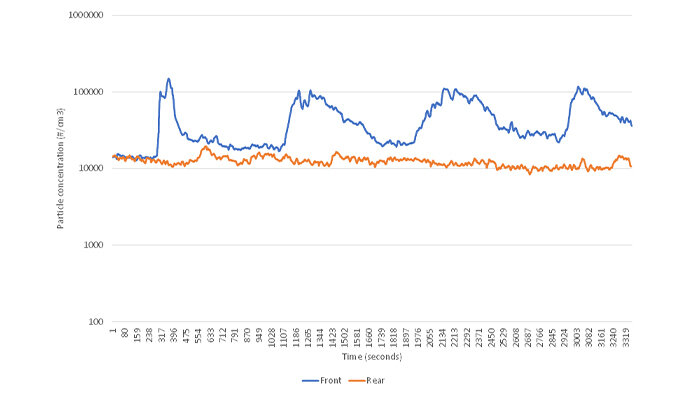
Then we ran on-road tests across the four vehicles, measuring exhaust particles from cold start, at neutral idle, with a warmed-up engine, under heavy load and finally during the filter-regeneration process. The test data was then analysed into illustrative trips of 300, 30 and 3 kilometres to simulate highway, commuting and local errand duty cycles:
Long Distance: 300km, average 60km/h, idling 10%, warm engine 70%, cold start 5%, heavy load 10%, filter regeneration 5%
Middle Distance: 30km, idling 10%, warm engine 40%, cold start 20%, heavy load 10%, filter regeneration 20%
Short Drive: 3km, cold start 100%.
The average per-second tailpipe emissions in the various operating modes across the four vehicles were:
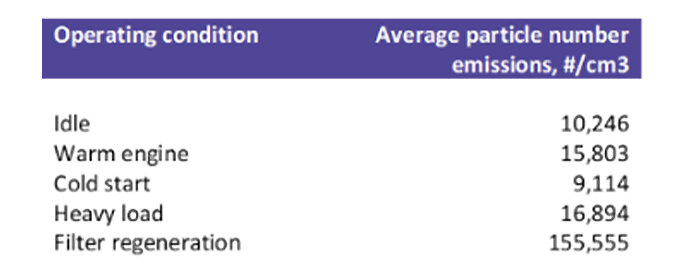
The standout result, which we did not anticipate, is that the net contribution of each car to particle pollution rests primarily on the ambient air, reflecting the dynamic way in which a car ingests air as well as exhausts it.
On a polluted day where ambient concentrations of particles are already high at 50,000 #/cm3, the vehicles remove on average 27,984 particles per second of operation. Conversely, on a clean air day when ambient concentrations are 10,000 #/cm3, all four vehicles are net polluters but at low levels in relative terms, averaging emissions of 12,016 particles per second of operation. This was across the 300km drive cycle.
During the 30km, middle-distance test with filter regeneration, all four cars are net polluters except on the dirtiest days for two of the vehicles. The latter detail is an important measure of the still relatively low absolute levels of particle emissions, albeit higher by a factor of 10 compared to normal operation.
For the ‘short errand’ 3km drive, the filters work exceptionally well. A completely cold particle filter is not inhibited, unlike SCR systems, which are highly sensitive to operating temperatures. On the ‘short errand’ route two of the vehicles were ‘net cleaners’ even on a ‘clean air’ day.

Note: negative figures indicate net cleaning of the air, and are marked in green.
Note that we are here making no comment about nitrogen oxides (and other gaseous) emissions from diesel vehicles, or the stark reality in many cities of a considerable stock of older, non-filtered diesels that are often very high particle emitters.
Recognising therefore that we have only tested one element of the overall diesel equation, nonetheless these tests raise important questions for the industry at a pivotal moment in drivetrains. To broaden the analysis, we must also consider gasoline particulate emissions, which have risen steeply as port-injection engines have been replaced by direct injection engines in an attempt to reduce CO2 emissions. This technology, which has been around since at least 2007, has become the norm rather than the exception.
Gasoline particulate emissions
In contrast to Port Fuel Injection (PFI) engines, Gasoline Direct Injection (GDI) engines have higher compression ratios and lower charge temperatures, delivering various efficiencies including lower fuel consumption. However, they are also responsible for increased fine and ultrafine particle emissions1. From our testing, the average PN emissions from GDI engines are more than five times higher than PFI engines: 1.3 x 10¹¹ #/km compared to 0.3 x 10¹¹ #/km respectively, both under warm start.
This matters hugely, given that in the four years that have followed the start of the VW ‘Dieselgate’ scandal in September 2015, diesel registrations across Europe have fallen from a peak market share of 51% in 2015 to below 30% by the end of the third quarter of 2019, according to the European Car Makers Association, ACEA. Simultaneously, there has been a shift in the complexion of gasoline engines towards GDIs, which now make up approximately half of the market.
While the balance of non-diesel sales has fallen to alternative fuel, hybrid and electric vehicles, and gasoline cars, 3rd Quarter sales in Europe in 2019 showed gasoline cars still outselling full battery electric cars by 29:1. Gasoline now accounts for 59.5% of the European market, while all the other alternative, non-diesel categories (electric, hybrid, mild hybrid and natural gas) only amount to 11.3% 2 .

The subject of gasoline exhaust emissions is a complex one, and under Euro 5b (since September 2011) the European limit of 4.5 mg/km PM (mass) and 6.0 x 10¹¹ #/km PN (number) has resulted in some but not all gasoline models being fitted with particulate filters. We should note that the nature of particles emitted by diesel vehicles and gasoline vehicles is slightly different. In general particles from GDI engines, while high in number are really quite small – and indeed it’s looking likely that EU legislation will move from 23nm diameter to 10nm to take this into account. Diesel particles are of the order of 100nm. These sizes are still tiny compared to the more familiar PM2.5 and PM10, which refers to micrometre values. PM10 represents the coarser particles around one-tenth the width of a human hair – 10 micrometres is equal to 10,000nm. Even the often referred to “fine particles” of PM2.5 can be up to 2,500nm in size.
If we are correct about this, there has been a sharp increase in potentially dangerous ultrafine particles as a consequence of the widespread adoption of direct injection gasoline engines plus a market swing back to gasoline. This increase in ultrafines has only recently been policed with the introduction of the Real Driving Emissions regulation.
Comparison to tyre wear emissions
While this has been going on, tyres have not been regulated at all for their emissions, and are believed to have become a leading source of non-exhaust emissions and of broad concern whether considered as an airborne source of pollution or as a watershed microplastic. Non-exhaust emissions are believed to constitute today the majority source of primary PM from road transport, 60% of PM2.5 and 73% of PM10 [DEFRA, 2019].
How to explain these figures, which seem inexplicably high?
In our initial tyre testing we began with a basic mass loss approach, hypothesising that an average tyre might shed an estimated 1.5kgs over a 30,000km life. In respect of the 200-mile (320km) test we conducted, this equates 16g in mass loss over that distance. Quadrupling the figure to account for four tyres, and dividing by 320 gives a theoretical per km mass loss of 0.2g (200 milligrams), already 44 times more mass loss per kilometre than is permitted in the current exhaust regulation (4.5 mg/km).
To our surprise, in real-world testing we found that tyre wear can be much, much higher than our starting hypothesis – as shown in our previous newsletter. As we were originally concerned that the mass loss levels would be too small to measure, we stacked the decks by choosing the cheapest tyres, ballasted the car heavily, chose a track with average surface quality and designed a test cycle with high speeds and much cornering.

Driving a 2011 VW Golf 320kms at high road speeds on the track resulted in a mass loss of 1,844g which equates 5.8g per km. This was 29 times worse than our hypothesis, and partly explained by our deliberate quest for a ‘worst case scenario’. It should be noted that the driving and vehicle payload would be aggressive but legal if conducted on the public highway.
Nevertheless, it is a very high figure: 5,760mg/km of completely unregulated tyre wear emission versus regulated exhaust emission limits of 4.5mg/km – a factor of over 1,000. And while we sought a worst-case scenario it could have been worse still. As safety organisations repeatedly note the real ‘real world’ is one in which tyres are routinely underinflated, increasing wear, whereas ours were inflated exactly to their correct levels; rough surfaces abound in many countries; speed limits are broken and budget tyres have flooded the market for years.
One objection to this may be that this lost tyre mass is mostly large particles which fall rapidly to the ground, whereas the tailpipe emissions are mostly ultrafines that hang in the air. It is true that most of the tyre mass was at the top end of the measured size range (PM10 or up to 10,000nm), and the tailpipe particles are mostly below 100nm. However, the tyre wear emissions also included a high number of particles down to 10nm, as a result of volatilisation of the tyre material due to heat in the tyres. Therefore, tyres shed material that both leads to microplastics in the watercourse, and ultrafines that compromise air quality.
Future trends
As the UK’s AQEG notes, that while regenerative braking is expected to reduce brake wear emissions, the increased weight and inefficiency of SUVs and battery electric vehicles will likely be associated with increased tyre wear, road wear and resuspension. The AQEG also goes further in speculating that a possible technological mitigation method for reducing tyre emissions would be ‘mandating formulation of low-wear/low-emission tyres, brake pads and road surfaces.’
We think it will go much further than that. New problems prompt new solutions, some of which are already at hand. There is a world of difference between high quality tyres and low quality tyres, for one thing; and the persistent bias of the industry currently towards aggressively-tyred high performance BEVs is partly an effort to market them to a still sceptical public, a trend that will moderate as BEVs become more accepted and efficiency rises to the surface. Driver style and the extent to which power electronics can moderate torque delivery is another evolving dynamic.
The challenge to the industry and regulators is an almost complete black hole of consumer information undone by frankly out of date regulations still preoccupied with exhaust emissions.
This flies in the face of current trends towards heavy SUV-bodied BEVs sporting traditionally wide, low profile tyres, compared to a much tinier subsection of BEVs in the marketplace that prize efficiency and refinement over looks and ultimate performance.
For now, tyre emissions are a wholly unregulated aspect of motoring, but we greatly doubt that this will remain the case. If tyres are shedding even a fraction of 5.8 g/km we have measured, and more than 1,000 times tailpipe emissions, this subject must be taken seriously.
1 Raza, Mohsin, Longfei Chen, Felix Leach and Shiting Ding. A Review of Particulate Number (PN) Emissions from Gasoline Direct Injection (GDI) Engines and Their Control Techniques. Energies 2018, 11, 1417: p1.
2 2,120,988 gasoline cars were sold across Europe in the third quarter of 2019, compared to 73,137 battery electric vehicles – 29x more. Figures from ACEA.

Emissions Analytics Speaking at the International Vienna Motor Symposium
James Hobday will present ‘Managing Reputation and Emissions Compliance through Independent Testing’ at the International Vienna Motor Symposium in April.

James Hobday will present ‘Managing Reputation and Emissions Compliance through Independent Testing’ at the International Vienna Motor Symposium in April.
Now in its forty-first year, the event will bring together more that 1,000 decision-makers from the most important enterprises of the world’s automotive engineering industry.
Speaking at 11.45am on 24th April, James Hobday will look at how - using Emissions Analytics’ database of over 2,000 vehicle tests – emissions stakeholders can calculate risk ratings, identify weaknesses and benchmark between vehicles.
An increasing number of sources of compliance risk: homologation, conformity of production and in-service surveillance under Real Driving Emissions
Reputational and policy risk: media, consumer and political perception
How it’s not sufficient to hide behind flawed regulations (such as WLTP)
The need for a holistic view of pollutant emissions, carbon dioxide and fuel efficiency
The Emissions Analytics independent testing programme - covering hundreds of vehicles across three continents each year
How this data is analysed and available in a unique database that is accessed by a governments, industry and others
How EQUA Index helps manage these risks using the Emissions Analytics’ database of over 2000 vehicle tests, covering passenger cars, light commercial, heavy commercial and off-road
Calculating risk ratings, identifying weaknesses and benchmarking between vehicles
Registration for this event is open here.
If you’d like to discuss any of the above topics in more detail, then email James Hobday to book a meeting or call James on + 44 (0)207 193 0489.

Emissions Analytics Addresses Oxford Air Quality Meeting
Our Chief Executive, Nick Molden, is speaking at Keble College Oxford this Friday, 10th January 2020, at the Oxford Air Quality Meeting.

Our Chief Executive, Nick Molden, is speaking at Keble College Oxford this Friday, 10th January 2020, at the Oxford Air Quality Meeting.
The event has been established to draw together experts in vehicle emissions, air quality measurement, public health, and policy and features a key note speech from UK clean air champion, Professor Martin Williams of King’s College London.
Speaking at 11.30 am, Nick Molden will look at solving poor air quality quickly and fairly and how the consequences of ‘Dieselgate’ continue to cause market confusion at government, industry and customer levels.
The aim of the event is to facilitate interactions and discussions across a wide range of stake holders in the air quality field. Recent advances in real driving emissions measurement mean that greater understanding of roadside vehicle emissions is being developed. In addition, low cost air quality sensing and an increasing insight into how various pollutants effect humans mean that the evidence base is growing rapidly.
The Oxford Air Quality Meeting will bring together all of these groups, alongside policy makers to enable future improvements in air quality.
Those wishing to attend can register here

The Self-Poisoning Car
What is the capacity of a car interior to emit volatile organic compounds (VOCs) over the life of the vehicle?

Real-time emissions of volatile organic compounds in the cabin
Unlike tailpipe emissions, Vehicle Interior Air Quality (VIAQ) is lightly regulated. In the broad area there are existing ISO and SAE standards, and an active United Nations Economic Commission for Europe (UNECE) working group. Some countries have national standards, in particular Japan, Korea, China and Russia. There are 97 VOCs listed as hazardous air pollutants in Title III of the Clean Air Act Amendments of 1990. Overall, the arc of regulation is at an early stage, covers a limited number of pollutants, and has much lower priority and profile compared to the exhaust pipe post-Dieselgate. Nevertheless, the total health exposure of drivers is significant and under-measured.
VIAQ breaks down into three broad areas. The first concerns ingress of pollution into the cabin, especially particles. The second looks at the build-up of pollutants from human occupants, including carbon dioxide from respiration. The CEN standardisation workshop #103 in Europe1, initiated by the AIR Alliance and building on initial test work by Emissions Analytics, is considering these first two elements. The third area, and the subject of this newsletter is the car interior itself and its capacity to emit volatile organic compounds (VOCs) over the life of the vehicle.

What might be colloquially and informally referred to as ‘new car smell’ has typically been ignored, partly because it has been difficult to measure. Recent advances in instrumentation now allow the measurement of not only total, time-weighted average VOCs, but it can now distinguish between different species of VOCs in real time.
Emissions Analytics and Cambridge, UK-based Anatune have worked together to test this ‘new car smell’. The subject has a particular resonance in Asia. 11.2 per cent of buyers in China complained about the odours they found in their new cars, according to the 2019 JD Power China Initial Quality Study.
Car interiors, comprising dozens of separate materials ranging from natural textiles to synthetic polymers and adhesives, emit a wide range of VOCs, among them acetaldehyde. Symptoms that customers have cited range from sore eyes to nausea and headaches, and aggravated respiratory conditions.
Acetaldehyde is especially problematic, owing to the fact that many Asians possess a less functional acetaldehyde dehydrogenase enzyme, responsible for breaking it down. This regional genetic characteristic is one reason why the strictest regulation of VOCs exists in the key Asian markets China, Japan and Korea, and why manufacturers typically observe these regulations for cars that will be sold globally.
However, acetaldehyde is merely one of dozens of VOCs that a car produces. The sources are typically:
Residual compounds from the manufacturing process and material treatment of different interior components and textiles
Adhesives and carrier solvents that will de-gas – as much as 2kg of adhesive can be found in a modern car, much higher than in the past where mechanical riveting and bolting was more common
Degradation of cabin materials over the longer term as a result of oxidation, ultra-violet light and heat.
The following table sets out the regulated limits in key Asian countries, in micrograms per metre cubed, and the potential human symptoms from exposure.
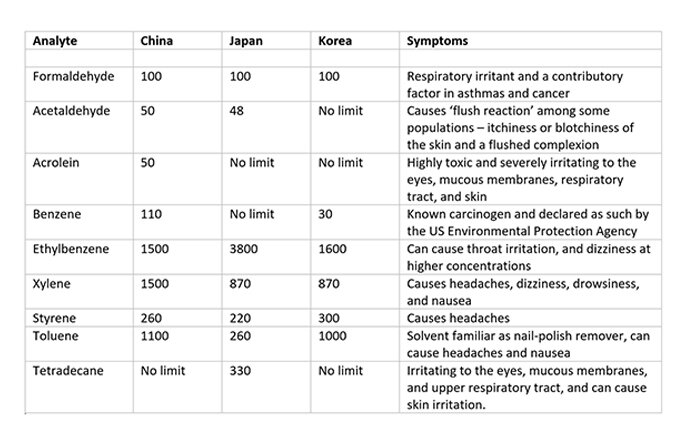
In this testing, not only did we manage to isolate different VOCs, but we quantified their mass using SIFT-MS, a type of direct mass spectrometry that uses precisely controlled soft ionisation to enable real-time, quantitative analysis of VOCs in air, typically at detection limits of parts-per-trillion level by volume (pptv).
Anatune provides chromatography and mass spectrometry-related analytical solutions, in particular the deployment of SIFT-MS, which stands for Selected Ion Flow Tube Mass Spectrometry and is built by the Christ Church, New Zealand-based company Syft Technologies. One of the main advantages over existing instrumentation is that SIFT-MS measures multiple analytes in real time, akin to a rolling video compared to the ‘snap shot’ of traditional chromatography.
As with any technology, there is a trade-off with the more traditional technique of thermal desorption/gas chromatography (TD/GC) analysis, where VOCs are collected on sorbent tubes on an integrated basis. The SIFT-MS approach cannot distinguish every analyte, and the most effective way to operate the instrument requires ‘telling it’ what you are looking for in advance.
In an initial test of a one-year-old gasoline Hyundai i10, Anatune deployed the Syft Technologies’ Voice 200ultra.
The car was tested every 15 minutes for 60 seconds over five hours on an early summer’s day, where temperatures rose to 20 degrees Celsius (68 degrees Fahrenheit). The measured concentrations were expressed as the mean across the 60-second duration of the sample. For the final 15-minute vent cycle, the car windows were opened, the car started and the air conditioning run at full power. The SIFT-MS then sampled continuously using the above conditions for the full 15 minutes.
The two principle outcomes of the test concern the steady accumulations of ten VOCs as temperatures rose; and the unexpected dynamic of emissions during the final fifteen minutes.
Most noticeably, the common solvents methanol and acetone rose from very low base points (18 and 12 micrograms per cubic metre) to 935 and 576 μg/m3 respectively. The 52-fold rise in methanol is noteworthy. While it is a very common solvent and not directly regulated, it is toxic and could be an irritant at these levels.

The only exception to these across-the-board rises was benzene, which fell from 17 to 15 μg/m3. However, this is where the final fifteen minutes revealed unexpected results.
Despite windows being open and the air conditioning turned on, some VOCs such as acetaldehyde rose steeply during the fourth to sixth minutes. During this phase acetaldehyde concentrations rose from an initial base of approximately 50 to 550 μg/m3, more than ten times the regulated limit in China and Japan.

Anatune Senior Application Chemist and SIFT-MS Specialist Dr Mark Perkins hypothesises that the car’s Heating and Ventilation system (HVAC) may form a type of ‘sink’ for some VOCs. When the venting or AC are activated, the sink is flushed out into the cabin causing a pronounced spike. Three other analytes that rose in the same time frame included styrene, toluene and benzene.
From a vehicle testing perspective, the ability to detect and speciate different analytes in real time opens up the possibility for more extensive research of exposure and the potential for regulation to reduce detrimental health exposures. It could also assist driver education in respect of ‘VOC build-up’ when a vehicle is parked in hot weather.
Overall what this shows is that a four-hour, time-weighted average of total VOCs – the basis of existing regulatory testing – could be improved. Future regulations will need to cover individual materials in isolation as well as ‘whole car testing’, by which we mean the actual, real-world way in which the many materials comprising a car interior act dynamically with each other and within the HVAC system.
With so many new entrants into the global car manufacturing sector, and at a time of drivetrain and material changes often connected with light-weighting, there has never been a more critical juncture at which to take seriously chemical emissions that can harm vehicle occupants and are already the source of a high volume of complaints.
Regulations should reflect where there is market failure, in particular where a consumer does not realise or cannot do anything about the health exposure. ‘New car smell’ may be unpleasant to certain consumers, but there is little understanding of the health detriment. Acetaldehyde is one of the better understood VOCs in the cabin so far, which was prominent on the vehicle tested, and which should be considered for early intervention.
1 CEN Workshop 103 held its first meeting on 4 November 2019, chaired by not-for-profit organisation the AIR Alliance, whose co-founder is Emissions Analytics' founder and CEO Nick Molden.
Burning Issue: Tyres And Air Quality
Are tyres replacing tailpipe as the policy priority?
Are tyres replacing tailpipe as the policy priority?
Tyres are rapidly emerging as a new source of environmental concern and this will affect the car industry.
In a recently aired BBC radio documentary, it was claimed that the world will discard 3 billion tyres in 2019, enough to fill a large football stadium 130 times1. Beyond this broad issue of resource use and material waste, tyres also sit uniquely at the intersection of air quality and microplastics.
This newsletter sketches the problem in its current form and considers certain automotive developments in its light.
As a car drives by, you cannot see its tyres wearing and therefore ‘tyre wear’ in this sense remains imperceptible except in deliberately extreme use such as branches of motor sport such as drag racing and drifting.
Yet over a lifetime of between 20-50,000kms, a tyre will shed approximately 10-30% of its tread rubber into the environment, at least 1-2kgs2. The wear factor (defined as the total amount of material lost per kilometre) varies enormously depending on tyre characteristics such as size – radius/width/depth – tread depth, construction, pressure and temperature. In one recent Emissions Analytics’ test, conducted under real-world rather than lab conditions, the four tyres on a standard hatchback lost 1.8kg over just 200 miles of fast road speeds, far in excess of what had been anticipated by the testers.
A tyre abraids owing to the friction between its contact patch and the road surface. It ‘emits’ particles across a broad size spectrum, from coarse to fine to ultrafine to nanoscale. It may also emit other forms of aromatics such as benzopyrene and benzofluorene, the result of the incomplete combustion of organic matter resulting in evaporation of the volatile content of the tyres, which the EU has regulated to a degree3.
Coarse particles typically fall rapidly to the ground. At the fine level and smaller, they are airborne for a certain duration, either being blown away from the carriageway before settling on the ground, or falling to the carriageway where re-suspension may take place as other vehicles pass.
Particle dispersion and deposition eventually occurs, but that is not the end of the story. The particles typically pass into the watershed through street drainage and are estimated to be a primary source of as much as 28% of microplastics found in the marine environment4.
The recent re-characterisation of tyre wear emissions as ‘microplastic pollution’ corrects the broadly misleading public idea, out of date a hundred years and counting, that tyres are composed principally of natural rubber. Instead, tyres are a close derivative of crude oil and their wholesale pricing typically tracks it.
A typical car tyre comprises 45% oil-derived synthetic rubber (polymer), 40% oil-derived carbon-black (filler, 40%), and 15% various additives to aid production processes, some of which typically contain heavy metals and some of which are also oil-derived.
Some tyres contain natural rubber, but to all intents and purposes we live in the age of the plastic tyre.

For not unrelated reasons, we also live in the age of the disposable tyre. From being an expensive product derived in large part from natural rubber, tyres have fallen in cost as globalisation has catapulted numerous new entrant tyre-makers into what is today a $240bn a year industry.
If we now turn to the automotive world, tyres are more important than ever to vehicle attractiveness and performance, but for many different reasons:
An emphasis on vehicle and tyre performance is often at the price of tyre longevity, particularly where higher diameter wheel rim sizes are combined with wide tyres, whether to convey power or sportiness
Tyres have become more disposable as their price has fallen in real terms, replacing an older tradition of re-treading carcasses for extended life
New entrant tyre-makers in Asia, South Asia and Eastern Europe have led to the advent of the ‘budget tyre’
Electric vehicles offer instant torque and higher kerb weights, implying higher tyre wear rates, even while regenerative braking is expected to reduce brake wear emissions
Electrification leads to a completely new appraisal of the tyre in respect of durability and noise
In-cabin tyre noise becomes a high-concern consumer issue as drivetrain noise is reduced or eliminated.
From a regulatory viewpoint, tyres in Europe are labelled according to three criteria, (the so-called ‘performance triangle’): rolling resistance, wet grip and noise – but that may change as tyre environmental impact rises up the political agenda.
From our perspective, Emissions Analytics has been conducting in-depth real-world tests on tyres. Two immediate insights can be shared:
Budget tyres wear rapidly and have high emissions
New instrumentation capable of measuring emissions down to the nanoscale shows that at the ultrafine level and smaller, the particle mass becomes far less instructive than the particle number, which is much more significant, and yet current regulations only measure mass
The size distribution has potential implications for the epidemiology (health) concern around very fine particulate matter and how it may affect human health.
In one recent test, Emissions Analytics used a Dekati ELPI+ (Dekati® ELPI®+ Unit standard with 14 size fractions from 6nm up to 10um for PN/PM concentration at 1Hz/10Hz sampling rate) to measure both particle mass and number. The first chart below shows the resulting mass distribution.
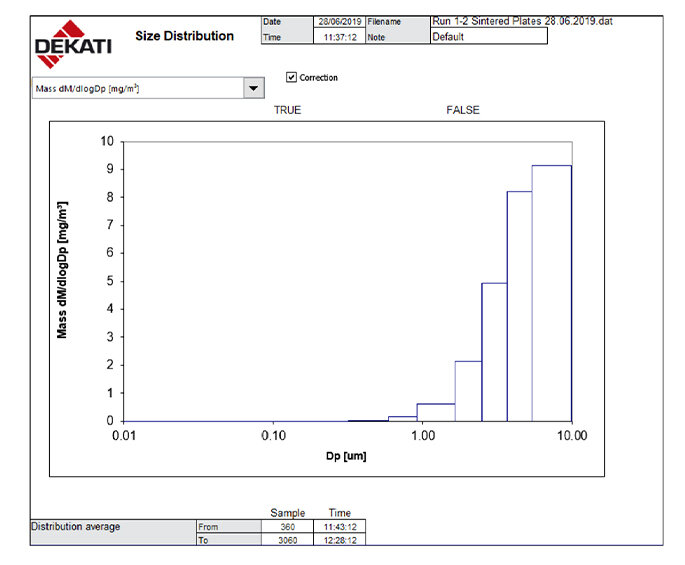
We regard this as a valuable piece of data even though it only corroborates what is broadly known, that a comparatively small number of coarser particles (up to and including the 10 micrometre size shown in the far right column, familiar as PM10) account for most of the recorded mass.
Then consider however the contrast when particle number is accounted for rather than mass: you get a mirror of the first graph, with a tiny amount of mass expressed as a very high number of nanoscale particles right down to the 10-nanometre level expressed in the first column (0.01 micro-metre).
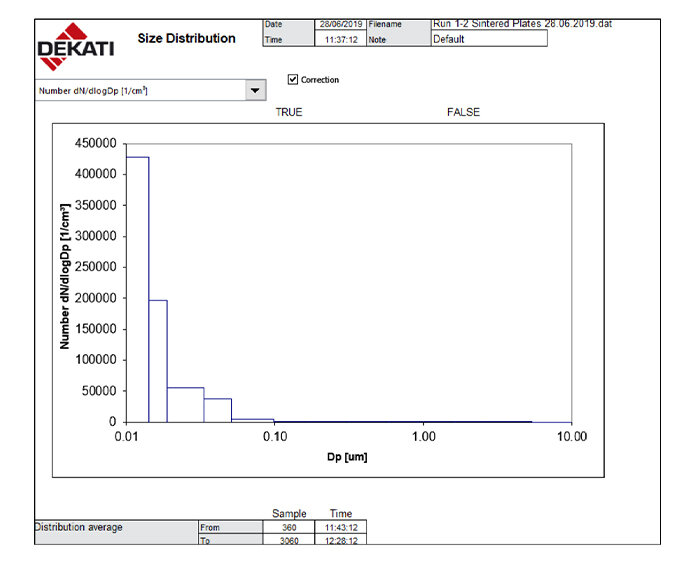
This is a potentially valuable insight because until now this high particle number count has typically either not been measurable or not been measured, owing to a regulatory preoccupation with mass and a lack of suitably sensitive real-time measurement instrumentation.
The ability to count particles down to 10 nanometres relies on the quality of the impactor chosen for this test, which is considered to be the best currently available on a commercial basis.
Regarding public health, there is a tentative emerging consensus among epidemiologists and other medical researchers that ultra-fine particles are potentially more injurious to human health than coarse particles, owing to their ability to translocate to the bloodstream through the lungs5.
Particles will need to continue to be measured both for their mass and their number. In respect of mass they are emitted in a large size range by tyres. In respect of number they emitted in high volumes.
We highlight the UK government’s recent report Non-Exhaust Emissions from Road Traffic, authored by the UK Government’s Air Quality Expert Group (AQEG). It recommends “as an immediate priority that non-exhaust emissions (NEEs) are recognised as a source of ambient concentrations of airborne PM, even for vehicles with zero exhaust emissions of particles.”
Quite apart from the broader point here that so-called ‘zero emission vehicles’ are in fact significant sources of non-exhaust emissions, the quantity of such emissions is set to rise.
The same UK government report notes that non-exhaust emissions are believed to constitute today the majority source of primary particulate matter from road transport, 60% of PM2.5 and 73% of PM10. While regenerative braking is expected to reduce brake wear emissions, the increased weight and torque characteristics of alternative drivetrains such as EVs will likely be associated with increased tyre wear.
In the same report it is suggested that a 10kg increase in vehicle mass accounts for a 0.8-1.8% increase in nanoparticle emissions from tyres. This is particularly relevant as a whole generation of new EVs is hitting the roads with considerably larger and heavier battery packs than in the past.
For small to medium cars, where modest range is acceptable for city use or where the glider (bare chassis) has been deliberately lightweighted to offset batteries (as per the BMW i3), the weight gain may be marginal. Indeed, a switch to narrow tyres may neutralise or even reduce tyre wear.
But a Tesla Model S or Model X, Mercedes EQC, Audi e-tron or Jaguar i-Pace, EVs with larger ranges and battery packs in the range of 60-100 kWh, weigh 2.3-2.6 tonnes. The 600kg battery pack in the Mercedes EQC would on the AQEG/DEFRA model potentially increase nanoparticle emissions from tyres by 48-108%, compared to a conventional vehicle weighing 600kg less.
The same argument can be extended to internal combustion engine vehicles. A heavier vehicle increases tyre wear, whereas lightweighting mitigates it. This has implications for the broader market trend towards SUVs, where often particularly large rim tyre sizes are adopted.
On this basis we think tyres are set to be scrutinised and regulated more, and perhaps also reinvented for electric cars to perform well in durability and noise. There will be opportunities and threats that arise from these changes.
We anticipate the need to place a value on low emission tyres, so that they are desired and consumers are willing to pay for them, in other words using a tax policy that internalises the externality to the benefit both of society and the environment.

1 Costing the Earth: Tread Lightly. BBC Radio 4, March 13th, 2019.
2 Grigoratos & Martini, 2014.
3 Since 2010 the EU has required the discontinuation of the use of extender oils which contain more than 1 mg kg−1 Benzo(a)pyrene, or more than 10 mg kg−1 of the sum of all listed polycyclic aromatic hydrocarbons in the manufacture procedure due to increased health concerns related to PAHs (European Commission, 2005).
4 Microplastics are considered to be all plastic particles in the range of 0.1–5,000 µm. A secondary source is when a larger plastic object breaks down once already in a marine environment. The figure of 28.3% was originally cited in Julien Boucher, Damien Friot, Primary Microplastics in the Oceans: a Global Evaluation of Sources, International Union for Conservation of Nature and Natural Resources, 2017, p21.
5 Newby, David: ‘Air Pollution and Cardiovascular Disease - A Mills and Boon Classic’ (2019).
Plug-In Hybrids Without Behavioural Compliance Risk Failure
Tensions between official EU emissions policy and member states.
Tensions between official EU emissions policy and member states.
When the Worldwide Harmonised Light Vehicle Test Procedure (WLTP) commenced in September 2017, it replaced the New European Driving Cycle (NEDC) with a more realistic, ‘real-world’ approach to emissions testing. Following this switch, several models of plug-in hybrid car (PHEV) were withdrawn from sale in Europe as their emissions ‘rose’ sharply under the new test, disallowing them from various subsidies and benefits. Yet interestingly a wide range of new PHEVs are now being launched, two years later.
The new crop of PHEVs are likely to have been optimised to the WLTP emissions test, and come with larger batteries in the range of 10-30kWh instead of previously 3-6kWh. This ensures that they achieve super-credit status, or sub-50g CO2/km emissions ratings, which initially allows them to be counted twice in the fleet average CO2 calculation. This is vital for manufacturers who have to meet impending fleet average emissions targets of 95g/km from 2020 or face large fines in Europe.

This strong incentive from the EU level directly clashes with some member state policies: national governments that have cancelled generous subsidies for all PHEVs. This group of policy makers are suspicious of PHEVs.
The Dutch government, followed by the British, in late 2018, withdrew previously generous PHEV subsidies. They cited evidence suggesting that many owners, attracted by a subsidy, rarely plugged in their PHEVs.
So what is going on and who is right? If a PHEV is not plugged in, it typically drives around on a smaller than optimal internal combustion engine and achieves poor real-world results.
Of all PHEVs tested by Emissions Analytics, which includes petrol and diesel versions, the average performance in this condition is 37.2 mpg (7.6 l/100km) and CO2 emissions of 193.3g/km, which is 62.5% worse than the official NEDC results.
By no stretch of the imagination are these compelling figures if, as EU policy makers would claim, the purpose is to reduce real greenhouse gases as quickly as possible.
That is not to say that PHEVs have no claim to virtue. Their primary strength is offering electrification without range anxiety, since an internal combustion engine remains present, whether as a part of the drivetrain or as a ‘range-extending’ battery generator.
However, one of the challenges for PHEVs is that by the nature of the technology, their performance cannot be properly encapsulated and articulated by the standard, cycle-based rating. Rather, the real-world performance of PHEVs rests to an unusually large degree on user behaviour and journey length, rather than instantaneous combustion performance.
Research studies have shown that some duty cycles – for example commuting to and from work every day but charging overnight and avoiding long distances – can result in virtually no use of the ICE. The consumer has in this case had an EV ‘on the cheap’, without the weight and cost of a large battery pack. This is a PHEV at its best.1
At the other end of the spectrum, a PHEV might be deployed on long journeys and never plugged in. This results in a significant disbenefit, the vehicle typically offering worse fuel consumption and emissions than a conventional ICE-only drivetrain. This is a PHEV at its worst.
While we can recognise that many current or potential PHEV owners understand that the electric driving share of a PHEV, expressed as its utility factor (UF), is the key to its fuel economy rating and emissions, nonetheless the Dutch data, based on fuel card usage, included a significant business user fleet where there was evidently no fiscal incentive to save fuel. These owners were hardly plugging in.2
In the study referenced in footnote 1, based on 1831 Chevrolet Volts in the US, the authors found generally excellent utility factors, the average being 78%. In the Dutch data, which included smaller-battery PHEVs and owners who typically didn’t bother to plug in, the average utility factor was 24%.
If we take this spread, 24-78%, as the real range of utility factor, and return to the Emissions Analytics average PHEV performance of 193g/km CO2, it can be re-expressed as spanning 151g/km CO2 (24% UF), to 46g/km CO2 (78% UF).
The effect of the WLTP has been to force model overhauls, leading to larger internal combustion engines, and larger batteries to achieve longer electric range.
This is precisely what happened with the Mitsubishi Outlander PHEV, at different times and places the leading PHEV in Europe. To achieve a sub-50g/km result under WLTP the manufacturer fitted a 2.4 litre petrol engine, replacing a 2.0 litre unit, and increased battery size from 12kWh to 13.8kWh. EV range fell from 33 miles under the NEDC to 28 miles under the WLTP, but crucially it allowed the SUV to retain a sub-50g rating (46g/km) as a category 2 Ultra Low Emission Vehicle.
The warning to policy makers is that current and future PHEVs offer most of the same strengths and weaknesses of previous models, and that car makers are optimising their products to achieve the sub-50g result under WLTP but without guaranteeing any actual reduction in emissions.
In a very recent instance one OEM, Peugeot, boasted of an SUV featuring 4WD and 300hp yet 29g/km CO2, premised on an electric range of 36 miles and a 13.2kWh battery. The 3008 SUV GT Hybrid4 qualifies in the UK for the lowest Benefit in Kind (BIK) tax rating of 10%, re-attracting a subsidy.
In another 2019 product launch, the Volvo XC40 T5 Twin Engine claims 262hp and a preliminary WLTP rating of 38g/km. In this instance some but not all variants of this model offer a ‘hybrid’ setting that tries to optimise overall efficiency, except that whether it is deployed or not sits with the owner. Such an innovation is likely to confuse regulators and consumers alike, even if it may also work well in practice.

Our position is that on reasonable assumptions PHEVs will deliver less and less certain reductions in CO2 than non-plug-in hybrids. In other words, that they are ineffective without behavioural compliance, and that such compliance is politically infeasible in most democracies where it would be considered an intrusion on privacy.
The case for future PHEVs may lie principally in the light to medium commercial fleet, where the advent of zero-emission city centres may force dual-drivetrain approaches, the pure electric drive share being saved for last mile delivery and the ICE (diesel as well as petrol) permitting long highway distances, refrigeration units and so forth.
Geo-fencing is also strongly foreshadowed in current fleet management, from public bus fleets to Uber’s app, and suggests a straightforward way to ‘enforce’ the correct use of a PHEV, thus compelling fleet operators to plug them in.
This would go a long way to addressing the ongoing weakness of the PHEV, its drivetrain sleight-of-hand that courts generous tax-payer subsidy but delivers poor real-world performance.
In the realm of private passenger cars, however, we have shown in a previous newsletter how by comparison non-plug-in, full hybrids offer much faster and more certain emissions reductions of up to 30%. Given the importance of reducing CO2 emissions agressively and quickly, the lower risk option may be preferable.
1 Patrick Plotz, Simon Arpad Funke, Patrick Jochem. ‘The impact of daily and annual driving on fuel economy and CO2 emissions of plug-in hybrid electric vehicles’ in Transportation Research Part A, 118 (2018) 331-340.
2 Ligterink, N.E., Eijk, A.R.A, 2014. ‘Update Analysis of real-world fuel consumption of business passenger cars based on Travelcard Nederland fuelpass data’, TNO Report TNO 2014 R11063.

The Promise Of Life Cycle Assessment And Its Limits
Approaches to comparative rating of vehicles.
Approaches to comparative rating of vehicles.
Life Cycle Assessment (LCA) is the principal way to achieve clarity over the environmental credentials of varying drivetrains, and may become the basis of primary legislation in Europe and beyond over the next decade.
The purpose of this newsletter is to consider how LCA can work in practice, bringing clarity to the automotive sector both as an efficient market, the producer of environmentally sensitive products and in respect of consumer choice, i.e. how vehicles might be rated and ranked for their ‘greenness’.

LCA has existed as a concept since the 1970s and is by now a well-established field of academic inquiry. Contrary to common perception in 2019, LCA is not necessarily about CO2 emissions and the climate ‘friendliness’ of one car over another, say diesel versus electric. LCA can equally apply to other impact categories such as social justice or supply chain efficiency, and indeed ‘non-climate’ environmental impact categories such as water use. It is a method for considering the total lifespan of a product, but the chosen theme and system boundaries can be many, and they can be divergent. It can be applied to any product and not just cars. Owing to their material and commercial complexity, cars are among the most challenging products to apply LCA to.
A useful historical note is to remember that a precursor of LCA was Technology Assessment (TA) in the US in the 1960s. The aim of this nascent philosophy was to brief Congress on the likely impact on society and economy of new technologies, to inform intelligent policy decisions.
LCA offers a not dissimilar service today. Conventionally, it relies on a modelling of a vehicle’s impact in four areas: fuel (from source to distribution); vehicle production, vehicle use and end-of-life.
Until recently the greatest emphasis was on the fuel because the use-phase of an internal combustion engine vehicle (ICEV) is the dominant source of emissions. With electrification, the emphasis has swung to vehicle production (batteries) and end-of-life (batteries), both about which there remains a lack of usable data. There is no utility scale automotive battery recycling, but it takes place on a small scale. Meanwhile, the estimate of embedded emissions from manufacture as a proportion of total emissions are 15-20% for a gasoline car, but 20-60% for a battery electric car. Recent studies have emphasised the larger figure in that wide range, citing not just the batteries but supporting, high emission components such as aluminium. Meanwhile the fuel question is displaced to the energy grid and looms large in any credible assessment of the environmental claims of EVs.
LCA also casts doubt on the industry’s claim that diesel is better than gasoline in climate terms. In fact a diesel car’s embedded emissions are higher than a gasoline car’s (the range of estimates is 20-30% versus 15-20%, respectively) thanks to the heavier engine block and typically greater emissions controls. Like an electric car it then has to ‘break even’ over its lifetime by offering lower in-use CO2 emissions.
It is worth noting that the academic field of LCA has already moved somewhat beyond these basic LCA applications even though they remain in their infancy and are not typically understood or applied by policy makers, consumers or even parts of the car industry. Current LCA trends are to move beyond product life cycles to consider user patterns and behavioural dimensions.
Rebound effects suffice here as a cautionary note. If a consumer saves fuel costs by buying an electric car, but spends the proceeds on a long-haul flight to the Caribbean, that’s a negative environmental rebound effect. Such whole system thinking demonstrates that beyond the application of LCA to cars there remain wider considerations, including the very desirability of private car ownership given projected global urbanisation rates, resource scarcity and the political imperative towards liveable cities.

Despite all such concerns, the advent of variously electrified drivetrains makes an LCA approach essential, in our view, for the achievement of basic consumer clarity around product claims as well as policy maker insight.
One central objective, echoing previous Emissions Analytics newsletters, is achieving the greatest reduction of CO2 emissions in the shortest possible time, in the real world and not just on paper, so as to achieve the promise of the Paris climate accord and the stated goals of the IPCC in containing climate change.
Unfortunately, almost all existing vehicle regulation in OECD countries is out of sync with this climate objective, having arisen in an era in which the internal combustion engine was overwhelmingly dominant. Existing regulation concerns fuel economy and tailpipe emissions. Because EVs have tank-to-wheel emissions of zero, they have caught the policy-makers’ ear for being ‘zero emission’. Partly as a result, numerous countries have now declared their intention to halt the sale of ICE drivetrain vehicles in coming decades.
Our view of this development is one of caution, partly because of the insight afforded by the application of LCA.
In short, countries such as the UK, India, France and China are moving towards outright bans on internal combustion engines before regulators have established even rudimentary frameworks for lifecycle carbon emissions of vehicles.
It is not widely understood in the West that China’s push into rapid electrification is primarily to address poor air quality rather than combat climate change. In LCA terms its electric cars are at best roughly on par with their ICEV equivalents, with small gains predicted by 2020.[1]
This helps to explain why one of the themes of 2019 has been a series of reports identifying the high upfront embedded emissions in electric cars and the perils of grids not yet weaned off coal and lignite.
Bloomberg NEF, with Berylls Strategy Advisors, recently claimed that by 2021, ‘capacity will exist to build batteries for more than 10 million cars running on 60 kilowatt-hour packs’, with ‘…most supply … from places like China, Thailand, Germany and Poland that rely on non-renewable sources like coal for electricity.’[2]
Modelling the climate emissions of the manufacture of these batteries led the analysts to claim that the 500kg + battery pack for an SUV emits up to 74 percent more CO2 than producing an efficient conventional car if it’s made in a factory powered by fossil fuels in a place like Germany.
Several other similar reports in 2019 have pinpointed the environmental achilles heel of electric cars – their batteries – some pointing out not just their manufacturing emissions but to other impact categories relating to the mining of battery materials at scale. In some of these reports the claim is that electric cars can be dirtier than diesel cars on an LCA basis, under certain scenarios.
At the opposite end of the spectrum, critics of these reports have been up front in admitting that fulfilling the promise of clean transportation rests on decarbonising the wider energy grid, both in respect of EV manufacturing and EV use-phase. The true potential of electric cars therefore lies in the future.[3]
[1] ‘Life cycle greenhouse gas emission reduction potential of battery electric vehicle’. Zhixin Wu, Michael Wang, Jihu Zheng, Xin Sun, Mingnan Zhao, Xue Wang. Journal of Cleaner Production 190 (2018) p462-470.
[2] www-bloomberg-com.cdn.ampproject.org/c/s/www.bloomberg.com/amp/news/articles/ 2018-10-16/the-dirt-on-clean-electric-cars; Berylls Strategy Advisors, www.berylls.com.
[3] ‘The Underestimated Potential of Battery Electric Vehicles to Reduce Emissions.’ Auke Hoekstra, Joule 3, 1404-1414, June 19, 2019.

Broadly expressed, we acknowledge elements from both sides of this debate and incorporate them in the preparation of individual vehicle assessment. The lowest GHG emission is from hydropower and on this basis an EV in Sweden, as early as 2010, emitted just 6g CO2/km in use; the highest GHG is from lignite and produces an equivalent figure of 353g CO2/km.[1] The authors of this respected academic paper consider that with the current EU grid mix, the emissions of BEVs are between 197 and 206g CO2-equivalent/km, depending on battery chemistry.
At this juncture it is important to emphasise the very promising middle ground occupying the space between ICEV and BEV, the land of the hybrid and plug-in hybrid. In many situations a part-electrified drivetrain can outperform both ICE and BEV owing to the very high embedded emissions in the BEV and its underperformance in cold weather and/or when fuelled from a fossil heavy grid.
In this observation we have in mind one particular paper breaking down drivetrain performance by US regions. The ICE drivetrain had the worst GHG emissions in almost all scenarios, demonstrating the imperative of electrification for climate mitigation in a broad sense; but where cold weather and part-coal grids came into play (typically in parts of the Midwest) the worst performer overall was a BEV, while in all regions the best performing drivetrains were hybrids and plug-in hybrids, partly owing to their ability to scavenge waste heat from an ICE to operate the HVAC system in low temperatures.[2]
As such our default position is technology neutrality respecting acknowledged unknowns. Whereas some reports have claimed that in-use battery degradation could add as much as 29% to the real emissions of a medium size BEV over its life, other studies have noted that the existing durability of batteries in some hybrids suggest that the industry assumption of a lifetime of 150,000km or 8 years (the ‘functional unit’ in LCA language), is excessively cautious, with some early hybrids achieving multiples of this. The truth is that we don’t know because there is not yet enough real-world data to draw on for real-world results.
Where Emissions Analytics will contribute is by modelling an LCA approach premised on the use-phase emissions attained through real-world testing, allowing for a rising scale of other inputs that permit worst-through-best scenarios instead of being captive to a particular model or paradigm.
As things stand there is an emergent consensus view that BEVs can potentially be 30-50% better in GHG emissions, in a whole life LCA perspective, with extensive renewables at manufacturing and in-use, but this is certainly not invariably so.[3] For now, deeming EVs as the cleanest simply by virtue of what they are is misleading.
It’s equally important to note in passing that while climate considerations have become imperative, electrification is something of a devil’s bargain owing to other environmental impact categories that remain far worse than for ICEVs no matter how far projected into a golden future – these include terrestrial acidification; freshwater eutrophication; human toxicity and non-exhaust particulate emissions.[4]
Discrimination by battery origin and market of operation will quickly become an important consideration, and forms the underlying basis of Emissions Analytics’ approach to a ratings model for vehicles.
The other emerging theme is the importance of the duty cycle. The emissions ‘breakeven’ potential of an EV rests on its mileage. It may well be that a small hybrid car remains in LCA terms much more efficient for the occasional or low mileage driver than a full EV.
These and other themes will emerge rapidly as an LCA approach comes to dominate thinking and the regulatory environment. Communicating ratings to car buyers in a comprehensible way will remain Emissions Analytics' mission.
[1] ‘Environmental life cycle assessment of electric vehicles in Poland and the Czech Republic.’ Dorota Burchart-Korol, Simona Jursova, Piotr Folega, Jerzy Korol, Pavlina Pustejovska, Agata Blaut. Journal of Cleaner Production 202 (2018) 476-487, p485.
[2] ‘Effect of regional grid mix, driving patterns and climate on the comparative carbon footprint of gasoline and plug-in electric vehicles in the United States.’ Tugce Yuksel, Mili-Ann M Tamayao, Chris Hendrickson, Inêz M L Azevedo and Jeremy J Michalek, Environ. Res. Lett. 11 (2016) 044007, p8.
[3] This was the finding of BMW in its LCA for the BMW i3 BEV, conducted according to ISO 14040/44 and independently certified in October 2013. The 30% figure assumed the EU-27 grid mix, while the 50% figure assumed 100% renewables. In this study almost 60% of the vehicle’s GHG footprint resulted from manufacturing despite enormous efforts of the company to source renewable energy for production, including all carbon fibre production and the use of re-cycled aluminium.
[4] ‘Environmental life cycle assessment of electric vehicles in Poland and the Czech Republic.’ Dorota Burchart-Korol, Simona Jursova, Piotr Folega, Jerzy Korol, Pavlina Pustejovska, Agata Blaut. Journal of Cleaner Production 202 (2018) 476-487. See Table 9 on p484.
Archive
- AIR Alliance 3
- Air Quality 38
- Audio 3
- Climate Change 14
- EQUA Index 21
- Electrified Vehicles 28
- Euro 7 3
- Fuel Consumption/Economy 20
- Fuels 4
- Infographic 18
- Media 4
- NRMM/Off-road 3
- Newsletter 103
- Podcast 7
- Presentation/Webinar 18
- Press Release 19
- Regulation 16
- Reports 4
- Tailpipe Emissions 49
- Tyre Consortium 2
- Tyre Emissions 26
- Vehicle Interior 6