
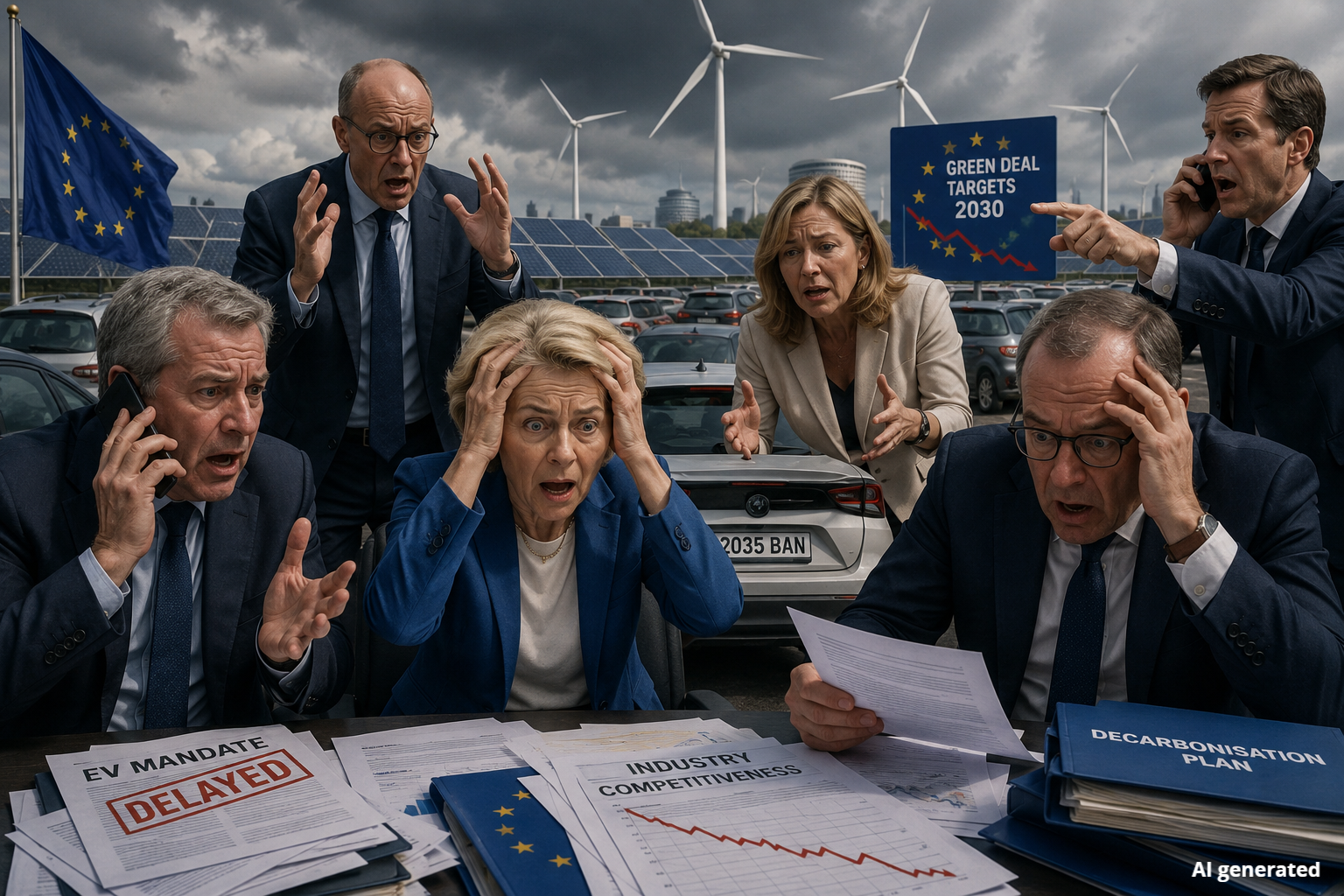
Euro-meltdown: How Europe spent tens of billions not reducing emissions
European policy makers are panicking, and with good reason. Not only does their decarbonisation policy look both ineffective and irrelevant to today’s challenges, the somewhat uncouth policy from across the Atlantic is looking better adapted every day. Of course, reducing carbon dioxide (CO2) emissions cannot be addressed in a vacuum, as it is intrinsically entwined with population trends, economic activity and power generation – as discussed in our recent newsletter – The identity crisis for net zero.
European policy makers are panicking, and with good reason. Not only does their decarbonisation policy look both ineffective and irrelevant to today’s challenges, the somewhat uncouth policy from across the Atlantic is looking better adapted every day. Of course, reducing carbon dioxide (CO2) emissions cannot be addressed in a vacuum, as it is intrinsically entwined with population trends, economic activity and power generation – as discussed in our recent newsletter – The identity crisis for net zero. Europe made hard work of reducing particulate, nitrogen oxide and other tailpipe pollutant emissions, by being slower and less diligent than the US. Even now the standards, though effective, are often still laxer in Europe. Today, Europe stands on a grave precipice, and must decide whether it changes course before too much more long-term damage is done.
Even though most developed European countries profess to want growth, they act to achieve anything but growth. High energy costs, extensive regulation, complex, distorting and burdensome tax regimes, inflexible labour laws, and so on. They prefer to redistribute a given economic cake rather than expand the cake. This behaviour is not new, but the consequences of this approach are becoming more critical with rapidly changing technology, geopolitical competition and accumulating environmental damage. Europe takes the basic approach that we generate a fixed “lump” of emissions that we need to tackle each type one by one, starting with power generation and transportation, and then moving on to home heating and other sources. The approach is to electrify everything, as power generation is easier to decarbonise. All this takes significant investment. As most European governments run significant deficits and national debts, much of the investment must come from private sources, domestic and foreign, lured by the promise of future “green growth” (which has so far been largely illusory at the macroeconomic level, even though some areas such as offshore wind have seen significant growth).
Now that we can see the lack of investment, growth and progress, European policy makers can only continue their mission by relying on three following more destructive ideas. First, we are exporting emissions: close domestic production and import the goods instead. For example, the UK’s territorial emissions in 2024 were 373 million tonnes, while its full consumption emissions were almost exactly double – 740 million tonnes. Second, the concept of “demand destruction” is being increasingly aired. It is usually deployed to mean reducing use of fossil fuel (good for decarbonisation) or energy efficiency (good for emissions, costs and productivity), but increasingly means economic recession. We can see that in factories closing and rising unemployment. Third, this is all wrapped up in the sanctimonious idea that we need to “set an example” to the world. Some would argue that is to fend off colonial guilt, but the rest of the world is clearly not interested in our moralising, just as European populations are increasingly revolting at the ballot box at the price of this unwanted example-setting.
In stark contrast, the US appears to be following the path of growing its cake. This was starkly clear at Emissions Analytics’ recent Off-Highway & Power Generation USA 2026 conference in Indianapolis. Energy demand projections have taken a sharp upwards turn primarily due to the needs of artificial intelligence (AI). This is not just any new industry, but one that potentially has long-term geopolitical and economic growth implications. The US reaction is that energy sources need to serve economic growth and, to that end, any and all sources need to be maximised now. It is not just a growth thing, but for national security. The cake must be grown, energy costs must be kept down, regulations must be accommodating. This will undoubtedly come, in the short term, with increased carbon emissions. However, increased national income will – subject to the right policies – provide the investment ultimately to decarbonise. Contrast real economic growth with illusory “green growth.”
How censorious should those committed to emissions reduction be of the US approach? At a high level, we should always remember that the US first pushed vehicle emissions control in the 1950s and continues to have generally stricter policies and limits than Europe does. Furthermore, some of the most radical environmental policies in the US were pioneered under Ronald Reagan and Richard Nixon, so Europe should be careful not to be too didactic. If we then look at how vehicle decarbonisation is progressing between Europe and the US, we might rethink the former’s cake-shrinking strategy.
Let us take the UK market as a reasonable median case for Europe. There are now around 2 million full battery electric vehicles (BEVs) on the road, with an average age of 2.5 years, reflecting the recent acceleration in sales. In round numbers, considering all factors, each of those BEVs will have incurred 5 tonnes of extra CO2 in their manufacturing and delivery, compared to an equivalent standard gasoline vehicle. So, this means 10 million tonnes of extra CO2 has already been emitted cumulatively due to the switch. This is equivalent to 2.6% of the UK’s total territorial emissions and 1.4% of its consumption emissions (the latter which includes extra-territorial production emissions). Compared to the benchmark gasoline car, the reduction in in-use emissions is around 140 g/km (215 g/km for gasoline minus 75% for BEV, taking into account the emissions in creating the respective fuels - data based on a combination of Emissions Analytics’ independent testing and data from academic literature). With each car saving 1.4 tonnes of CO2 per year based on average mileage, the mean deficit on the manufacturing emissions is still 1.5 tonnes. In total, therefore, the UK’s BEV strategy has so far led to an increase of 3 million tonnes in its actual CO2 emissions. With about 85% of BEVs sold in the UK being manufactured outside of the UK, we can see that the BEV strategy significantly reduces the country’s official emissions, while significantly increasing its actual emissions! No wonder the government sticks doggedly to the policy.
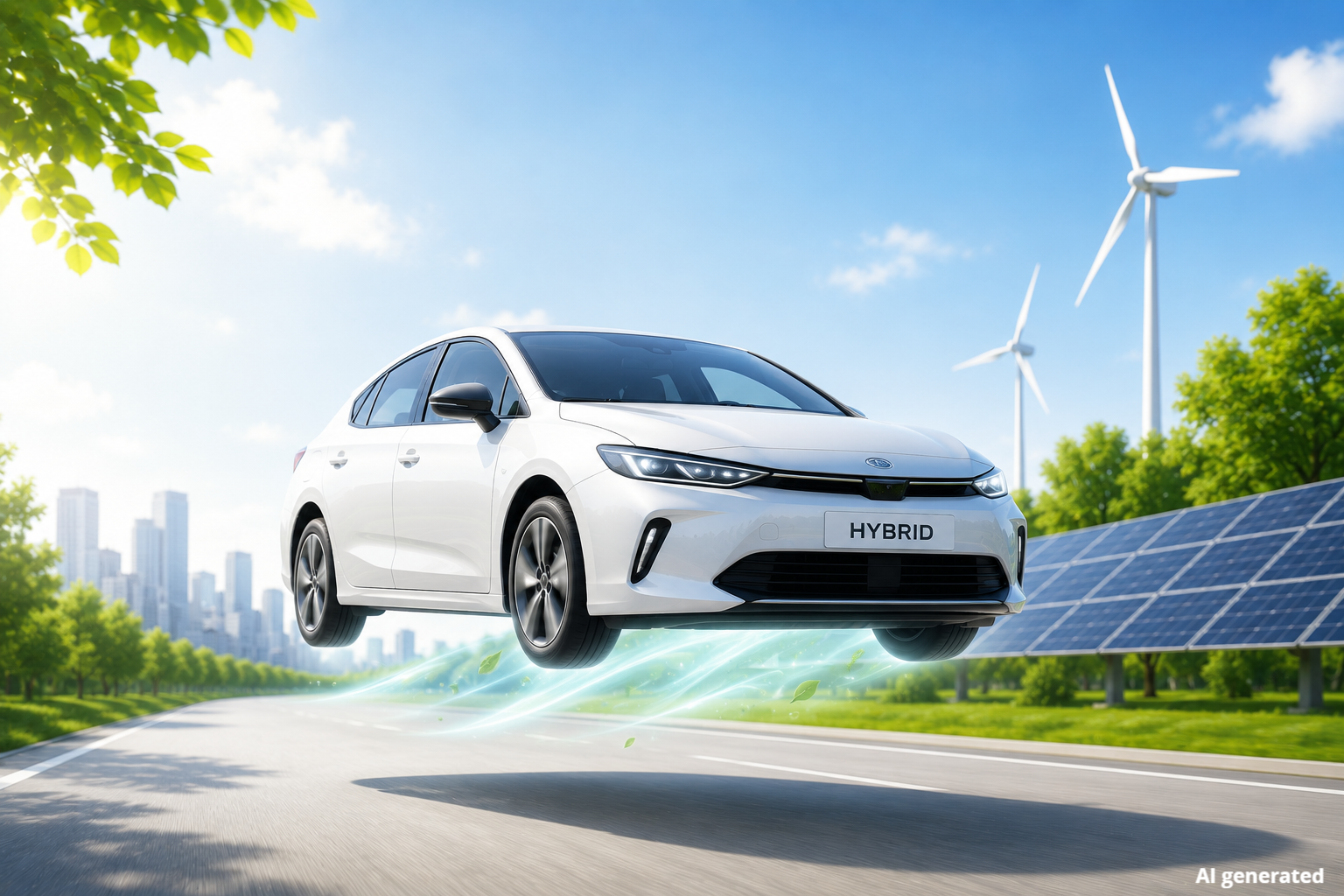
With BEV penetration of around 10% of the new car market in the US, the main way vehicles have been decarbonised so far has been through hybridisation, which accounts for about 15% market share. What would have happened if the UK had switched those 2 million vehicles to full (non-plug-in) hybrids instead of to BEVs? The increased manufacturing emissions would have been around 1 tonne per car, while the in-use saving would have been 0.7 tonnes per year (145 g/km for hybrid versus 215 g/km for gasoline). So, the total CO2 reduction would have been 3.5 million tonnes so far, comfortably paying back the 2 million tonnes of increased manufacturing emissions. Further, this would have been 4.5 million tonnes better than the BEV scenario.
To achieve this, the average effective discount from the list price of a new BEV has been around 50% in the UK, when you take into account discounts, subsidies and tax breaks. Therefore, in summary, the UK has spent around £40 billion in support for BEVs to increase CO2 emissions compared to the best alternative strategy. And the story gets worse, in two ways.
First, due to accelerating demand for grid electricity, driven in part by AI, the marginal electricity used to charge BEVs is likely to stay dirtier for longer than predicted. In fact, in 2025 in the UK, the average carbon intensity of the grid increased by 4%, according to the National Energy System Operator (NESO). In many European countries, fossil fuel power stations are being kept open longer than planned, or even re-opened. In some cases, coal plants are being fired up again. Consequently, the forecasts that BEVs will get ever-cleaner through their lives may be insecure.
Second, look closely at a Chinese-made BEV. It is extraordinary how much the quality has improved over a short space of time, but these vehicles have differentiated themselves by being software- and entertainment-led. With this comes a new concern: obsolescence. Empirical data shows that the batteries should last plenty long enough, but, as early Teslas are already demonstrating, the hardware and software may become so outdated that cars are scrapped early due to the second-hand market valuing them so lowly. If, for example, BEVs were only to last the length of their typical seven-year warranties, the lifecycle CO2 emissions would be only 50% less than a standard gasoline car and – crucially – the same as a full hybrid. While the evidence is only just emerging as most BEVs are still very young, projections for carbon emissions reduction fall apart if this accelerated obsolescence comes to pass.
You can now see why European policy makers are panicking. At the same time, in both regions, consumers are increasingly demonstrating through real, unsubsidised purchases, that hybrids strike the best balance of efficiency, cost and environmental responsibility. Emissions Analytics has long predicted full hybrids to be the best way to decarbonise transport for now, based on its independent real-world test data and economic realities. Whether the better path thereafter will be an evolution to full electric vehicles or the widespread use of low-carbon fuels is now the subject of lively debate in Europe. Emerging data suggests the optimal outcome will be a mix, depending on location and use case.
It is important to recognise that there are downsides to the US approach. Emissions may be lower in the short term by avoiding the up-front manufacturing emissions from BEVs, but the potential for long-term reductions are reduced. By excluding Chinese BEVs from the US market, local consumers have less choice and are likely to pay more on average for private motor cars than they otherwise would.
Where does that leave the choice for European policy makers? They could, of course, ape the US approach, although this would be a profound change of direction and humiliating for so many groups currently in positions of power – and so highly unlikely. The current approach is to double down on decarbonising the grid and be prepared for extensive demand destruction and curtailment of consumer freedoms as green growth does not materialise and recession becomes the only policy tool left. While substantial expansion of wind and solar energy has some merits, the investment required in dispatchable power or grid-scale storage is unaffordable, and therefore will not be afforded.
Which leaves only one serious alternative; one that has an unmistakably European flavour. A policy à la française. Large-scale nuclearisation using a standard design of fission reactors – both full size and small modular – could deliver the significant expansion of a stable, clean grid and a manageable cost. Uranium is a raw material that can be sourced without creating vexatious geopolitical dependencies. The marginal cost of electricity would be very low, aiding industrial competitiveness. To make this happen, planning regulations would have to be radically simplified, which should also have wider economic benefits in terms of much sought-after economic growth. Raising the capital to make this happen remains a challenge, just like all the other options. Without other spending cuts, most of the finance will have to come privately.

Bottom line, as the Kaya identity explained in the last newsletter sets out, it is impossible for Europe to reduce the combination of the carbon intensity of its energy and the energy efficiency of its national income anything like fast enough to meet its decarbonisation goals without exterminating large sections of its population (unlikely) or a major, persistent recession. Sadly, most policy makers are digging in for now, which will only make the price higher once a re-evaluation is forced upon them. Shame.

The identity crisis for net zero: Why you can bend politics but not truth
Regular readers will expect predominantly empirical data from Emissions Analytics, but this newsletter takes a detour into pure logic. More Karl Popper than David Hume. At the time of writing, vehicle decarbonisation targets across Europe are coming under serious strain, yet proponents are doubling down. The fear of invalidating the fundamental decarbonisation policy of electric vehicles powered by renewables is too great. But rather than argue over the latest facts and figures – are battery electric vehicle (BEVs) sales soaring or crashing – we can assess the situation in an alternative way. We can ask ourselves what the logical conditions would need to be to meet the various mandates. Is it logically possible?
Regular readers will expect predominantly empirical data from Emissions Analytics, but this newsletter takes a detour into pure logic. More Karl Popper than David Hume. At the time of writing, vehicle decarbonisation targets across Europe are coming under serious strain, yet proponents are doubling down. The fear of invalidating the fundamental decarbonisation policy of electric vehicles powered by renewables is too great. But rather than argue over the latest facts and figures – are battery electric vehicle (BEVs) sales soaring or crashing – we can assess the situation in an alternative way. We can ask ourselves what the logical conditions would need to be to meet the various mandates. Is it logically possible?

To assess this, we should consider the Kaya identity, developed by Japanese energy economist, Yoichi Kaya, in 1997. It describes the relationship between several economic, energy and population metrics and total carbon dioxide (CO2) emissions. The crucial element is that is not an equation, but an identity. A mathematical equation describes the relationship between variables such that at least one permutation is true. An identity, in contrast, is always true. Simplistically, “a = 2” tells you the correct single value for “a”, whereas “a × 2 ≡ 2a” is true for all values. In other words, the identity describes something that is logically true, as the Kaya identity describes total global CO2 emissions as the product of the following factors:
CO2 ≡
Population × GDP per capita
× Energy intensity of GDP × Emission intensity of energy
To achieve global net zero, therefore, we must reduce at least one of these elements to zero. Moreover, there is no other way to achieve the goal. It’s just maths and logic. It is not that we can come up with some new, creative engineering or policy ideas to find another way. Any initiatives to reduce CO2 must lower one or more of these factors.
And so, we can look at each of these factors to assess the prospects and possibilities for reaching net zero in much the way Europe and some other countries plan. We can immediately rule out population as the lever, as killing large swathes of the human population would not be acceptable. In fact, the human population is still on a growing trend, although is likely to peak around 25% higher than today around the end of the century. In the longer term, declining global population may ease the emissions burden, but only on a timeframe way beyond current policy objectives.
Reducing energy intensity of GDP means becoming more efficient: producing more with less energy. LED light bulbs. Lower fuel consumption cars. Arc furnace steel plants. Recent decades have seen many successful initiatives in energy efficiency, not least the move with cars that used to only deliver 20 miles per gallon of fuel and how, with hybridisation, can easily achieve 50. Most of these initiatives come at the cost of upfront investment, but have the advantage that the reduced energy consumption delivers on-going financial savings to offset this investment. Therefore, naturally, people and businesses will invest in energy efficiency until their margin gain is zero. In most cases, this will be well short of zero energy consumption, and so there is likely to be a natural lower limit on how low energy intensity of GDP will go without technological breakthroughs or government incentives.

The next lever is the emissions intensity of energy. Once we have exhausted ways to produce the same economic activity with less energy, we must make that remaining energy cleaner. Solar heated hot water. Nuclear powered submarines. Flour ground by windmill. The ultimate, perhaps, will be nuclear fusion, which offers the prospect of unlimited carbon-free energy. Currently this remains prospect rather than reality. It is a further interesting feature of the Kaya identity that – if we get to scalable, commercial nuclear fusion with near-zero emissions intensity of its energy, we would be able to achieve net zero CO2 emissions while having near-infinite economic activity and catastrophically inefficient products and processes. In other words, if one variable in the identity tends to zero, zero CO2 will be achieved however bad the other factors are. Such an outcome would unlikely be the best for human society if that energy would also almost cost-free, as we would bump up against other planetary constraints such as space and physical resources in an orgy of consumption. In other words, decarbonising human activity is a policy priority but should never represent some exclusive or even abiding objective of the world.
We can put some rough numbers of how these various factors have changed over time. Symbolically, let us take the 1997 as the benchmark year, not just as it is when the Kaya identity was first published, but also as the date of the Kyoto protocol, which framed some much of subsequent decarbonisation policy. A reasonable estimate would be that, since 1997, global population has increased by 37%, energy intensity of GDP has fallen by 33%, and emissions intensity of energy has come down by just 4%. Combined, this would imply a 12% reduction in global CO2 emissions, which is in stark contrast to the approximately 50% increase in actual global emissions. How can this be?
The likely explanation for the difference is the final factor that we have yet to consider: GDP per capita. Economic activity per head of population, in other words. While not a perfect measure of financial welfare, it is the least bad global metric we have. We get richer on this measure as we become more productive, squeezing more activity out of our finite resources of land, labour, capital and enterprise. Since 1997, global GDP per head has risen strongly, by 80%, which accounts almost exactly for the gap.
Why come to GDP last in this discussion? Energy and emissions intensity are both factors that most people would agree are good things to reduce. There are challenges in doing some, and effort and investment is required, but becoming more efficient must help our CO2 goals. Population is more ambiguous as a target, with arguments on both sides as to whether a greater or smaller population is desirable. Whatever, governments’ ability to influence fecundity is almost always shown to be futile, whether you are Mussolini or Macron. GDP per capita, on the other hand, is a variable we can strongly influence by policy, and by and large we want GDP to be as high as possible, to deliver us a good standard of living. There is, therefore, a direct conflict: we want GDP to go up, but we want CO2 to go down. Governments aim to reconcile these two objectives by reducing energy and emissions intensity. Energy efficiency schemes continue, and are often worthwhile, but it is clear than infinite efficiency is impossible. That leaves the main lever of government being to reduce emissions intensity of energy to zero. That is our “net zero.
How realistic is this? Let us be practical and accept that zero emissions intensity of energy is unachievable, but that a 90% reduction would be close enough to put net zero within reach. To reach that goal, a compound annual reduction of around 7% would be needed in emissions intensity from 2020 to 2050. This might not sound too daunting, but over the last twenty years – despite all the efforts and investment – Europe has only achieved around 2% per year reduction. Globally, the rate of improvement has been even lower.
There is only one case in the history of the modern world in which such reductions in emissions intensity were achieved. This was France’s policy of nuclear expansion in the 1970s and 1980s in responsible to the oil crisis of 1973 and 1979. They build almost 60 nuclear reactors in less than a generation, and as a result achieved emission intensity reduction of electricity of 11% per year in the 15 years afterwards. Even that only translated to 3% at the whole energy system level. Then, Chernobyl happened almost 40 years ago to this day, which gave ample (although largely misplaced) ammunition to anti-nuclear groups to pressurise European and US governments to limit further nuclear investment (although. Only now, in the face of logical consequences of the Kaya identity, is that beginning to change.
Therefore, it is only reasonable to conclude that the 2050 date for reaching net zero as interpreted by the International Panel on Climate Change, following the Paris Agreement of 2015, is not going to happen, and in all likelihood we will not even get close. Where does that leave a government – such as the UK or many in Europe – that is so strongly wedded to this global emissions objective? Only one lever is left: allow GDP per person to fall, such that a combination of reduced economic activity, higher efficiency and lower emissions intensity can together get close. There is no other way.
But we must be clear what this means logically: a long and severe economic recession. Poorer citizens. Worse quality of life. There is no other way, logically, if you want to hold doggedly to the objective.

Populations in Europe are becoming increasingly restive about their financial welfare slipping progressively behind other countries and in real terms. There is a high chance that a limit will be reached that will be expressed electorally. Stagnating living standards have now persisted for twenty years. While the banking crises of 2007/8 is often blamed for this, persistent recession today may be in no small part the deflationary policy of decarbonisation endorsed by governments in the same period, as for example by the 2008 Climate Change Act in the UK.
What might this on-going, severe recession look like. Energy rationing for a start. This may sound fanciful, but we are already seeing the structure of rationing appearing. “Vehicle-to-grid” charging of BEVs may sound like a great policy for efficient allocation of electricity to transportation demand – which it is – but it is also a mechanism which governments could abuse to extract energy from car batteries and prevent recharging by certain people at certain times. The new vehicle fleet CO2 target regime is, in practice, becoming a mechanism for rationing the number of internal combustion engine vehicles that can be sold. In the UK, within a few years you will not be able to rent a house that does not achieve a certain level of energy efficiency.
At the point that voters rebel, the current orthodoxy must be replaced by an approach that does not put emissions reduction above the financial welfare of citizens. And the profound frustration is that there is a one way out of this problem, as shown above all by France, by rolling out nuclear fission at scale. This could take the centrally-directed form pursued by France, but small modular reactors offer the possibility of greater speed, flexibility and competition in an area currently overburdened by regulatory constraints.
Maybe it is not too late, logically.

Tear down the sign!
Every morning, this shopkeeper places a sign in his window: “Workers of the world unite.” He doesn’t believe it, no-one does, but he places a sign anyway to avoid trouble, to signal compliance, to get along. And because every shopkeeper on every street does the same, the system persists – not through violence alone, but through participation of ordinary people in rituals they privately know to be false.
Mark Carney, prime minister of Canada, was quoting Czech dissident and subsequent Czech president Václav Havel in his special address at the World Economic Forum in Davos in January 2026.
The capacity to stop pretending
Every morning, this shopkeeper places a sign in his window: “Workers of the world unite.” He doesn’t believe it, no-one does, but he places a sign anyway to avoid trouble, to signal compliance, to get along. And because every shopkeeper on every street does the same, the system persists – not through violence alone, but through participation of ordinary people in rituals they privately know to be false.
Mark Carney, prime minister of Canada, was quoting Czech dissident and subsequent Czech president Václav Havel in his special address at the World Economic Forum in Davos in January 2026.
Since perhaps 1997 and the Kyoto Protocol we have arguably been “living within a lie,” as President Havel put it when referring to how the post-War Communist regime could sustain itself. Not because climate change is unimportant, nor that other environmental challenges around air, water and soil pollution and biodiversity can be ignored, but because we collectively have been pursuing policies that we know are not working. Most vexingly, everyone in power still clings to net zero, just as citizens are beginning to take their window signs down: …the old order is not coming back.

We can argue at length as to how severe the threat from climate change is – noting that none of the International Panel for Climate Change scenarios forecast planetary extinction – and whether electrification of vehicles or decarbonisation of the electricity grid through solar and wind are the optimal policy responses. That is not the point of this article. Emissions Analytics has long proposed, based on its real-world test data, that hybrid electric vehicles are the optimal solution for the immediate future, and there is no true route to decarbonisation without a very significant expansion of nuclear fission energy generation.
The deeper question is how so many current environmental policies are sustained when they are obviously not working. More specifically, how can environmental laws be maintained when they are perennially violated. It is perhaps no surprise, then, that citizens are increasingly discontent with their political systems.
What is increasingly clear is that, in 2026, for the world of environmental rules and emissions reduction, things have fundamentally changed. It is ironic that the individual calling this change towards “strategic autonomy” is a Canadian prime minister who has historically been a major proponent of global net zero policies.
He was personally responsible for embedding net zero into the core of financial policy and institutions, particularly through his leadership at the Bank of England and later as the UN Special Envoy for Climate Action and Finance. As Governor of the Bank of England, he helped reframe climate change as a systemic financial risk rather than a purely environmental issue, driving early work on climate stress testing, scenario analysis, and stronger expectations for climate-related disclosure across the banking and insurance sectors. In his UN role, he extended this agenda globally by mobilising private finance for the transition, including co-founding the Glasgow Financial Alliance for Net Zero (GFANZ) at COP26, which brought together major financial institutions to align lending and investment with net-zero goals.
Yet, in January 2026, he is saying: Friends, it is time for companies and countries to take their signs down… We participated in the rituals, and we largely avoided calling out the gaps between rhetoric and reality.
While he was talking about the rupture in the rules-based order generally, net zero arguably forms part of that order, and so he might as well have been talking about net zero specifically. The fact is that the world is currently not close to meeting its obligations under international climate change treaties, particularly the Paris Agreement, which aims to limit warming to well below 2°C and ideally 1.5°C. While most countries have submitted climate plans (NDCs) and reporting systems are improving, the combined commitments remain far too weak, putting the world on track for roughly 2.3-2.9°C of warming this century rather than meeting the agreed targets. Emissions continue to rise in many regions, enforcement mechanisms are limited and global cooperation is weakening.
But this is not just a question of being off track on one, albeit important, international treaty. Not meeting environmental laws has become institutionalised, extending beyond climate change to other areas of environmental legislation such as air, water and chemicals. Just two examples are that most member states of the EU have failed fully to implement the Marine Strategy Framework Directive (Directive 2008/56/EC) that required Member States to achieve Good Environmental Status (GES) of EU marine waters by 2020, and there is still persistent and widespread non-compliance with the 1991 Nitrates Directive (91/676/EEC) that targeted reducing nitrate pollution from agriculture to protect water quality. In England, the Office for Environmental Protection, a watchdog that was set up in 2021, has concluded that the country is “largely off track” for seven out of its ten Environmental Improvement Plan goals for 2023, with the remaining three goals only “partially on track.” These goals cover biodiversity, air, water, chemicals and pesticides, resource wastage, climate change and biosecurity.

A legally binding environmental target is at risk of being little more than a rhetorical device if it is not supported by a clear enforcement mechanism. If governments can miss the target without penalties, if no institution is truly accountable for delivery, and if failure carries no concrete consequences, then the “binding” nature of the commitment becomes largely meaningless. In that sense, a target can exist in law while remaining effectively optional in practice.
Proponents often point to indirect forms of enforcement — judicial review, statutory duties, reporting requirements or oversight bodies — but these mechanisms frequently amount to weak substitutes for genuine compulsion. Courts can rarely force governments to achieve outcomes, only to revise plans or explain themselves, and transparency alone does not guarantee action. Too often, legally binding targets end up binding process rather than performance: governments are required to publish strategies, not to deliver results. Without clear sanctions or automatic regulatory triggers, the practical force of such targets remains doubtful.
You may ask why a government would not want to meet its own environmental target? Most likely, the true direct costs and indirect economic and social effects may have been underestimated, or that the government department or agency did not have the appropriate skills. Witness the current struggle to 95% decarbonise the UK electricity grid by 2030 – setting such a tight deadline doomed the government to have to overpay for infrastructure. We also must consider the possibility that there was never an intention to address to the target, but it was announced anyway for political gain.
Non-compliance is not cost-free. Assuming the target was socially desirable in the first place, any period of non-exceedance is sub-optimal. It also may punish organisations that have met legal requirements, creating a free-rider benefit for those who have not met the target – an unfairness. The act of having to defend non-compliances in the face of the judiciary or public opinion via campaign groups, takes up significant time and resources of ministers, officials and parliamentarians, which could be better spent.
What should we conclude from this? Is it that governments are just over-ambitious in setting environmental goals and poor at implementing policies to meet them? Or is this all just evidence of a deeper game, where power can be sustained despite little foundation by maintaining a collective delusion? Either way, it is easy to see when citizens in many countries are increasingly disillusioned with their governments.

What is the solution? One side might bludgeon the other into submission. Net zero as currently set up might win in the face of popular opposition. Conversely, climate denial voices might harness popular discontent, and environment policies gutted as a result. What may be a better outcome is to acknowledge citizens’ instincts, priorities and pressures and strike a fundamentally pragmatic balance between environmental and social damage. Drop the dogma. Drop the moralising. Focus on real-world effects, realistic costs, deliverable plans, pragmatic compromises. And deliver. In doing so, trust can be rebuilt.
As a final thought, Mark Carney was perhaps the natural person to call an end to our collective delusion about the rules-based international order, as someone central in building the net zero edifice but who became prime minister of Canada, a country that pulled out of the Kyoto Protocol in 2012. We have, as he rightly said: the capacity to stop pretending.
Tear down the sign!

Governance Combustion Engine
Nitrogen oxide (NOx) emissions are created in hot, high-pressure, oxygen-rich environments. Court 76 at the Royal Courts of Justice in London was certainly hot and high-pressure this week, albeit less oxygen-rich by the end of each session. Yes, the long-awaited “Dieselgate” group litigation case has kicked off in the UK, only ten years and 25 days since the scandal originally broke in connection with Volkswagen in the US. The case and damages may take a year to resolve, keeping the near-fifty lawyers in the room and others well serried and occupied. Notable by its absence is Volkswagen itself, though it casts a long shadow.
When authorities break their own environmental laws
Nitrogen oxide (NOx) emissions are created in hot, high-pressure, oxygen-rich environments. Court 76 at the Royal Courts of Justice in London was certainly hot and high-pressure this week, albeit less oxygen-rich by the end of each session. Yes, the long-awaited “Dieselgate” group litigation case has kicked off in the UK, only ten years and 25 days since the scandal originally broke in connection with Volkswagen in the US. The case and damages may take a year to resolve, keeping the near-fifty lawyers in the room and others well serried and occupied. Notable by its absence is Volkswagen itself, though it casts a long shadow.

The case will hinge on whether a large number of manufacturers installed prohibited defeat devices in their vehicles to spot that they were underdoing a certification test and switch to a “cleaner” mode than used in normal driving conditions. There are many, nuanced, arguments on both sides. This may not, however, be the most interesting aspect of this case. That so many lawyers can be working for so long untangling the truth originally springs from a simple failure: a poorly and ambiguously written legal regulation. A legislative failure. Compounding this, in practice there was no routine surveillance to check that NOx emissions were actually low, and there was also no enforcement. Governmental failures. More troubling still, several authorities were aware of real-world NOx exceedances (4.5 times the limit according to Emissions Analytics’ independent testing, which had been published) and decided to do nothing about it, until they were forced to by the fall-out from Volkswagen being prosecuted in September 2015. Therefore, for at least five years, governments were happy for their own laws to be broken.
Sadly, this case is more commonplace than one would hope and expect. In fact, it is emblematic of a failed mode of regulation, government and enforcement that has become all too normal. We are not here talking about where an industrial company illegally dumps waste into a river and is then prosecuted by the competent authority. Rather, it is about governments enacting environmental laws or regulations that they then go on not to meet themselves. It is only because most offences are not criminal ones, or that public office comes with certain immunities, that many government ministers are not in jail.
For more than a decade, the UK government persistently breached its own legally binding air quality limits for nitrogen dioxide (NO2), in violation of both domestic and retained EU law. Under the EU Ambient Air Quality Directive 2008/50/EC, the government was required to ensure that NO2 concentrations did not exceed annual and hourly limit values after 2010. Yet successive administrations failed to meet these limits across dozens of urban zones, particularly in London, Birmingham and other major cities. The courts repeatedly confirmed this illegality: in landmark cases brought by Client Earth (2015, 2016 and 2018), the Supreme Court and High Court ruled that ministers had acted unlawfully by approving inadequate air quality plans and not delivering compliance “as soon as possible.” Despite judicial orders, updated plans again fell short of statutory duties under the Environment Act (1995) and the Directive, revealing a pattern of systemic non-compliance and policy inertia that left the UK in continuous breach of its own air pollution laws for much of the 2010s.
Also in the UK, the Environment Agency has repeatedly failed to monitor England’s rivers and groundwater for many emerging pollutants of concern, despite its statutory duty under the Water Framework Regulations (2017) to maintain comprehensive surveillance of water quality. While the Agency is legally required to track priority and specific pollutants to assess chemical and ecological status, its monitoring network has declined sharply over the past decade, with most sites now tested for only a fraction of relevant contaminants. Substances such as PFAS, pharmaceuticals, microplastics, and other persistent organic chemicals – widely recognised by scientists and regulators as major environmental and health threats – remain largely untested or are monitored only through limited pilot studies. This failure leaves large gaps in the national evidence base, undermines compliance with environmental targets under the Environment Act (2021), and exposes both ecosystems and communities to unquantified risks. The Agency’s narrow testing regime therefore represents a persistent breach of the precautionary and polluter-pays principles that underpin UK and international water law.
A third example relates to handling used tyres, where the “T8 exemption” is being used to undermine the UK’s environmental permitting regime by allowing large quantities of waste tyres to be treated and stored without the oversight, safety standards or accountability required under a full permit. Intended for small, low-risk operations, it has instead become a loophole exploited by commercial-scale processors, leading to widespread stockpiling, fires and illegal dumping. Bypassing the controls envisaged in the Environmental Permitting Regulations, the T8 exemption weakens enforcement, distorts the recycling market, and frustrates the original legislative intent to ensure that all waste activities are managed in a manner that protects human health and the environment.
Turning to wider environmental challenges, the Committee on Climate Change and the High Court have found that the UK government is in breach of its legal obligations under the Climate Change Act (2008, as amended) because its flagship strategy – the Carbon Budget Delivery Plan – fails to show how the legally-binding carbon budgets will be achieved. Ministers are said to have approved the plan based on incomplete and unjustified evidence, with key assumptions unsupported and no credible pathway provided for meeting future carbon budgets.
A final example relates to a recent study by Investigate Europe, which exposes a multi-level breakdown in the enforcement of soil and water laws across the EU: at the national level, several member states are failing to implement binding judgements from the Court of Justice of the European Union (CJEU) on environmental protection, including cases tied to soil degradation and unlawful water extraction. At the supranational level, the European Commission – despite its role as “guardian of the treaties” – has allowed dozens of such rulings to sit unresolved for years without pressing for fines or binding corrective measures. For example, Spain has repeatedly ignored CJEU rulings over the illegal over-extraction of groundwater around the Doñana wetlands, a UNESCO-listed ecosystem now facing severe drought and biodiversity collapse. The result: key ecosystems continue to suffer, the rule of law is undermined, and the promise of enforcing EU soil and water standards remains hollow.

Generically, we can see that these breaches conform to a pattern. They all originally spring from a genuine environmental issue. It often goes wrong at the critical next stage, when a legislative or regulatory approach to solve the problem is postulated. At least five flaws can creep in. First, there can be over-ambition or scope-creep, often through public pressure or lobbying by environmental interest groups. Trying to solve too many problems at once leads either to parts of the rules being left incomplete or multiple leniencies or derogations being built in to reconcile the ambitions with practicality. It is even possible that industries to be regulated might act to expand the scope of a regulation, knowing it will then collapse under its own weight.
The next three flaws are legislative failures, often caused by asymmetries of skill, power and resource between regulators and the regulated. The second flaw is not including a robust method for on-going, independent, surveillance of the effectiveness and costs of the regulation. Thirdly, if no effective enforcement mechanism is included, there will be little force to the regulation and it will encourage non-compliance. Fourth, through a lack of technical skill or deliberate design, regulations get drafted ambiguously, which invites different parties to interpret in different ways – as the UK Dieselgate case shows.
Finally, also under public pressure or lobbying, a regulation might find its way onto the statute books despite the issue not being supported by the scientific evidence and, therefore, the application of the regulation imposes costs without provable benefit.
By some combination of these factors, the legally-enshrined environmental goals do not get met, or do not meet the public’s expectations. This is a recipe, at best, for public criticism, but increasingly likely it is an invitation for private legal action to be taken against governments for breaking their own laws. We are then in court, with all the attendant costs and time. Just the UK Dieselgate case is quoted as a “£6bn case.” While there is the monetary dimension, there is also the delay in dealing with the original issue, with all the associated societal damage. The combined result is that every time an authority is defeated in court, the lower confidence in authorities sinks and, often, decisions are then made to mitigate the negative effects that create unintended and undesired consequences – which can feed back to start of the process and create a doom-loop. In practice, what often happens is that governments are rapped over the knuckles and given more time to meet their own laws. This can happen repeatedly so the laws are technically still in place, but compliance may not be achieved in good time, if ever.
Is the US any better? At a high level, the US and Europe differ in how well they meet their environmental laws mainly because of variations in enforcement structure, political stability and regulatory culture. The US system relies on strong federal statutes, higher penalties and active private litigation, which encourage compliance but are undermined at times by sharp political swings. While agencies are arguably under-funded, their technical expertise often exceeds their peers in Europe. The UK and EU, by contrast, emphasise long-term, binding targets and the precautionary principle, but often struggle with weak or inconsistent national implementation and limited enforcement capacity.
Some might say that it is better to have some environmental regulation of a problem rather than none, even if it is imperfectly drawn, is not subject to surveillance and for which there is no realistic enforcement. However, this is the route we have been pursuing, and it has resulted in a significant loss of confidence in our governments’ ability to govern. As a constructive proposal, we should perhaps apply to environmental regulation similar principles to those used in making good tax policy, to create systems that are:
Cheap to establish and operate
As easy to understand as possible, without expert advice
Designed first and foremost by the regulator and not the regulated industry
Achieve the goal with the minimum collateral distortion in behaviour
Spread the cost of compliance as widely and thinly as possible
Ensure high legal certainty so players know the effects of changing behaviour
Have strong and well-understood surveillance and enforcement.
Unless changes like this are adopted, governments are effectively outsourcing good policy making to shifting alliances of activists, interest groups and the courts, in a way that is costly to society. In the meantime, to stop government passing laws they have no serious intention of fulfilling, we should enact the principle that any environmental regulation that is flouted by governments themselves for more than twelve months are automatically scrubbed from the statute books.

How, you may ask, is this relevant to the Dieselgate proceedings in the Royal Courts of Justice and whether vehicle manufacturers broke the law? Under the prevailing Regulation (EC) No 715/2007, Chapter IV, Article 13, countries of the EU were required to adopt “effective, proportionate and dissuasive” penalties for breaches of the Regulation. They did not do this, so authorities were breaking their own laws. Had they done what they had legally obliged themselves to do, which would have discovered any NOx exceedances quickly, we might not be sitting in a stuffy court room for months.
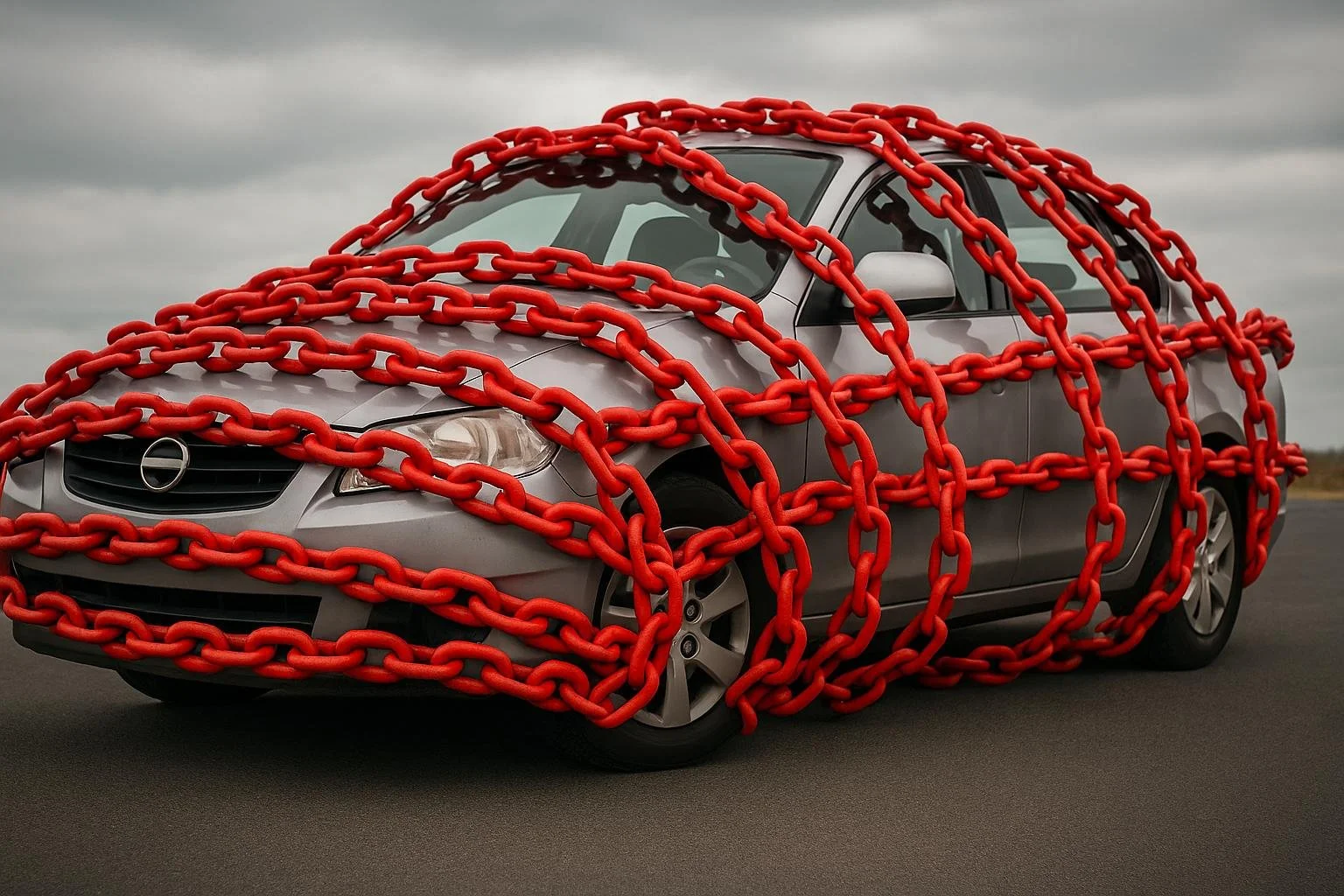
Grand theft auto?
No-one seriously doubts manmade climate change, and there is more of a scientific consensus on the range of likely effects than some of the more lurid headlines would suggest. The cost of the impacts is reasonably clear. To solve climate change, the technology options are also fairly clear and well costed. There is also consensus that we need to invest now in the solutions, even if there is some disagreement as to the total net cost over time. Why, then, is it all proving so hard to see through?
Why we are not solving climate change
No-one seriously doubts manmade climate change, and there is more of a scientific consensus on the range of likely effects than some of the more lurid headlines would suggest. The cost of the impacts is reasonably clear. To solve climate change, the technology options are also fairly clear and well costed. There is also consensus that we need to invest now in the solutions, even if there is some disagreement as to the total net cost over time.
Why, then, is it all proving so hard to see through?
We sit here around the societal dinner table shouting at each other, rather than genuinely discussing, listening and trying to understand each other. The carnivorous fossil fuel industry goads the vegan environmentalist, who moralises back, while trying to ignore the side-order of climate-denial fruit.
The simplistic answer to why this is proving a hard problem to solve is that there are powerful incumbent interests in fossil energy production and associated industries. That is not news, although it is an inescapable fact. We are stuck because we are trying to dislodge the vested interests in a way that is unlikely to work. We are attempting property appropriation, when we actually need to cut a deal. We are not on the brink of a political revolution because consumers remain quite happy with their cheap fossil fuels. Therefore, we need to address the preeminent position of the fossil fuel industry within our social contract, within agreed property rights and with the consent of all sides. After all, society needs industry for its security and quality of life, just as industry needs social acceptability.
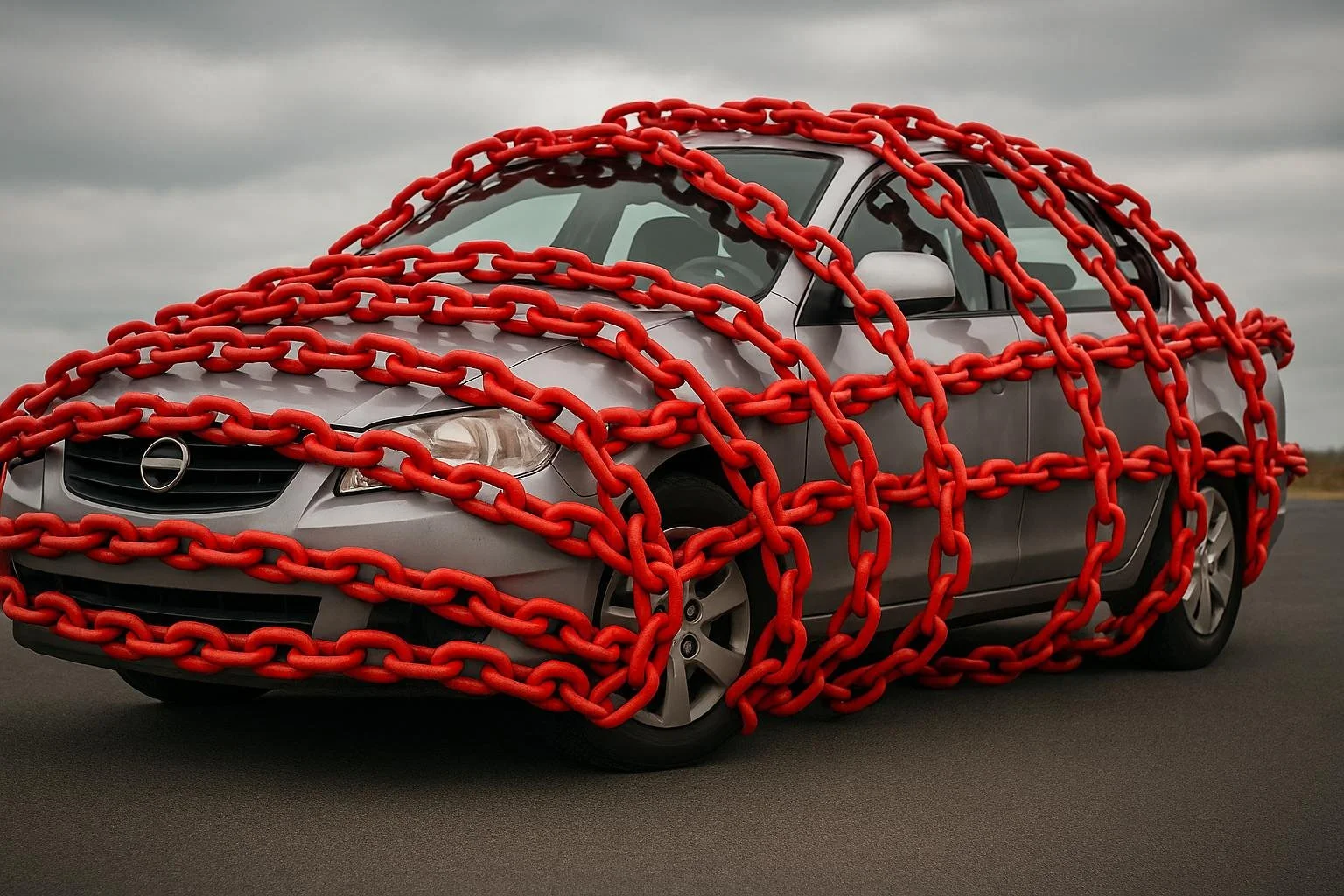
If you think the accusation of property appropriation is far-fetched, consider this. Cars are a perfectly legal product for consumers to buy and use around the world, but in Europe, in particular, there have been progressively tightening constraints on when, where and how they can be used. Rules start sensibly, for example with speed limits and highway codes – the safety benefits outweighing the constraint on personal liberty. Access controls or pricing may deliver urban air quality benefits that society values. Then we get to blanket access prohibitions, technology bans, SUV-shaming and so on. For producers, who have equally been trading cars quite legally, they find technologies in which they have internationally competitive intellectual property (for example, internal combustion engines) banned, or assets they have developed (for example, oil fields) become stranded. It is reported that the European Union (EU) may even ban car rental firms and large companies from buying anything but electric vehicles from 2030.
To any pragmatic reader, the best answer is clearly to strike a midpoint that balances societal costs and benefits. All sides could probably agree on this, although sub-arguments would undoubtedly run as to where exactly that midpoint was. In practice what is happening is that each side is competing to extremes: net ZERO, vision ZERO, and so on. This is such a mistake as bads (such as pollution) tend to exist as by-products of goods (mobility). The only way to zero bads is zero goods. So, it is no wonder that the two sides cannot come together and just shout at each other, in a binary struggle for survival.
By virtue of their strong incumbent position, the fossil fuel industry can afford to take a cautious position on any significant changes. To try and dislodge these entrenched interests, the following playbook is often employed by opposing interest groups:
1. Highlight something undesirable (climate change, road safety), and make it an “emergency”
2. Set a target of zero for the undesirable thing
3. Make it a moral/existential crusade
4. Pick the winning solution
5. Pay “independent” organisations to lobby for your choice
6. Recruit followers and evangelists to pursue a grassroots campaign
7. Impugn the motives of anyone who disagrees with you.
Of the many questionable tactics, it is possibly stage two that is the most damaging. If you require zero bads then you ask for a de facto ban. You are appropriating physical and intellectual property. The constraint on free behaviour is not in proportion with the damage caused by the bad. Some car manufacturers promulgate the idea of zero fatalities from driving. As preventing those last few accidents will be so disproportionately expensive, it effectively makes cars infinitely expensive. A de facto ban. For society, undoubtedly an undesirable outcome.

The EU is undertaking a more direct form of property appropriation, but it also sits within the broader theme of net zero. It legislated recently to force car owners to scrap their vehicles when significant repairs are needed. Classic cars – typically valuable – are excluded but roadworthy older cars that deliver solid motoring but that are worth little in the market are highly vulnerable. We wrote about this “end-of-life” vehicle regulation when originally promulgated, in Kohlendämmerung.
Recent legislative discussions have made the proposal less troubling on the surface of it, but more troubling in the detail. Rather than being forced to scrap a vehicle at the point of repair, it only applies if selling the car, at which point proof of roadworthiness would be needed. In addition, sales between private individuals are excluded from the requirement. For vehicles being sold by or to a dealer, or via an online platform, a roadworthiness certificate would be required. Where a vehicle was in need of repair, showed excessive wear or had leaking fluids, an independent expert would need to be commissioned to opine on whether the vehicle was at the end of its life. At the end of life, the owner would need to deliver the vehicle to a special facility and obtain a certificate of destruction. As roughly half of vehicles in Europe are transacted commercially, rather than privately, this can be seen as a material transfer of value – in terms of expert fees – away from the vehicle owner, although you could always circumvent this by selling your car privately. Nevertheless, there would be inevitable diminution in vehicle value.
So, on the surface, the proposal has been made more acceptable and truer to the objective of avoiding exporting dud cars and aiding resource circularity. However, worrying terms hide in the details. It leaves it to Member States of the EU how strictly to implement the criteria listed in Part B of Annex I [of “Proposal for a Regulation of the European Parliament and of the Council on circularity requirements for vehicle design and on management of end-of-life vehicles, amending Regulations (EU) 2018/858 and 2019/1020 and repealing Directives 2000/53/EC and 2005/64/EC.”] A country could take a pure and extreme interpretation of the “criteria to be assessed.” Worse, the European Commission can rewrite the criteria whenever it likes, without democratic safeguard:
In order to take into account technical and scientific progress, the power to adopt acts in accordance with Article 290 of the Treaty on the Functioning of the European Union should be delegated to the Commission in respect of amending Annex I determining the criteria on when a vehicle is end-of-life vehicle.
If the sales of battery electric vehicles lag the key 2035 targets, what is there to stop the end-of-life rules being tightened both to put consumers off buying the last generation of internal combustion engine vehicles at the same time as pushing more existing vehicles off the road?
It is quite striking how far down the road of property appropriation we have already been led, but it has of course been done sliver after slice. Even so, it is not sufficient to criticise unless a viable alternative to solving climate change can be offered – but there is. As we have shown, aiming for zero bad entails banning the good. It’s going too far. Just to eke out that last benefit comes at a huge cost. The optimal point is, much more plausibly, the point at which the benefit increase equals the cost of achieving. This can only be practically achieved by putting a price, by some mechanism, on the pollution. In this vein, credit should be given to the EU for progress made so far on putting a price on carbon, although there is a long way to go to make the system broad enough in application to be effective.

For cars, there is fortunately a solution at hand, as detailed in a recent book by Professor Felix Leach and Nick Molden called Critical Mass – the one thing you need to know about green cars. As most unabated pollutants correlate well with car weight, if vehicle taxation were changed to be based exclusively on this factor, a price of pollution would effectively be established. No bans. No property appropriated. Just the driver paying the right price for the pollution created. The driver will adapt behaviour according to the price, and generate tax revenues to fund wider societal goods. As an aside, it is paradoxical that many who oppose such pricing approaches are strong advocates for dynamic pricing of electricity for electric cars.
To work out where you on the appropriation-pricing spectrum, ask yourself what the correct question is. Is it How do we limit driving? or is it How do we limit climate change?. The latter is the right question. If you plump for the former, you are using climate change to pursue a separate, car-restricting idea. And if you are plumping for the former, you will be much more disposed towards property appropriation. This polarity appears in another incarnation very often: How do we push electric cars? in contrast to How do we decarbonise transport?. They are not the same thing, and if you put the first question as the primary one, you are more interested in promoting electric cars than you are cleaning up transport.
Which brings us to the deal to be done to solve the problem of vested fossil fuel interests. Much as we might object to the pollution their products lead to, these companies have created legitimate, legal assets. Moving forward, their products should pay the true price of the pollution created, which is relatively uncontroversial, and is practical as described above. But this will still reduce the value of their assets, and, to get them to accept this, a level of compensation will be required. Not full compensation, though, as supporting decarbonisation will give them renewed societal legitimacy. Just as when the National Health Service was founded in the UK, the doctors were paid handsomely to forego their endowed interests to build a new public healthcare system. Just as when European slave owners were compensated for the loss of their labour to build a more equal society. This may be distasteful, but if an endowment is legally obtained, appropriating it will not work. This is also distinct from vexed discussion of compensation for past injustices, whether that is climate reparations, through first nation peoples, to the 245 cattle given to the Maasai for culturally sensitive artefacts in Oxford. Rather, we are talking about a conscious deal to allow progress.

In summary, then, we are not achieving our climate change goals because we have postulated zero as the desirable goal, have stirred up moral panic and are heading down the road of property appropriation. This will not work, not least because so many people have their pensions invested in industrial incumbents. There is a useful contrast with how so much progress has been made improving urban air pollution. Zero pollution has never been suggested, solutions have been carefully calibrated to balance societal benefit against cost, incumbent industry has been part of the solution, morals have largely been kept out of it, and air quality is much improved on just ten years ago. We need to apply this urgently to climate change. If it means net-minus-80% carbon dioxde and everyone plays their part in the solution, we will be a lot better off than now.
Yet it is so tempting for each of us to the decide the “right” solution and – due to the vital important of the topic – force this answer on others as a moral rather than objective imperative. Jean-Jacques Rousseau, the French philosopher writing in 1762, believed that people, when acting rationally and considering the common good, would naturally choose to obey laws that promote the overall well-being of society. Forcing someone to adhere to such laws is, therefore, simply helping them realise their true, rational will. In the famous phrase, they should be “forced to be free.” This is very much the theme and philosophy of European governments right now. It is not so different from how Stalin and Mao sought “moral improvement” of their people. This is a slope, and a dangerous one if you choose to go down it.
So, we have a choice between an unpalatable deal and a dangerous challenge to liberty. Put another way: the combustion car is under threat of being outlawed in order to dislodge fossil fuel interests. The economic, geopolitical and social damage from this may be much greater than a pragmatic deal, and may just hand the economic rent enjoyed by fossil industries straight to a different set of equally uncontrollable industrial and political interests.
Chose thoughfully, and be careful what you wish for.

The most complex suicide note in history?
The 1983 UK General Election saw the Labour Party manifesto dubbed the longest suicide note in history. The current policy for decarbonising transport in the UK and Europe may be the most complex one. For the policy to work, it is necessary simultaneously to switch the grid to green sources and fundamentally change the relationship between consumers and their cars, in order to balance that new grid. Both are a major challenge, and if either fails, the whole policy fails. If it does go off plan, we may well end up with undesirable cars being powered by a dirty grid, and an unresolved climate change problem. Are industry and government locked in a suicide pact?
Vehicle emissions and grid decarbonisation
The 1983 UK General Election saw the Labour Party manifesto dubbed the longest suicide note in history. The current policy for decarbonising transport in the UK and Europe may be the most complex one. For the policy to work, it is necessary simultaneously to switch the grid to green sources and fundamentally change the relationship between consumers and their cars, in order to balance that new grid. Both are a major challenge, and if either fails, the whole policy fails. If it does go off plan, we may well end up with undesirable cars being powered by a dirty grid, and an unresolved climate change problem. Are industry and government locked in a suicide pact?
We are not used to living in age of electricity rationing, but this is a real prospect as we try to clean our grid with a big switch to renewable energy sources. The UK is already flirting with using its contingencies, even on the existing less intermittent grid, with fewer electric cars and data centres – although at no point so far has the grid come close to shutting down. On 3 December 2024, headroom was nearly eliminated such that a call for rapid reaction contingencies was initiated. On 8 January 2025, power had to be called from Norway to preserve headroom. These are just the first inklings of a problem, and one that applies to many European countries, not just the UK.
The underlying challenge is that we are trying to expand grid capacity to meet rising demand, while at the same time decarbonising it. The chosen primary route to decarbonisation is renewables – specifically wind and solar. These sources have two limitations. First, as they are intermittent, they need accompanying storage to save the surplus peak energy and release it during dark or windless hours. Second, they have relatively low “capacity factors” – the ratio of actual electricity generated in practice compared to the theoretical maximum. Therefore, it is necessary to “oversize” the installed capacity to generate the same electricity as traditional energy sources. Together, to make this approach work, it is necessary to install significant amounts of wind, solar and storage.
The UK’s National Energy System Operator (NESO), which runs the electricity grid, has published a number of scenarios for electricity demand and supply through to 2050, in the context of aiming for net zero . As a measure of the tightness of supply in 2050, even though the installed capacity of wind is forecast to increase by a factor of five and solar by a factor of six compared to 2023, this is not enough to switch off traditional fossil fuel production. Nuclear is also forecast to increase almost four-fold (which would be great for emissions reduction, but would need enormous commitment to achieve), and interconnections to other countries almost three-fold. Still, not enough.

To fulfil the projected 146% increase in annual electricity demand, the vehicle fleet is expected to contribute in two new ways: “demand management” and “vehicle-to-grid storage.” Demand management and its “smart pricing” seek to shift demand to times when there is surplus renewable power. Vehicle-to-grid (V2G) or bi-directional charging allows the grid to suck energy out of your car when the grid needs it. In other words, you will be constrained in when you can afford to charge up, and you might find a lack of charge in your car for your journey. If, for example, only 20% of cars are plugged in at the crucial time, those connected could lose 3 kWh each hour based on NESO projections. Of forecast peak capacity in 2050 of 119 GW, smart pricing reduces demand by 12 GW and V2G could provide 20 GW of power. Therefore, the vehicle fleet is expected to contribute 27% of peak demand to make the numbers add up. This comes at the cost of constraining personal freedom and the inherent attraction of the motor car. On most days, it will be fine, but consider those dark, still, winter Dunkelflaunten when your car will be an expensive brick. This will reduce the utility of a car, and so the willingness of consumers to pay. Fewer cars will be sold, at lower prices, with damage to the industry and personal welfare.
Some, however, would say that such an outcome would be good if it reduces demand for private motoring and leads to a shift to public transport. The bigger problem that remains is that, even with demand management and V2G storage, grid capacity might still fall well short of growing demand. Of the 116 GW of installed capacity in 2023, 36% of this is to be shut down to meet net zero – primary gas and biomass sources. If we take NESO’s “Electric Engagement” scenario where almost the whole fleet is electrified by 2050, 386 GW of installed capacity is needed. In other words, the “clean” part of the grid in 2023 would need to be increased more than five-fold by 2050. 344 GW of new capacity would need be installed that did not exist in 2023. Just 19% of the forecast grid in 2050 was already in place in 2023. Although the UK in particular has made good progress in decarbonising its grid so far, future infrastructure requirements for 2050 are large and risky. If, for example, we fall 25% short of the target for new build-out, it would leave a supply gap of 68 GW in 2050.
At the same time as we face the risk of falling short on supply, demand could rise more quickly than expected. This is not just speculation, as the question is being forced on us by a seismic change since the vehicle electrification policy was enacted: Artificial Intelligence (AI) is taking off in a way that exceeds the expectations of most. As a result, the well-understood increase in electricity demand needed to support a BEV fleet (around 28 GW in 2050 with unmanaged demand) has now been joined by rapidly growing – and somewhat unpredictable – demand from AI. Just one example, as reported in The Guardian recently, is an application submitted for a new data centre in the UK that would “…cause more greenhouse gas emissions than five international airports.” It is forecast to consume 3.7 bn kWh [3.7 TWh] of energy per year when running flat-out, releasing 857,254 tonnes of carbon dioxide (CO2), based on the current average grid mix.
The same NESO scenario as above assumes electricity demand from data centres to be 54 TWh in 2050. One of the more bullish forecasts is from the BloombergNEF, at 3,700 TWh globally. As the UK is approximately 3% of global GDP, that would imply 111 TWh in the UK. This would reflect 39% of 2023 demand and 16% of forecast demand in 2050. If correct, this would create 57 TWh, or almost 7 GW running constantly, of extra demand on top of the Electric Engagement scenario forecast. For comparison, Wood Mackenzie, a consultancy, is already tracking 134 GW of new data centres in the US, which would be 17 GW if pro-rated to the size of the UK. The BloombergNEF projection may, therefore, turn out to be cautious.
So, we can see that persuading customers to buy BEVs is only part of the challenge. Even if we electrify everything, our demand forecasts must be accurate, supply capacity build must happen, and car owners must be willing to engage with behavioural change. If these conditions are not met, we may not have the capacity necessary to meet demand. On plausible scenarios we could be at least 75 GW short, or 19% of the forecast installed capacity in 2050. In this case, what would happen?
The first instinct would be to “manage” demand further. The 75 GW shortfall assumes the maximum use of vehicle smart charging, so that is not an option. Authorities could move to a harder rationing of electricity for motor vehicles, which would be possible by restricting use of public chargers and more aggressive use of V2G storage capacity. It is likely that authorities would prefer to limit motor vehicle use than home heating or electricity, or industrial activities. With remote working now commonplace, driving would be the first activity to be cut, for all but essential purposes. The alternative would be to keep fossil fuel power generation going for longer, which would be politically highly embarrassing.
Despite the embarrassment, it is possible that governments may keep fossil power stations so people could keep driving. In this case, it would be fair to see vehicles as powered by marginal, “dirty” electricity. At present, the marginal CO2 per kilowatt-hour (kWh) of electricity is 350 in the UK, compared to an average carbon intensity of 124 g/kWh. So, almost three times dirtier at the margin. The European Union (EU) marginal rate is around 550 g/kWh, compared to an average of 244 g/kWh. In Poland, the values rise to 880 and 662 g/kWh respectively. This illustrates that the cleaner the average grid becomes, the greater the proportionate uplift at the margin is likely to be. It is worth noting that France’s current grid carbon intensity is 24 g/kWh on average but 510 g/kWh at the margin; even 18 nuclear power plants with 57 reactors is not always enough.
In future, the carbon intensity of the grid at the margin is likely to remain similar to today, at 350 g/kWh. Applying Emissions Analytics’ own real-world testing and decarbonisation modelling, we see the following. The second column covers all the up- and down-stream carbon in making and ultimately disposing of a vehicle, and liquid fuel production. The second column covers the tailpipe CO2 and the same emissions from electricity generation. Each powertrain/grid combination can then be compared over the life of a car compared to the gasoline ICE baseline.

The “average grid” scenario reflects the situation today, where there is sufficient grid capacity to power the new BEVs, but the sources of energy are mixed, including significant fossil fuel gas. The “marginal grid” scenario is similar to NESO’s Electric Engagement scenario, but where capacity growth falls materially short, vehicle-to-grid does not work, or demand growth is even greater than expected. In other words, the new BEVs are being powered entirely by the marginal, fossil fuel energy.
On the current grid mix, BEVs already reduce lifecycle CO2 by 49%, whereas in the EU it is only 32%. In the worst case scenario, having invested so much in electrifying the fleet, the UK might find only a 16% reduction in CO2 emissions. The EU could be in any even worse position, with CO2 rising by 13%, although this is unlikely to happen as the current marginal sources derived from coal would likely have been replaced by gas by 2050.
Which leaves an interesting dilemma. If we push ahead with a best case scenario that gives 85% CO2 reduction thanks to a clean grid, but we fail to make the grid work or demand soars unexpectedly, we could easily end up in a scenario that would be worse than the low risk option of converting the fleet first to plugless full hybrids, which would allow us to bank 29% CO2 reduction quickly and for low cost. Put another way: if we want to convert the fleet to all-electric by 2050, we must be certain that the grid can accommodate such a fleet cleanly.
The optimal strategy, we would suggest, is to push for hybridisation of the fleet simultaneously with grid decarbonisation, and only push on to fully electrified vehicles when the clean grid capacity is secure. This would be a more robust mix of risk and outcome. It would not meet net zero by 2050, but it would reduce delivery risk, and reduce CO2 more quickly in the early years by avoiding the high manufacturing emissions caused by largescale battery production. As readers of many previous newsletters will recall, Emissions Analytics believes that the data points to hybrids – especially full hybrids, with a decent battery size but no plug – being the best way to decarbonise transport for the next decade. After that, fostering technology-neutral competition between rival technologies would be optimal. During the coming decade, investment should be sharply focused on decarbonising the electricity grid, rather than subsidising well-off people to buy expensive (and heavy) pure electric cars.

If we mess this up, we might yet end up living the joke of having to charge up our electric vehicles with a diesel generator. (The AI-generated image above probably cost us 5 grams of CO2 emissions…) Having just recovered from a recent visit to an unnamed low carbon vehicle show that involved entering through unmistakable clouds of diesel fumes from the backup generators running the stands, this is clearly undesirable. At Emissions Analytics’ most recent conference, called Off-Highway Powertrain & Fuels and which we hosted in Chicago, a session stood about these static power sources. Demand is soaring for utility-scale, diesel-fuelled generators, most notably to power data centres to fulfil the already-voracious appetite AI systems have for energy.
Has the suicide note already been signed?
Postscript
We have taken a largely UK and European perspective in this newsletter, but similar arguments are playing out in the USA. For an insightful read from that perspective, we would recommend the article U.S. Energy Policy Undercuts EVs to Make Way for AI by Tammy Klein published recently in Transport Energy Strategies.

Emissions Analytics supporting citizen science in air and water
Inspired by two recent projects, Emissions Analytics is pleased to announce its support for the launch of a new service to empower citizens in testing their air and water: WHATSINMY?.
Inspired by two recent projects, Emissions Analytics is pleased to announce its support for the launch of a new service to empower citizens in testing their air and water: WHATSINMY?.

This will put the power of advanced laboratory techniques into the hands of any citizen interested in, or concerned about, their quality of their water or air.
The aquatic inspiration for this was a project led by Earthwatch Europe that sent people out around the south east of England to take samples of river water. Emissions Analytics’ contribution was in identifying the hallmark chemicals of tyre wear emissions. Chemicals from styrene to 1,4-Benzenediol, 2,6-bis(1,1-dimethylethyl) were identified in road run-off flowing into rivers, and we were able to identify that they are likely to have originated from tyres. This was made possible by Emissions Analytics’ database of 500 chemically reverse-engineered tyres currently on the market.
The work has already been expanded as part of Earthwatch’s Great UK WaterBlitz programme, and you can see the very latest results here. The rivers of the Evenlode catchment had 995 unique organic chemicals, 592 of which appear in Emissions Analytics’ tyre chemicals database. Of those, 41 are mentioned in academic literature as coming from tyres, but a further 11 were in all of the river samples and we are confident are in tyres, but have not yet been studied in the literature.
On the other side of the Atlantic, late 2024 also saw the launch of major new project testing air quality samples, this time in Southern California for the South Coast Air Quality Management District. Emissions Analytics has been commissioned to run a multi-year project testing hundreds of air samples. Again, the main aim is to identify chemicals originating from tyres, again harnessing our tyre reference database.
Both these pieces of work involved the sophisticated laboratory equipment run by Emissions Analytics called two-dimensional gas chromatography and time-of-flight mass spectrometry. Sounds a bit baffling, but this is a specialist piece of kit that allows you to take a sample and separate out all the organic compounds in the mixture, identify them and quantify the amount one by one. Of the hundreds compounds we find in a sample, each can have radically different effects, from being harmless to highly toxic.
This all led to the inspiration for WHATSINMY?. Why not put this power into the hands of citizens, at a time when there is great concern about water and air quality? There is a loss of trust in governments and regulators to protect us. Dieselgate collapsed confident in vehicle and air pollution regulation. Rivers regulated tainted with effluent has led us to doubt the ability of regulators to contain the behaviour of industry.
So, Emissions Analytics is now committing to providing this sophisticated laboratory testing equipment to anyone who is interested. We will be supporting citizen science campaigns to collect water and air samples. To complement that, WHATSINMY? offers the ability to buy personal test kits directly on its website. This can be used in your home or office to diagnose private contaminations concerns, as well as to detect pollutants in public spaces: unleash the power of expert testing science in your world.
Emissions Analytics has always been committed to understanding and reducing real-world emissions, and is excited to support the democratisation of its work to solve the pressing pollutant issues of 2025 and beyond.

Kohlendämmerung?
Twilight of the carbon economy
Dusk approaches, but the denouement is unclear. Will the flames of 2026 engulf fossil fuels, the internal combustion engine, electric vehicles or net zero? Are we about to see the twilight of the carbon economy? Or perhaps twilight of our environmental idols?
Twilight of the carbon economy
Dusk approaches, but the denouement is unclear. Will the flames of 2026 engulf fossil fuels, the internal combustion engine, electric vehicles or net zero? Are we about to see the twilight of the carbon economy? Or perhaps twilight of our environmental idols?
The clever construction of zero emission vehicle mandates and the exclusion of manufacturing emissions from the definition, has created a scenario where European authorities apparently must triumph in their push for electrification of new vehicles, whether it actually reduces carbon dioxide emissions sufficiently. The battle has now moved to second-hand cars. To meet net zero by 2050, it is a priority to get all internal combustion engine (ICE) vehicles off the road, just as those drivers for whom battery electric vehicles (BEVs) are not suitable hold onto their ICE cars as long as they can. Although car drivers are repeatedly assured by governments and their funded spokesmen that no-one will appropriate their existing ICE vehicles, current drafting of EU legislation suggests otherwise. While it remains controversial whether they are coming after your ICE car, let us examine the question of whether such a policy could be justified by any emissions reduction it would bring about.

Before going further, this topic has previously generated controversy, when it was wrongly reported that new legislation proposed a ban on repairing cars over 15 years old. This was rightly debunked by AFP. Even though no such time limit was proposed, there is genuinely good motivation in stopping unroadworthy vehicles in Europe being exported to countries with lesser standards. However, is there further nuance in the proposed regulation, and how does it square with emissions reduction?
To incentivise low carbon dioxide emission vehicles into the market, Europe – with some minor differences between the European Union and the United Kingdom – use three main tools. First, and most high profile, is the ‘zero emission vehicle’ (ZEV) mandate, which requires a certain proportion of each manufacturer’s new car sales in a year effectively to be BEVs. Second, there are the fleet average carbon dioxide targets, also applied to each manufacturer, and which are in practice similar to the Corporate Average Fuel Economy (CAFE) targets in the US. Weighted by sales, their emissions each year must be below a certain threshold set by the EU. The third and least visible tool, is the very definition of BEVs, along with hydrogen fuel cell vehicles, as emitting zero carbon dioxide, which creates a large hidden bias in their favour. This is clearly untrue during their usage – as the electricity to power them in almost all cases emits some carbon – and during their manufacture. On average, a BEVs emits around six tonnes more carbon dioxide when it is made compared to an equivalent ICE vehicle, but then emits around 1.5 tonnes less each year during its use. As this zero emission definition feeds into the requirements of the ZEV mandates and CAFE targets, all three can be seen to work in harmony to create a strong incentive for manufacturers to sell BEVs, and an incentive that is stronger than is warranted by the emissions reduction potential.
Despite these incentives, only about one in five new car buyers in Europe are opting for BEVs, which is a flattering proportion as the size of the market remains subdued, in part due to some people switching to buying used having been priced out of the new market as manufacturers have rationalised their traditional vehicle ranges. Nevertheless, authorities will be able to force through their BEV targets because manufacturers can simply ration the availability of ICE vehicles. As CAFE targets and ZEV mandates are based on market share by technology, if manufacturers are struggling to sell BEVs, they can always restrict ICE vehicle numbers. To match supply to demand, this would be done by increasing ICE vehicle prices and consequently their per unit profitability. Manufacturers would let governments and authorities take the heat for factory closures and lost jobs as a result of lower vehicle sales volumes. The alternative scenario is that governments ply the industry with BEV subsidies to boost their sales volumes, thereby maintaining ICE vehicle sales volumes too. This is less likely, however, as most governments are fiscally constrained, and such subsidies would primarily act as significant financial transfers to industry.
The lack of desirability of BEVs is most vividly seen in their current depreciation rates. In the first three years of life, a typical BEV in Europe loses around half of its value. In cash terms the reality is starker, as a typical BEV is more expensive than the equivalent ICE vehicle, so the cash depreciation can be over 50% more for the BEV. So long as this demand remains weak, the effective price of new BEVs will remain higher, thereby limited the quantity sold. At the same time, the second-hand value of ICEs vehicles is strong – up 21% in Europe since the start of 2020, according to EUROSTAT – through some combination of consumers switching from new to used vehicles and a general rising demand for car transportation. As ZEV mandates get tougher, this trend is only likely to strengthen. Existing owners of used ICE vehicles will be incentivised to hold and maintain them for longer than before, while those who would previously have bought new will enter the market for used ICE vehicles. For a long time, demand for BEVs may remain weaker than governments wish due to the presence of a preferable alternative.
With the rules already in place, as described above, authorities will be able to force all new vehicles to be BEVs, but at a cost to government in terms of higher unemployment, lost tax revenue and electric vehicle subsidy payments. This total political and fiscal cost could be high. How could this be avoided? How could governments stop demand leaching away from BEVs to ICE vehicles? The only way is to eviscerate the second-hand market for ICE vehicles.

It is highly unlikely that governments would directly confiscate vehicles, or even force them off the road at a certain fixed age, such as 15 years. Property rights are still generally well respected in Europe. It is also relatively unlikely that vehicles would be priced off the road through punitive taxation, as the owners of the oldest vehicles would often be people on low incomes and requiring their vehicle to get to work. More subtly, the EU has in fact already promulgated a regulation that may effectively achieve this goal, included within ‘Green Deal’ legislation in July 2023: “REGULATION OF THE EUROPEAN PARLIAMENT AND OF THE COUNCIL on circularity requirements for vehicle design and on management of end-of-life vehicles, amending Regulations (EU) 2018/858 and 2019/1020 and repealing Directives 2000/53/EC and 2005/64/EC.” Take a look at Annex I, Part A, clause 2.
The vehicle is economically irreparable if its market value is lower than the cost of the necessary repairs needed to restore it in the Union to a technical condition that would be sufficient to obtain a roadworthiness certificate in the Member State where the vehicle was registered before repair.
The owner must deliver such an ‘end of life’ vehicle to an authorised destruction facility if told that it meets these criteria. The owner is not permitted to repair or sell the vehicle. Members states will be left to designate the authorised facilities, which will then issue the edict that a vehicle is beyond economic repair, although it would seem reasonable to assume that it would be garages or safety testing centres such as the German TÜVs or performing the MOT, if applied in the UK. There is a carve-out for certain classic vehicles over 30 years old.
In addition, the European Commission website carries an explanation of the proposed regulation, which includes:
If a car needs a repair, any part may be changed as long as the vehicle is fit to pass the roadworthiness inspections and remains authorised to operate on the EU roads. [our emphasis]
What is apparently a clarification leaves open the question of what “…remains authorised to operate on the EU roads…” means. By the construction of the sentence, it must mean more than just being roadworthy. As drafted, therefore, this could mean exactly that any repairs must cost less than the residual value of the vehicle for the car still to be authorised to be used.
We would like to hear from anyone within the EU’s legislative process as to whether, and in what way, the text is going to be changed. As poorly drafted legislation has a nasty habit of finding its way onto the statute book through omitting to correct it, what is written on the page is more important that words of reassurance.
If the correct interpretation is that vehicles will forcibly be scrapped if repairs are too expensive, let us examine what that would mean in practice and the effect on emissions. We have researched twelve popular vehicles in Europe and looked at the age at which they could be written off under the definition above. Assume the market value is the trade rather than retail price. We have then considered two scenarios: a mild-to-moderate repair of a full set of brake pads and discs, and a moderate-to-serious repair requiring the replacement of the gearbox. The costs of these repairs include labour and any taxes, and are based on costs in the UK. The table below summarises the youngest model year of each vehicle where the value of the vehicle is less than the cost of the repair.

The aim of this table is not primarily to compare vehicles, but to derive a representative average for the market. For example, the Citroen Picasso would be deemed scrap if it needed a new gearbox at just seven years old. For a new set of brakes, it would be written off at 15 years old. The Ford Fiesta would survive much longer, due to its slower depreciation rate.
This analysis suggests that the proposed regulation would be able to force almost all vehicles off the road above the age of 18.5 years, as a mild-to-moderate fault is highly likely by that age. It would also force the scrappage of a material proportion of vehicles above nine years old, for those that develop more serious problems. As there are approximately 13.2 million cars reaching their tenth birthday each year in Europe according to the European Automobile Manufacturers’ Association (ACEA), that creates a significant amount of additional vehicle demand. Some of that will further augment demand for the remaining used ICE vehicles, but a growing proportion will be forced either to buy BEVs or forego having a private motor car at all.
While this is not the place to discuss the political or social aspects of the policy, what does it mean for emissions? There are three main aspects. The first, and the flawed premise of the whole policy, is that BEVs are zero emission and, therefore, ‘perfect.’ As we have shown in previous newsletters, on a lifecycle basis, BEVs reduce carbon dioxide emissions by about 50%, compared to full hybrids offering a 30% reduction – so, 20% points more. Still much better, but this is a gap that may not justify such an extreme policy.
The second aspect is around whether it is better to keep your old car as long as possible or upgrade to the latest technology. The general answer is that, from a carbon dioxide perspective, it is almost always better to keep an old car as long as possible, because building a new BEV car will incur an extra six tonnes of emissions upfront in making it. Even where the new car has a substantial efficiency advantage, the payback time of these manufacturing emissions can be long. The main caveat to this is that if the other tailpipe emissions – air pollutants such as nitrogen oxides and particulates – are high, it can be justified to upgrade on the basis of overall damage. Broadly, gasoline vehicles after 2005 do not contribute significantly to air pollution; for diesels, it is more complicated, but anything after 2018 should be fine, anything before 2009 is bad, and many in the middle are questionable – not least due to the emissions manipulation crisis that became Dieselgate.
The final aspect relates to the correlation between vehicle age and miles driven. The older the car, the less it tends to be driven on average. For example, from the UK’s periodic technical inspection MOT data, a car under three years old in Europe is typically driven 8,086 miles (13,018 km) per year, but a car between nine and twelve years old only goes 5,241 miles (8,438 km) annually. As most of the emissions from an ICE vehicle arise from its usage, the distance driven is highly relevant to the optimal emissions decision. To take an extreme example, if an ultra-high-emitting, modern classic ICE vehicle were driven only 500 miles year, a forced upgrade to a BEV would cause the emission of six tonnes of carbon dioxide in the latter’s manufacture, for almost no saving in in-use emissions. We discussed this is more detail in a previous newsletter, which showed that if you drive fewer than 3,000 miles (4,830 km) per year it is unlikely you would ever pay back the manufacturing emissions from switching to a BEV. The EU policy proposed above is targeting exactly those older vehicles. Consequently, this policy, if enacted, would likely lead to substantial increases in lifecycle carbon emissions, by driving old, lightly-used ICE vehicles off the road. From an emissions point of view, it would be better to let them run until they die naturally.

Beyond the need artificially to increase demand for BEVs by forcing ICE vehicles off the road, there are other potential reasons for this policy. As Europe continues to equivocate on expanding its nuclear electricity generation, the grid will be decarbonised mainly through additional wind and solar capacity. This creates a significant intermittency problem, which must be balanced by a large storage mechanism. This can be done, but it is expensive. Better, would be to harness a large, pre-existing fleet of battery electric vehicles and mandate bi-directional charging so energy could be moved in and out of that fleet as the grid needed for balance. A second motivation may be to make sense of the ambitious aims for autonomous driving, often motivated by the desire to improve road safety. The prospect of true automation – level 5 – on the open road is far away, and may prove to be impossible while there is a vehicle fleet of different ages and technologies, and while only some are autonomous and connected. By forcing these older vehicles off the road, it could lead more quickly to algorithm- rather than human-controlled driving.
In summary, we question the headlong rush to BEVs on the grounds that the cost per unit reduction of carbon dioxide emissions is too high and there are more pragmatic and effective ways, such as with full hybrids. However, the rules of the game as set in the EU and UK mean that authorities must be the winners, unless the fundamental mischaracterisation of BEVs is overturned. Otherwise, BEVs will win, it is just a question of at what price. That cost to taxpayers and industry will be minimised if older ICE vehicles can be forced off the market as soon as possible. In doing so, the cost will be surreptitiously shifted to consumers, and especially owners of older vehicles and lighter users. And, to aggravate the situation, it may well lead to higher carbon emissions. But if this added cost forces many people out of cars completely, that will certainly meet the objectives of a prominent minority of policy makers. It appears that we are the point where the EU and UK want to force through their BEVs mandates at any cost.
But Valhalla is not an end, but a beginning.

Why you should be interested in tyres
A surprisingly compelling subject
Dinner table, or social media, conversation may centre on arguments over which football team deserves to win the league, or whether the Mustang or Camaro is better, but the common feature of such polemics is that they represent simple and interesting questions. The topic of tyres, however, and if you dare raise it, may stun your companions into silence. Tyres are not simple and interesting. They are complex and boring – at least on the outside.
A surprisingly compelling subject
Dinner table, or social media, conversation may centre on arguments over which football team deserves to win the league, or whether the Mustang or Camaro is better, but the common feature of such polemics is that they represent simple and interesting questions. The topic of tyres, however, and if you dare raise it, may stun your companions into silence. Tyres are not simple and interesting. They are complex and boring – at least on the outside. Delve a little deeper, and they become items of sophistication and almost wonder. Mysterious, near-anonymous products that power many parts of the modern economy and society. Omnipresent, but no ingredients label. Emissions Analytics thinks you should be interested in tyres, and you should talk about them at dinner tonight.

But if you can’t face that quite yet, you should first of all attend our newly launched conferences in Europe and US on tyre emissions and sustainability. Many excellent events already exist in this sector, but the common factor is that they look at tyres from the inside out: from the industry perspective in how to make better tyres. Environmental concerns are now forcing us to look from the outside in: how can we mitigate the effects of tyres from their manufacture and usage. Regulation is coming – and has already arrived in California.
The tyre industry is highly sophisticated yet somewhat secretive. Challenging problems are solved quietly without disclosing the nature of the solution. European tyres have achieved combinations of grip, noise and rolling resistance to meet the requirements and demands and of the market, while US tyres have remained simpler in formulation as durability has remained the over-riding preference. Unlike vehicle manufacturers, which exist in spotlight of regulation and consumer interest, tyre manufacturers just get on with it. Witness the invention of synthetic rubber in the Second World War, which has defined the industry ever since.
The big challenges today are often environmental. How to makes tyres with more sustainable materials – however they be defined? How to reduce microplastic and volatile organic emissions in use? This is not a problem created by heavy battery electric vehicles, but the near elimination of tailpipe pollutant emissions from modern vehicles has brought it into focus – many vehicles now emit 90% below emissions standards for nitrogen oxides, carbon monoxide, and particles. Although distance-specific tyre mass emissions may be in long-term, like-for-like decline, this is increasingly offset by more vehicles on the road, more miles driven, heavier vehicles and more torque. Our testing suggests 26% tyre wear emissions from pure battery vehicles compared to equivalent full hybrids.
To counter this trend, new tyre formulations are being quietly brought to market to handle this heavier and ever more demanding vehicles. The immediate concern that ‘eco’ tyres could deliver such performance at the price of being more environmentally toxic appears to not to be simplistically true from Emissions Analytics’ latest testing. On our toxicity potential metric, these eco tyres may in fact be a quarter or more less toxic than standard tyres. This could to a great extent neutralise the increased mass wear rates, but with two caveats, First, it requires detailed analytical testing to verify this. Second, these eco tyres come at a financial price to the consumer.
While the focus in such matters of regulation tend to start with new products, it may be regulations about replacement tyres that will have a greater bearing on the combined environmental of tyres. A brand-new battery vehicle equipped with the latest, most sophisticated eco tyres limit emissions, only for that good work to be undone when they are ultimately replaced by cheaper, less sophisticated alternatives. A private saving for the vehicle owner may create a public cost in pollution.

Seeking to address these questions, our first event will take place in Prague on 28-29 February 2024, and further details can be found here. Two months later, on 24-25 April, we will pick up the discussion in Southern California, details here. We encourage you all to apply to attend and submit abstracts for presentations.
Alongside this, we will be publishing regular, detailed results of Emissions Analytics’ tyre wear and chemical composition testing, along with our monthly newsletter, via our Emissions Intelligence subscription – please contact us to find out more.
Together, these new initiatives from Emissions Analytics are engaging with society and industry to bring about an understanding and appreciation of the sheer cleverness and importance of tyres, and how vital the right choices are for the environment. Consumers want to do the right thing, but the choice of tyres for many is currently too boring and complex. Let’s change this. Let's start the conversation.

FUD off
Fear, uncertainty and doubt in an age of decarbonisation
Fear. Uncertainty. Doubt. This rhetorical triptych is increasingly used as an insult to describe interventions from anyone who deviates from the current environmental orthodoxy. When French philosopher René Descartes sat down in the seventeenth century Netherlands to write his Discourse on Method, he also faced FUD.
Fear, uncertainty and doubt in an age of decarbonisation
Fear. Uncertainty. Doubt. This rhetorical triptych is increasingly used as an insult to describe interventions from anyone who deviates from the current environmental orthodoxy. When French philosopher René Descartes sat down in the seventeenth century Netherlands to write his Discourse on Method, he also faced FUD. Fear that his beliefs about the world, both factual and ethical, were built on flimsy foundations. This led to great uncertainty in a time of religious adherence. The solution was doubt: to chip away at any beliefs that were not based on good reason, applying persistent and critical doubt. In doing so, he believed that he had rebuilt knowledge and faith but with firm foundations, based on his cogito ergo sum - I think therefore I am.

Rather than being used as an insult, FUD is what should be applied with urgency to the current debate about climate change and transport decarbonisation. Now faced with a growing body of information and concerns about a strategy of pure battery electrification being the optimal approach, we should stand back and re-evaluable. Chip away at the idols.
Descartes was a supreme rationalist, and reason is what we need. We debate tailpipe regulation, clean air zones and air quality largely with facts and figures, and logical arguments. Move onto climate change – a closely related issue – and calm, rational debate gets suspended in favour of polemics. This changes the nature of the debate in a way that destroys the debate. For many, doubt cannot be tolerated. Fear should used to keep order.
The “climate emergency”, as fearsomely styled, is serious. It is scientifically highly certain that climate change will have bad effects on humanity, possibly very bad. However, none of the standard models say that life and our planet will end, yet the challenge is being presented as an emergency, of existential significance. Of ontological significance.
But climate change is something to fear. There are many uncertainties as to what exactly will happen. Applying critical doubt is essential to working out the optimal response. So, let’s embrace FUD. Better than blind faith. There will always be strongly opposing views – centrist, European technocracy is an illusion – so rather than demonising the traditional energy sector or the environmental NGOs, let’s hammer it out as humans in the human realm.

One of the other more likely health risks in the garage experiment was from asphyxiation due to high CO2 levels, arising from the engine combustion. The parallel in the vehicle cabin is elevated CO2 due to respiration of the occupants. Human harm tends to occur when concentrations exceed 15,000 ppm, although cognitive impairment can occur well below that, which might lead to reduced reaction times and increased accident risk. While the garage concentration reached 8,509 ppm after half an hour, concentrations inside the vehicle when tested on the road reached just 1,564 ppm after the same time, even with the ventilation system on the ‘recirculation’ mode. On fresh air mode, concentrations rose by an average of just 13% above the 417 ppm background. As with PN concentrations, there were big variations between vehicle models as to how fresh the air was kept on recirculation: CO2 increased by 103% in the best case and 275% in the worst.
Overall, therefore, the particle exposure inside the cabin is a bigger risk than when locked in a garage with an idling ICE vehicle of the current generation. While CO2 concentrations in the garage were higher than in the cabin, driving a vehicle is operating a complex, mobile machine and, therefore, even a modestly elevated level of CO2 could compromise safety. It should be noted that some relevant pollutants have not been studied here. Particle mass was not chosen due to the relatively low levels being emitted from modern tailpipes and entering the cabin even with low-quality filters and ventilation systems. Nitrogen dioxide (NO2) emissions are extremely low from gasoline vehicles – the dominant powertrain now – and concentrations in the cabin are also very low. A major area of focus in our future work is the role of volatile organic compounds (VOCs). These tend to be low from tailpipes, although some species can be highly toxic even in low concentrations. Inside the cabin, these VOCs arise mainly from interior materials, especially in hot conditions. Some mix of compounds, of varying potential toxicity, evaporate from seats, carpets, dashboards and other plastics. In short, the greatest risks in the cabin are PN, CO2 and VOCs, while in the garage it is PN, CO2 plus carbon monoxide (CO) for gasoline vehicles and NO2 for diesels.
Taking this complex area and turning into something that vehicle owners and buyers can use practically, the AIR Alliance this month is launching its Cabin AIR Index, based on CWA17934. The most immediate action that can be taken, rather than changing the vehicle itself, is to swap the filter in the ventilation system. Changing the filter regularly is important to avoid degradation, and then the choice of filter brand is important. The initial test results – comparing six different filters on the same vehicle – show that the best filter reduced the interior pollution almost three times more than the worst filter. Therefore, this simple component of typically around $40 in value, can make a significant difference in chronic pollution exposure in the cabin.

For the truth is that there is much common understanding as to our environmental challenges. There are arguments as to the best solutions, and who should benefit and who should pay the price. And what is that largely common understanding? Decarbonisation of transport is vital, and electrification is the key. However, electrification is very different from “full electrification”, and electrification can manifest itself in many ways, including non-battery forms of storage. The real question is not whether battery electric vehicles will take off, but whether they will reduce total carbon dioxide (CO2) emissions as much as implied. Air quality continues to improve in most places, and new internal combustion engine vehicles are not the cause, but rather it is from older vehicles and non-tailpipe sources from a wide range of vehicles. Energy efficiency is one important aspect of emissions reduction, but cost efficiency is more important if maintaining our standard of living is the priority. ‘Net zero’ is nothing magical or sacrosanct. If we can get to net-minus-80% for half the cost, might that not be better for society in the round?
Or perhaps: cogito ergo sum hybrida.
With the profound importance of these matters, Emissions Analytics will be redoubling its efforts to bring independent, real-world data to the debate. We will chip away persistently to reveal the facts, and to analyse, recognising uncertainties where they exist. We have for many years supported the work of the not-for-profit AIR Alliance in publishing free-access ratings for real-world nitrogen oxide (NOx) and CO2 emissions. In July, a rating for vehicle interior air quality was added, showing how drivers can reduce their exposures to ultrafine particles in the cabin. Early this year, we launched the Tyre Emissions Research Consortium, with the aim of bringing together researchers and interested parties from around the world to foster and accelerate understanding of how emissions from tyres affect air, water and the food we eat. Remarkably, it already has over 800 participants.

We are continuing to expand our in-house EQUA testing programme, which takes vehicles from the marketplace and subjects them to testing for their tailpipe emissions, tyre emissions, and materials off-gassing fumes as part of vehicle interior air quality. We offer access to the full data as part of our subscription products, but from this autumn we will also launch Emissions Intelligence, which will present a monthly webcast with the very latest results and interpretation in the context of market and regulatory developments. It will allow any market player to have their finger on the pulse of emerging problems and solutions, and will be free for all existing clients and collaborators.
The first webinar in the series will take place on Tuesday 19 September 2023, and will look at the latest developments in tyre emissions testing and regulation, and sharing highlights from our EQUA testing. Please sign up on our website.
Finally, in 2024 we will be launching a series of conferences, including a European conference on the decarbonisation and pollutant emissions reduction in the non-road mobile machinery, with a particular focus on renewable fuels. This is a classic area where electrification is valuable but cannot solve all problems – a multi-pronged approach is necessary. The programme will be published soon. Do sign up and attend if you are working in this area.
We invite you all to participate in these efforts. Please get in touch.
We embrace discussion and creative, fact-based disagreement. We are technology neutral, open to any approaches that can address global environmental problems while preserving standards of living. We don’t know all the answers. But we have a good instinct as to where to look.
Cabin fever
In our last newsletter we looked at the unethical challenge set by a high profile academic to see whether you would die if locked inside your garage with an internal combustion engine (ICE) vehicle running.
Why vehicle interior air quality is worse than in your garage
In our last newsletter we looked at the unethical challenge set by a high profile academic to see whether you would die if locked inside your garage with an internal combustion engine (ICE) vehicle running. Answer: no if you choose a current model, but probably yes if you choose something else and run it in a single garage. Don’t take the risk. But what happens if we invert the question? How safe is it to be inside the same car driven in the open air? That may sound like a stupid question, as most of us put ourselves in that position regularly, but how much do we really know about the quality of air inside a vehicle? Is it very different from standing in a garage with an idling engine?
The challenge of the garage test is that tailpipe emissions are being emitted into a confined space with limited air to dilute it. The question of air quality inside the vehicle cabin is actually the same: pollution from the ambient air is sucked into the sealed, confined space of the vehicle cabin. In fact, the interior air volume of the car is substantially less than the volume of the garage. This problem of pollution build-up, and the potential effect on driver health, has become more marked as the construction quality of vehicles has improved such that there is little air exchange except through the ventilation system.

To evaluate this, Emissions Analytics performed tests for vehicle interior air quality across over one hundred vehicles in Los Angeles in the US, Oxford in the UK, and Stuttgart in Germany. For each test, the interior air quality was measured in real-time for particle number (PN) and carbon dioxide (CO2) concentrations, simultaneously with testing for the same pollutants immediately outside the vehicle from a second, matched, analyser. Particle number was chosen as probably the single biggest health threat, and CO2 build-up is a driver safety issue representing the stuffiness of the interior air.
The test protocol was modelled on a new standardised methodology from CEN (Comité Européen de Normalisation or European Committee for Standardisation), published in September 2022. The CEN Workshop Agreement (CWA) 17934 was the product of Workshop 103, which was initiated and chaired by the AIR Alliance and attracted around 40 industry experts in its development and validation.
The US results, which were performed on a repeated thirty-minute route around Los Angeles International Airport, saw average external PN concentrations of 22,901 particles per cm3. For comparison, fresh country air is typically around 2,600 particles per cm3, and the concentration out of a post-2018 diesel exhaust averages just 10,000 per cm3. Across 97 recent model year light-duty vehicles tested on this route, the average interior PN concentration was 21,419 particles per cm3, so only 6.5% below the ambient. As an average this might suggest that filtration via the vehicle ventilation system is largely ineffective, but this is not true. The range of results was between 9,388 and 47,977 particles per cm3. On the Cabin Air Quality Index (CAQI) defined under CWA17934, the values were between 0.31 at the best-performing end, and 2.10 at the worst end. In other words, the vehicle with the best ventilation system protected its occupants by reducing PN pollution by 69% compared to outside, but the worst vehicle saw double the outside concentrations. This can be the case due to the accumulation of particles in a well-sealed cabin, and where the interior air is not properly refiltered. A similar pattern was seen on the European tests in terms of the relative concentrations between the inside and outside, but the outside concentrations in absolute terms were, about double – for example, around Oxford the average concentration was 43,312 particles per cm3. This may come as a surprise, but might be explained by the higher proportion of diesel vehicles with no or compromised particulate filters in Europe.
Thinking back to the garage thought experiment, over one hour with the idling gasoline vehicle in a single garage, the PN concentration rose from the 2,600 background to just 3,529 particles per cm3. Therefore, concentration rose by about a third, but remained 84% below the average exposure suffered by the occupant of the vehicle testing on the roads of Los Angeles. The chart below shows the instantaneous and cumulative concentrations from the road test on a Ford Explorer with average performance, compared to the modelled garage PN build-up. So, by a large margin, you are exposed to fewer particles in the sealed garage than driving in normal on-road conditions, and this is true due to two main factors. First, the exhaust filtration on new cars has an efficiency of over 99.9%, so these vehicles are emitting a very small net number of particles, even when the ambient air is relatively clean. Second, the ambient air for the road test has PN concentrations well above background, which must in turn come from sources other than modern vehicles with exhaust filters – most likely from older vehicles, non-exhaust emissions, industrial sources, farming and home heating. In other words, these modern vehicles with filtered exhausts are not a significant source of PN pollution, yet the occupants may still suffer the pollution from other proximal sources.
One of the other more likely health risks in the garage experiment was from asphyxiation due to high CO2 levels, arising from the engine combustion. The parallel in the vehicle cabin is elevated CO2 due to respiration of the occupants. Human harm tends to occur when concentrations exceed 15,000 ppm, although cognitive impairment can occur well below that, which might lead to reduced reaction times and increased accident risk. While the garage concentration reached 8,509 ppm after half an hour, concentrations inside the vehicle when tested on the road reached just 1,564 ppm after the same time, even with the ventilation system on the ‘recirculation’ mode. On fresh air mode, concentrations rose by an average of just 13% above the 417 ppm background. As with PN concentrations, there were big variations between vehicle models as to how fresh the air was kept on recirculation: CO2 increased by 103% in the best case and 275% in the worst.
Overall, therefore, the particle exposure inside the cabin is a bigger risk than when locked in a garage with an idling ICE vehicle of the current generation. While CO2 concentrations in the garage were higher than in the cabin, driving a vehicle is operating a complex, mobile machine and, therefore, even a modestly elevated level of CO2 could compromise safety. It should be noted that some relevant pollutants have not been studied here. Particle mass was not chosen due to the relatively low levels being emitted from modern tailpipes and entering the cabin even with low-quality filters and ventilation systems. Nitrogen dioxide (NO2) emissions are extremely low from gasoline vehicles – the dominant powertrain now – and concentrations in the cabin are also very low. A major area of focus in our future work is the role of volatile organic compounds (VOCs). These tend to be low from tailpipes, although some species can be highly toxic even in low concentrations. Inside the cabin, these VOCs arise mainly from interior materials, especially in hot conditions. Some mix of compounds, of varying potential toxicity, evaporate from seats, carpets, dashboards and other plastics. In short, the greatest risks in the cabin are PN, CO2 and VOCs, while in the garage it is PN, CO2 plus carbon monoxide (CO) for gasoline vehicles and NO2 for diesels.
Taking this complex area and turning into something that vehicle owners and buyers can use practically, the AIR Alliance this month is launching its Cabin AIR Index, based on CWA17934. The most immediate action that can be taken, rather than changing the vehicle itself, is to swap the filter in the ventilation system. Changing the filter regularly is important to avoid degradation, and then the choice of filter brand is important. The initial test results – comparing six different filters on the same vehicle – show that the best filter reduced the interior pollution almost three times more than the worst filter. Therefore, this simple component of typically around $40 in value, can make a significant difference in chronic pollution exposure in the cabin.

Of all the vehicles Emissions Analytics has ever tested, the Tesla Model X achieved the best cabin air quality rating, achieving PN concentrations more than 92% below outside levels. Both its bioweapon defence mode and its normal modes achieved excellent protection, thanks to a combination of HEPA (High Efficiency Particulate Air) filters. The downside of this approach is a large physical size (about 1.2 metres wide) and the relatively high replacement cost. The upgrade is around $500 currently. While originally only available on the Models S and X, since late 2021 it was also standard on the Model Y.
In summary, we have shown in previous newsletters that we are thinking about vehicle pollution in the wrong way now. New ICE vehicles emit almost no pollutants from the tailpipe, except CO2. To solve this decarbonisation challenge, we are moving to heavier electric vehicles, and in doing so are creating a tyre emissions problem that dominates anything from the tailpipe, as shown in a previous newsletter. In this newsletter, we have shown that being inside a vehicle can be more hazardous than being outside. In short, apart from replacing older vehicles as soon as possible, we should be concerned with non-exhaust and non-vehicular emissions rather than the tailpipe, focusing particularly on fine particles and VOCs from plastics and tyres. We have a good instinctive grasp of exterior air quality problems, but need to improve our understanding of interior pollution. Tesla is stealing a lead on the competition by acknowledging the issue of cabin air quality, and offering a practical solution today. Let us hope that other manufacturers follow, and the new CWA17934 standard can be used to prove their effectiveness.

Don't try this at home!
Increasingly simplistic calls to #Stopburningstuff and #Stickyourselftothings have recently been accompanied by another call: that anyone who challenges the virtues of battery electric vehicles (BEVs) should shut themselves in their garage alongside their idling internal combustion engine (ICE) vehicle for an hour, to see whether they emerge to tell the tale.
An emissions thought experiment
Increasingly simplistic calls to #Stopburningstuff and #Stickyourselftothings have recently been accompanied by another call: that anyone who challenges the virtues of battery electric vehicles (BEVs) should shut themselves in their garage alongside their idling internal combustion engine (ICE) vehicle for an hour, to see whether they emerge to tell the tale. This is a rather unethical, and arguably shocking, call that can only cheapen the decarbonisation debate. It is one thing coming from fringe on-line influencers, but quite another when it comes from well-known, vocal academics.
The tastelessness of the proposal aside, as Emissions Analytics is committed to using independent testing to understand real-world emissions questions, we have taken the challenge in the form of a thought experiment. The conclusions from previous newsletters are that modern ICE vehicles are extremely clean relative to older ones, while BEVs have low but non-zero pollutant and carbon dioxide emissions, leaving the optimal policy more finely balanced than typically thought. Contradicting this, does the challenge, while flippant, hold an essential truth?

Traditional thinking is that toxic fumes would quickly overwhelm you, while a BEV would sit there passively emitting nothing. Such an experiment tests in microcosm the effects of vehicles on the wider environment. To see what the likely effects would be, we can forecast pollutant concentrations in our test laboratory using Emissions Analytics’ real-world test data from tailpipes and non-exhaust sources, together with the latest academic research.
Without wanting to spoil the result, as with so much in the decarbonisation debate, the answer is nuanced and highly sensitive to the selection of the vehicles. So, it should be emphasised in the strongest possible terms: don’t actually try this at home!
A typical single European garage is about three metres wide, six metres long, and three metres high – so, about 54 m3 in volume, which is similar to one of our laboratories. Let’s assume a constant ambient temperature of around 20 degrees Celsius, which is in line with the temperature used for a vehicle certification test. Vehicle emissions should be estimated from cold start, with the engine having been soaked at the same temperature overnight. For the thought experiment, it is assumed that no pollutants escape the laboratory, although some gas egress would be necessary to avoid gradual pressurisation of the space. To avoid accusations of sophistry, we will assume that the ICE vehicle does not have stop/start or other cut-out system engaged, so it is idling throughout.
The laboratory is assumed to contain air with standard background gas and particle concentrations, as shown in the table below. Also indicated in the table are guides as to when concentrations of each pollutant start having negative human health or cognitive effects (the ‘threshold of harm’), and the immediate danger levels. These danger levels have been compiled from multiple sources, many from the world of occupational safety. For some, there are some wide variations in views, but we have tried to pick a fair midpoint for the purposes of illustration. The references are listed at the end of the newsletter.

First, let’s first take the controversial one: a diesel. Diesel is a fuel that burns around a quarter more efficiently than gasoline and was for a generation pushed as a route to decarbonisation, only then to be undermined by excessive real-world NOx emissions. Many air quality problems we suffer today arise from these excesses. In this case, we have taken a 2021 Volkswagen Passat 2.0 litre 148 bhp front-wheel drive automatic vehicle certified to the latest, strict Euro 6d-ISC-FCM emissions standard. The results are modelled by using the second-by-second data from an actual real-world test by Emissions Analytics on its EQUA test route, using a Portable Emissions Measurement System (PEMS) augmented by sampling of VOCs onto thermal desorption tubes for later GCxGC-TOF-MS analysis.

During this hypothetical experiment, the vehicle would suck in and then emit about 30 m3 of gas – mainly nitrogen – which is equivalent to about 55% of the total laboratory air volume. The colour coding indicates whether the concentration after one hour is below the no-harm level (green), or between the no-harm and immediate danger level (amber). We have also considered whether the process of combustion would use sufficient oxygen from the air to create an asphyxiation risk. Clear to see is that there is no red, which would indicate immediate danger.
The most dangerous pollutant, therefore, is nitrogen dioxide, but the forecast levels are still half of the recommended immediate danger levels, despite the amount of air in the laboratory being relatively small. Even with this worst-case pollutant, if the volume of the laboratory were just 1,438 m3 (about 27 single garages, or the interior volume of an Airbus A380 aircraft), the amount of air would be sufficient to dilute the NO2 to the point of no harm. Put this car in the open air, and you can see why this powertrain is no longer a problem from an urban air quality point of view.
The experiment was then extended to a modern gasoline vehicle: a Renault Clio 1.0 litre 88 bhp front-wheel drive manual vehicle certified to the Euro 6d-TEMP-EVAP emissions standard. The main difference in the outcome is for NO2, which is now at a negligible level, and CO, which is about double the diesel vehicle. Carbon monoxide is rightly feared as highly poisonous gas to humans, and even modern gasoline vehicles emit a significant amount when the engine is cold, but after about two minutes the catalytic converter brings it down to low levels, even in dynamic driving. As this engine is smaller than the diesel one, the total amount of gas ingested and then exhaled in one hour is only around 12 m3, or 22% of the total volume of the laboratory.

So, for both ICE vehicles, idling in a single garage for an hour, is likely to be negative for your comfort, health and enjoyment, but not fatal. But are we covering everything? If we sit alongside a BEV, are there any effects at all?
As we showed in a previous newsletter, VOCs don’t just come out of the tailpipe, but also ‘off-gas’, or evaporate, from the surface of car tyres, as they are substantially made from components of crude oil. For the Tesla Model Y tested, we found that total VOCs from the tyres was 0.26 grams over one hour. If these tyres were the only source of VOCs, they would lead to 1.2 ppm in the laboratory at 20 degrees Celsius. The distinctive smell experienced when entering a tyre warehouse is caused by these VOCs.
There are two further non-exhaust sources of VOCs. First, fuel evaporates from the fuel tank of an ICE vehicle, even though most gasoline vehicles have ‘canister’ systems to capture as much as possible. The US Environmental Protection Agency Tier 2 regulations limited these emissions to 0.05 g/mile (0.03 g/km), and they have been tightened significantly since. If 60 km were travelled in one hour, this would mean evaporative emissions of 1.8 grams.
Second, a recent academic paper on unreported VOC emissions from road transport highlighted the issue of VOCs from the evaporation (not usage) of screenwash, which contain a mix of mainly alcohols, and which the authors termed “non-fuel, non-exhaust” emissions. The paper proposes a distance-specific emissions factor of 58 mg/km. To convert this to grams per second for the purposes of our experiment, we assume the same average speed of 60 km/hour as above for the test cycle the emissions factor was derived for. That implies total emissions over one hour of 3.5 grams.

In total, these non-exhaust VOCs add up to between 3.8 and 5.6 grams over the hour. The lower end of the range is for the BEV, as there would be no fuel evaporative emissions, although this may be offset by larger tyres, which is a trend with battery vehicles due to their weight. The totals for the exhaust alkanes and aromatics were 0.07 grams for the diesel and 0.11 grams for the gasoline. Therefore, the non-exhaust sources are around 50 times higher than the exhaust VOCs. In summary, it is best to not to dwell in a small, sealed space, whether it contains an idling ICE vehicle or a BEV that is switched off.
To this approach there is one important caveat. Change the car to an older one, and the outcome may not be as favourable. Older gasoline vehicles can have much higher CO emissions, a gas that can have rapid and terminal effects, while older diesel vehicles are famous for their elevated NOx emissions. The Volkswagen Passat examined here had NOx emissions of 19 mg/km when tested on Emissions Analytics’ combined EQUA route. This is 76% below the regulatory limit, which is typical of the current generation of diesels. Wind back only five years, and the emissions would have been more like 400 mg/km. Being locked in the garage with that car would lead to a poor health outcome. This is why, fundamentally, the Ultra Low Emission Zone in London, and similar schemes in other countries, are beneficial to air quality, as it is the older vehicles that are a disproportionate source of pollution.
The conclusion from this analysis, apart from avoiding academics with unethical experiments, is that how we think about vehicle emissions is ripe for a complete overhaul. Most of the impacts come from the tailpipe of older vehicles, and from non-exhaust sources on new vehicles. Any properly functioning modern vehicle, operating in the open air, will contribute a negligible amount to air quality problems from the tailpipe. The carbon dioxide problem remains, however, which is the subject of extensive discussion elsewhere.
It remains true that ICE vehicles produce a range of potentially highly toxic compounds from combustion, but at current concentrations when rapidly diluted in the open air, they cease to be a major problem. But this insight points to the next major are of concern: inside the vehicle cabin. Pollutants from older vehicles enter through the ventilation system, and VOCs evaporate from the interior materials, to which the driver and passengers are exposed over extended periods within a sealed cabin. Without the benefits of dilution and filtration in a poor ventilation system, the health exposures can be significant. We will look at this in our next newsletter…
References
Carbon dioxide (CO2): https://www.fsis.usda.gov/sites/default/files/media_file/2020-08/Carbon-Dioxide.pdf
Carbon monoxide (CO): https://www.epa.gov/indoor-air-quality-iaq/carbon-monoxides-impact-indoor-air-quality
Nitrogen oxides (NO2): https://nj.gov/health/eoh/rtkweb/documents/fs/1376.pdf
Nitrous oxide (N2O) http://www.ilo.org/dyn/icsc/showcard.display?p_card_id=0067&p_version=2&p_lang=en
Particle number (PN): Emissions Analytics' testing
Formaldehyde (CH2O): https://www.osha.gov/sites/default/files/publications/formaldehyde-factsheet.pdf
VOCs: https://getuhoo.com/blog/home/understanding-vocs-and-its-effects-on-health

What matters is not the promise of electric vehicles but the actuality
Friday 18 September 2015 saw Dieselgate break. This was the culmination of a growing dissonance between real-world nitrogen oxide (NOx) emissions and official values for cars and vans. The rupture was created by governments picking a technology, for the purposes of decarbonisation, where too much was taken on trust within a fragile governance system.
Friday 18 September 2015 saw Dieselgate break. This was the culmination of a growing dissonance between real-world nitrogen oxide (NOx) emissions and official values for cars and vans. The rupture was created by governments picking a technology, for the purposes of decarbonisation, where too much was taken on trust within a fragile governance system. The industry said, rightly, that technology existed to solve the NOx emissions. The sad reality was that this technology wasn’t deployed in a way that actually reduced NOx enough in practice, and Europe has been dealing with the air quality consequences ever since.
Equivalent failures must not happen as we try new routes to decarbonisation, especially as a generation has been lost with the diesel experiment. Many air quality problems have been solved even with internal combustion engine technology, with the simpler challenge remaining of updating the car parc. But decarbonisation is harder, and that is why the promise of battery electric vehicles (BEVs) – the leading contender in light-duty vehicle CO2 reduction – is rightly being scrutinised in exhaustive detail.

Mr Bean actor and car collector Rowan Atkinson’s recent intervention, saying he felt “duped” by the green claims of BEVs, caused a stir, not least because the article appeared in The Guardian, a well-regarded, environmentally conscious UK newspaper. Much electronic ink has been spilt since, including a subsequent ‘fact check’ by Simon Evans, a climate journalist, in the same publication. In the spirit of open enquiry and technology neutrality, and given the importance of the topic, we decided to perform a ‘fact fact check.’ In doing this, Emissions Analytics’ only motive is to get as close to the truth as possible, and to acknowledge where we have uncertainties.
In headline, most of what Simon Evans wrote is true, including:
BEVs won’t solve all the problems associated with car use. Our comment: very true, and may in some specific cases make them worse.
BEVs reduce greenhouse gas emissions by two-thirds on a lifecycle basis relative to combustion engine cars in the UK, and the benefits are growing. Our comment: performing accurate lifecycle analysis is exceedingly hard, and the answer is sensitive to your choice of model and input assumptions. The two-thirds claim is in the range of plausible estimates, even though Emissions Analytics’ work put the estimate closer to half currently. Nevertheless, the point stands.
Emissions from producing batteries are significant, but are quickly outweighed by the in-use emissions from gasoline and diesel cars. Our comment: how quickly depends on the true lifecycle emissions of the battery, vehicle and fuel, but it is most likely to be in the two to seven year range in the UK (with a wider range across Europe). Given that a car typically lasts about 13 years, anywhere in this range could be deemed quick.
Hydrogen is not a mainstream and proven technology in the same was as BEVs are currently, although it may improve too. Our comment: we agree – it is predicted to improve, and may emerge as the preferred solution for freight transport where the size of the battery is problematic.
Battery electric technology is the most energy efficient of the alternatives. Our comment: true, noting that efficiency is an important but not the only consideration.
Batteries may well outlast the rest of the vehicle. Our comment: data on battery longevity is encouraging on the whole.
Lithium-ion batteries do not contain rare earth elements. Our comment: batteries often contain scarce materials, and rare earths are used in electric motors.
However, there is one sentence in the article that we should focus on in particular. Not that it is incorrect, but that it is true in a dangerous way:
“Indeed, without a widespread shift to EVs, there is no plausible route to meeting the UK’s legally binding target of net zero greenhouse gas emissions by 2050…” [To clarify, in context “EVs” meant BEVs, excluding hybrids.] This sentence is important because it is a fact, but it is a fact by definition. In other words, legislation defines BEVs as zero emissions. Bingo! But are they actually zero emissions? No, as Simon Evans correctly points out. The manufacturing and electricity-generation emissions are defined out of the equation. The manufacturing emissions are mostly parked offshore; in practice most of them occur in China, where battery materials and processed before they can be utilised.
So, we have a rapidly looming echo of Dieselgate. You cannot define your way to decarbonisation. Repeating the assertion that BEVs are zero emission doesn’t make it any more true. BEVs in the UK are lower carbon than any current alternative – that is true. But they come at a cost and with consequences – economically, geopolitically, environmentally, ethically – that make them no more than a highly promising and valid alternative alongside many others.
Let’s not wake up on Tuesday 18 September 2035 to find that we have applied gargantuan resources, failed to reduce CO2 enough, and created new unpleasant side-effects.
So, Rowan Atkinson may be right for the wrong reasons, and others wrong for the right reasons. The truth is that Europe, and the world, perhaps cannot afford another Dieselgate.
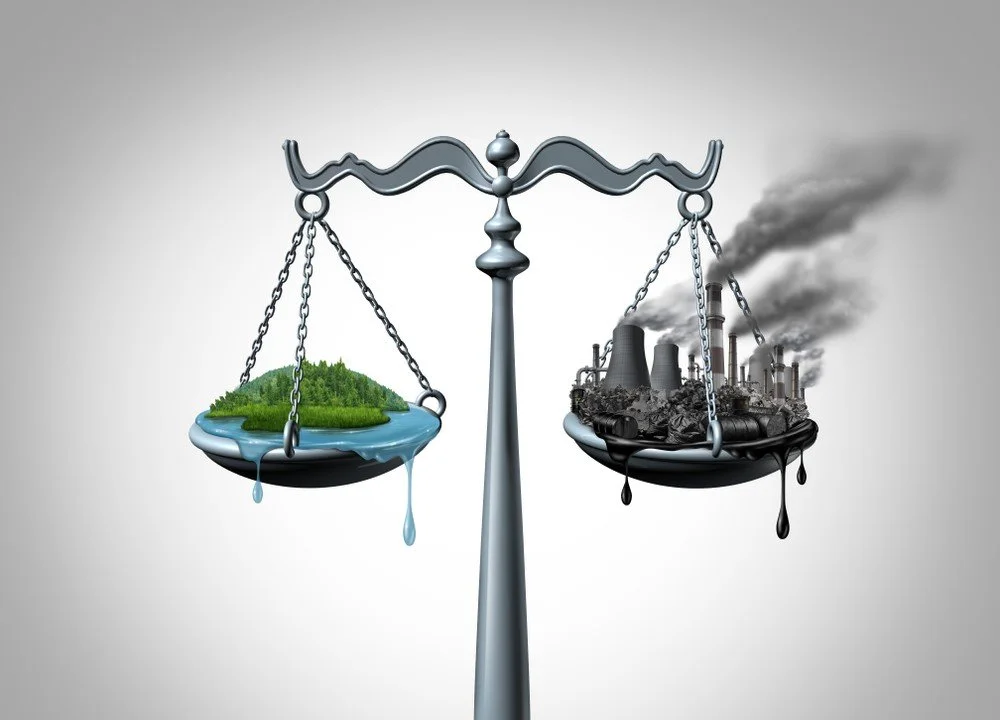
Environmental justice
The term ‘environmental justice’ can often be used in a mushy, socialistic sense, but behind it is a deadly serious concept. Put broadly, it means that all parts of society should be treated equally under environmental law, or that everyone has the right to the same protection from pollution and other harm from emissions.
Why distributional efficiency matters
The term ‘environmental justice’ can often be used in a mushy, socialistic sense, but behind it is a deadly serious concept. Put broadly, it means that all parts of society should be treated equally under environmental law, or that everyone has the right to the same protection from pollution and other harm from emissions. More strictly, it can be seen as a form of allocative efficiency. In other words, environmental interventions should be directed where they create the most benefit, up to the point that the marginal benefit equals the marginal cost of delivery. Protection from emissions shouldn’t be the preserve of the rich or powerful, but should be judged beneficial for anyone to whom it can deliver a net improvement in the quality of life. Applying this concept is important in any free society where people are not all living in the same circumstances, with the same preferences and behaviours.
Through this lens, we can develop an additional perspective on the current debate around the decarbonisation of transport. In doing so, we can see that a multitude of solutions is the optimal approach not just because of constraints on resources, the actions of hostile states, and the state of our electricity grids, but also because people are diverse, and society’s interests are best served by giving each person the most suitable mode of transport.

Switching from an internal combustion engine (ICE) vehicle to a battery electric vehicle (BEV) is an investment. As well as the obvious financial investment on the part of the buyer, it is an environmental investment in the sense that higher carbon dioxide (CO2) emissions are generated during manufacture which are then offset during the usage of the vehicle. As a good guide, the CO2 footprint of BEVs is greater than that of ICE vehicles because of the emissions from making the battery, as the elimination of the engine and other components is roughly offset by the electric motors. Further, electricity generation according to the average mix in Europe or the US creates about as much CO2 as the oil extraction, refining and distribution. Therefore, switching to a BEV initially makes CO2 worse, until a ‘break-even’ point is reached after a period. It should be well noted that these averages are offered as a rule-of-thumb in order to simplify a complex picture and reveal the break-even concept, not to downplay the actual variability and spread in manufacturing emissions, grid mix and so on in specific places.
Estimates of how long into the life of a vehicle the break-even point is reached vary widely, as the result is sensitive to the interaction of the following main factors:
Carbon intensity of the electricity grid
Embedded carbon in battery manufacture
In-use vehicle emissions rates
Distance driven per year.
Electricity grids vary from near-zero CO2 in France to largely coal in Poland – in the latter scenario most BEVs never pay back the manufacturing CO2. Embedded carbon in battery manufacturing typically varies between 2.5 and 16 tonnes, which is driven by a combination of mining, refining and transporting the wide range of rocks and minerals required. In-use emissions from modern gasoline engines average around 184 g/km according to Emissions Analytics’ real-world EQUA testing on European vehicles, but most fall in the range from 107 g/km for the best fully hybridised engines to 248 g/km for non-hybridised sports utility vehicles. As a result, even assuming average driving distances per year, you can get almost any answer for the CO2 break-even date, depending on your location and the type of the comparator vehicles. As a guide, most commonly cited break-even points fall between two and eight years.
This analysis, however, neglects the vital element of the distance driven per year, which is often – as above – assumed away as some representative average. According to Field Dynamics, in 2019 – pre-Covid – the average UK car was driven 7,124 miles (11,470 km). The UK is around the average of European countries in this respect. The distribution of annual miles across all cars subjected to periodic technical inspection (PTI) saw the majority of cars with less than 5,000 miles per year (8,050 km) and just 0.5% above 30,000 miles (48,300 km). This matters because the fewer miles driven, the longer it takes to reach the break-even CO2 point. The table below compares trading in your old ICE vehicle for a typical BEV, rather than changing to a typical full hybrid electric vehicle (FHEV) emitting 120 g/km.

* Proportion split pro rata from original report.
On the other factors above, typical average values have been taken: average grid carbon intensity for Europe and seven tonnes of embedded carbon in the battery. Calculations here take the mid-point of the distance ranges, and the top group is assumed to have an annual mileage of 35,000. The CO2 and break-even calculations assume driving behaviour is the same between the different vehicles. It is further assumed that vehicles have a twelve-year useful lifespan on average; while many last longer than this, the number of miles driven falls rapidly as they enter a twilight life of reduced use. We should note that there is a potential bias in these numbers as vehicles are not subject to the PTI test in the UK until three years old.
These results prove that the more intensively a BEV is used, the quicker it will pay back the CO2 investment. For the heaviest users, that payback will be within one year, and deliver about ten times the overall CO2 savings than in the original battery manufacture. At the same time, the lightest users never practically pay back that investment if they switch to a BEV, only offsetting half of the battery emissions. Therefore, those light users are much better switching to the FHEV. Most crucial is the proportion of cars that fall into this category: about one third. If these people take the FHEV option rather than switching to the BEV, the overall reduction in CO2 across the fleet would be 17% greater, and the reduction in the need for scarce battery materials would be around 32%.
This proportion will of course be lower in countries with cleaner grids, where the batteries have been manufactured using cleaner energy and the in-use emissions of the ICE vehicles are higher. Equally, the proportion will be higher in the opposite circumstances.
Applying a similar calculus to the US, we see that it is generally a much more suitable region for vehicle electrification. While it shares a similar pattern of grid electricity to Europe – majority based on fossil fuels, with big variations between regions – other factors work to its advantage. First, US car owners travel around 13,500 miles (21,600 km) per year on average, almost double the European average of about 7,000 miles (11,200 km). Therefore, a US driver pays back the CO2 invested in a BEV's manufacturer in half the time. Second, US wholesale energy costs around one quarter of Europe’s, so it can more credibly and competitively build the necessary extraction and processing supply chain, rather than just the final battery assembly part. Third, North America is the global region with the highest degree of urbanisation, and BEVs offer the biggest efficiency gains in urban driving, due to powertrain efficiency at slow speeds and regenerative braking.

In summary, this analysis can be put as: why are we forcing light car users to spend more money on vehicles that actually pollute the planet more? While Zero Emission Vehicle (ZEV) mandates may be direction-finders and worthy aspirations, it is also very important we make sure that those who do convert to BEVs are the right people, from an allocative efficiency point of view. ICE bans are even more problematic than ZEV mandates because ‘success’ would be wilfully suboptimal A better approach would be to drop the bans and be highly selective with mandates, and rely more on the CO2 targets and/or carbon pricing to set the direction and then let the industry and consumers rearrange their supply and demand accordingly to deliver the best environment outcome in the most efficient, speedy and equitable way. In this way, lightly used cars would not be swapped for BEVs, saving money and CO2. That would be true environmental justice.

Champagne Supernova?
When an exploding star led to the observation of supernova SN 2003fg in 2003, it was nicknamed the ‘Champagne Supernova’ due to its unusual brightness, and its inexplicably great mass. Many supernovae eventually succumb to their own weight, leaving behind a black hole. Are we at this stage with battery electric vehicles (BEVs)?
A bright light, with a heavy weight
When an exploding star led to the observation of supernova SN 2003fg in 2003, it was nicknamed the ‘Champagne Supernova’ due to its unusual brightness, and its inexplicably great mass. Many supernovae eventually succumb to their own weight, leaving behind a black hole. Are we at this stage with battery electric vehicles (BEVs)? Their prospects are currently shining brightly despite their literal weight as well as their likely wider toll on the environment, from watercourses to the seabed, due to their production. Hybrids, by contrast, tread relatively lightly on the planet, yet give off a more muted glow of past glory – perhaps more like a red dwarf. In this newsletter we want to consider a further way in which vehicle size and weight matter, and why the BEV industry must address this rapidly if it is successfully to deliver pollution reduction.

Astronomical parallels aside, we can simply say that BEVs are too big and heavy right now. Yes, there are heavy internal combustion engine (ICE) vehicles, but on average BEVs are around 40% heavier and 40% bigger like-for-like, as set out in a previous newsletter. This trend may well continue, and the weight premium increase, as BEVs come increasingly equipped with lithium ion phosphate (LFP) batteries as they are cheaper and require fewer scarce materials. It may even be the case that this weight leads to structural risks for transportation infrastructure, such as roads and car parks, although this has yet to be proven.
While this is all true, it is easy to get stuck in a pattern of ‘trading averages.’ As Senecal et al meticulously pointed out, you can only assess the decarbonisation potential of BEVs in the US by looking at local-scale grid electricity, and marginal rather than average carbon intensities. Similarly, with vehicle selection, you can only judge the benefit by understanding the marginal changes. If someone replaces a frugal gasoline car with a larger BEV, that is likely to be worse for the environment in the round. Equally, switching from a large gasoline V8 to a small city BEV is very likely to be better. It is easy to make simplistic ‘stop burning stuff’ slogans stick when you conjure up the image of a pre-particle-filter diesel being replaced by a gleaming Tesla. However, for the same investment, you are likely to get more pollutant and carbon dioxide (CO2) emissions reduction from trading those old diesels up for the latest full hybrid electric vehicles (FHEVs). So, what we mean by an ICE vehicle, and the variation in performance within that group, matter. Put another way, it is not the optimal approach to dispense with all ICE technology just because many are high-emitting, just like it would be wrong to reject all BEVs just because many are currently very heavy.
Our previous newsletter suggested that tailpipe emissions from FHEVs had reached a ‘do no harm’ status, by showing levels more than 90% below a range of air pollution legal limits. What this did not show was whether those apparently low levels were in fact sufficiently de minimis to be of little concern, or whether we were still burning stuff in a detrimental way for air quality. An immediate caveat to make is that there is a relevant difference between this European test and apparently similar US vehicles. In Europe, unlike the US, a large and increasing proportion of gasoline ICE vehicles are equipped with particle filters, which significantly reduce the particle mass and number emissions from the tailpipe. Therefore, US particle emissions remain concerning and, as a result, there is greater benefit in switching to BEVs in that market, in the absence of widespread adoption of these filters.
That said, we can look more closely at the volatile organic compound (VOC) emissions from the same test to put the results in context. We showed that there were 4.38 mg of tailpipe emissions over our EQUA test, or 0.03 mg/km. This compares to the most relevant official limit of 100 mg/km for total hydrocarbons, which puts the car more than 99% below the limit. These low emissions were compared to the 330 mg emitted from the tyres on the same test. But, still, how bad is 0.03 mg/km? A recent paper, from March 2022, in Environmental Science & Technology by Wang et al, measured the VOC emissions from four humans seated in a controlled climatic chamber, using proton transfer reaction time-of-flight mass spectrometry and gas chromatography. Without the presence of ozone, the emissions averaged 2.2 mg per human per hour, rising to 4.6 mg in the presence of ozone. Averaging these, and applying the result to the length of the EQUA test, it would imply that a human driver would emit 12 mg of VOCs in total. Therefore, during the EQUA test the driver may have emitted three times more pollution from his body than came out of the tailpipe of the car being driven. Stop metabolising stuff!

So, we can see that the levels of regulated exhaust pollutant emissions from the FHEV are now trivially low. Of those not regulated, the sub-23 nanometre, ultrafine particles are probably the greatest omission, which is being addressed by regulators soon, as set out below. What is left is a more serious concern about VOC emissions, especially from tyres. There are three main reasons we should be concerned about such emissions. First, VOCs can have a direct health effect through inhalation or contact with the skin – many are harmless, but the worst organic compounds can be carcinogenic. Second, VOCs can react in the air to create ‘secondary organic aerosols’ (SOA), i.e. new particles, for which the health and environmental effects are well described elsewhere. Third, these organic compounds have an ‘ozone formation potential’ (OFP), ground-level ozone being one of the main constituents of the smog hanging over city skylines.
From the testing on the Tesla and Kia described above, we see tyre VOC emissions of 2.2 mg/km from the Kia and 6.1 mg/km, from the larger-wheeled Tesla. Taking the ‘secondary organic aerosol formation potential’ (SOAFP) for five target compounds and the average value for the remainder from Wang et al (2017), this implies a maximum possible particle formation of between 0.03 mg/km and 0.1 mg/km. The latter is shown in the table below, which is from the Hankook tyre on the Tesla. This may sound low, but tailpipe particle emissions are now as low as 0.02 mg/km, so the tyre VOC emissions could more than five times the tailpipe mass emissions.

Using a similar approach for ozone formation, the test could have yielded up to 13.2 mg/km. There are no direct regulatory benchmarks to compare this to, however.
This shows not only that tyre size matters, but that chemical composition does as well. From over three hundred tyres tested by Emissions Analytics, the surface area of light duty vehicle tyres – from which the VOCs evaporate – can vary by around 100%, depending on whether you have a 155/60 R15 skinny summer tyre, or a 235/65 R17 specialist SUV tyre, for example. Across 73 tyre manufacturers tested, the proportion of aromatics – some of the more potentially toxic compounds, and highlighted compounds in the table above – vary in concentration from 78 to 582 micrograms per milligram of sample. In other words, the concentration of certain chemicals, and the surface area from which they can evaporate, varies significantly between tyres. As a consequence, vehicle size and weight, with the tyres that accompany that, evidently affect emissions in use, in addition to the materials required for their construction.
This shows not only that tyre size matters, but that chemical composition does as well. From over three hundred tyres tested by Emissions Analytics, the surface area of light duty vehicle tyres – from which the VOCs evaporate – can vary by around 100%, depending on whether you have a 155/60 R15 skinny summer tyre, or a 235/65 R17 specialist SUV tyre, for example. Across 73 tyre manufacturers tested, the proportion of aromatics – some of the more potentially toxic compounds, and highlighted compounds in the table above – vary in concentration from 78 to 582 micrograms per milligram of sample. In other words, the concentration of certain chemicals, and the surface area from which they can evaporate, varies significantly between tyres. As a consequence, vehicle size and weight, with the tyres that accompany that, evidently affect emissions in use, in addition to the materials required for their construction.
What does this mean for regulation? The current Euro 7 proposals are generally a sensible step, as set out in a previous newsletter, not least to make the regulations more technology neutral and tighten ultrafine emissions limits. A less prominent part of the proposal is to tighten the ‘evaporative emissions’ test. This is designed to limit the VOCs off-gassed during refuelling and the use of vehicles, for example vapour escaping from the fuel tank. The test is conducted in a controlled chamber and the escaping VOCs collected over a one-hour period when the vehicle is hot followed by 48 hours when it is cool, all with the ambient temperature varying across a ‘normal’ range. Currently, the total emissions must be less than 2 grams, although this may be significantly reduced with Euro 7. This is relevant because the test, although not specifically designed to do so, will pick up off-gassing from the vehicle’s tyres. However, this is one respect in which Euro 7 is not technology neutral: the evaporative test only applies to gasoline vehicles. So, BEVs with large tyres have no limits applied.

In conclusion, we have shown the risks of myopically looking at tailpipe emissions, and the dangers of asserting the environmental impact of vehicles simply from the type of powertrain. In short, environmental logic points towards a mixed car parc made up mainly of smaller BEVs to cover town driving and larger FHEVs for more general purposes, brought about as quickly as possible in order to get the black hole of older, dirty cars off the road as soon as possible. Vehicle weight, and hence emissions, should be minimised to allow the smallest tyres that are safe and effective. This is a lower risk approach, and from an economic point of view a ‘lower regret’ option as we would not be gambling resources of potentially up to $1 trillion globally, according to some reports, on a maxi-BEV technology that may not deliver its promises. If we pivot to this lighter approach, in ten years’ time, as with 1990s Britpop Oasis’ champagne supernova, you might not have to wipe that tear away now from your eye.
Do No Harm
Emissions Analytics performed a comparison test between a Tesla Model Y and a Kia Niro full hybrid electric vehicle (FHEV), on itsreal-world EQUA test cycle conducted in the UK in March 2023.
How efficiency does matter
In our last newsletter we showed how the energy efficiency of vehicles is not the only consideration in decarbonisation. We should also think about efficiency of resource allocation. Resources are scarce, and the job of decarbonisation is big, so we need to invest our money carefully. One way to judge this is to consider an alternative measure of optimality: Pareto efficiency. Vilfredo Pareto was a nineteenth century Italian economist, who described a system being Pareto efficient when is not possible to change the allocation of goods without harming at least one person. Interpreting that for transport decarbonisation, we can say that a change of powertrain can be a Pareto improvement if it is possible to improve all relevant aspects without disadvantage to someone. For clarity, following Pareto improvements does not necessarily lead us to the globally best outcome, but offers relatively easy ‘wins-wins’, opportunities which are scarce in complex modern economies. What can this tell us if we apply it to some real-world test data?
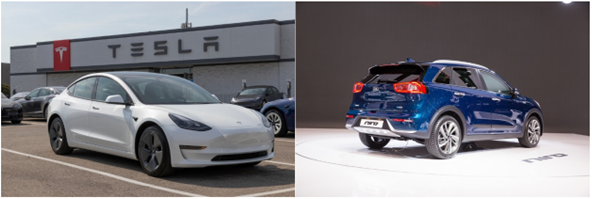
To study this, Emissions Analytics performed a comparison test between a Tesla Model Y and a Kia Niro full hybrid electric vehicle (FHEV), on its real-world EQUA test cycle conducted in the UK in March 2023. The vehicles were less than one year old, equipped with the original tyres, with similar tread depths, and closely matching odometer readings. Both are standard size sports utility vehicles, with the same number of seats, while the Tesla is physically slightly larger. Importantly, due primarily to the 78.1 kWh battery, the empty weight of the Tesla was 489 kg greater. From a driveability point of view, this is offset by almost treble the power and double the maximum torque. The detailed specifications are shown in the table below.

Selecting the appropriate pair of vehicles presented various dilemmas, and the conclusion was that there is no perfect answer. Perhaps the most obvious approach would have been to compare the hybrid to a Kia Niro EV. From an engineering point of view this would have been a good like-for-like comparison. However, Emissions Analytics is committed to understanding what happens in the real world and, therefore, it would be unwise to the neglect the biggest selling battery electric vehicle (BEV) by revenue in the world in 2022, the Tesla Model Y. The pairing of this with the Niro hybrid reflects a common choice that real customers are making, even if that means a technically less perfect comparison. As evidence of this being a good comparison, the table include effective monthly lease costs, which shows there is less than 10% difference. These figures assume the buyer is a company car driver paying the higher rate of income tax in the UK, which reflects the most common type of buyer; the difference is caused by the low benefit-in-kind tax on the BEV. The mix of incentives varies around the world, some more generous, some less so.
With the background of climate change and Dieselgate, there is a strong narrative that we need to “stop burning stuff” to solve our environmental problems. Non-combustion sources of emissions, such as from tyres, typically get dismissed as just big chunks/having no air quality effect/not very toxic/inconvenient. At the same time, some BEV owners report that they see lower tyre wear, and other higher wear compared their previous internal combustion engine (ICE) vehicle. However, it has been unclear whether there has been simultaneous behaviour change, in terms of driving style or routes, or the measurements are unreliable.
For this test, the vehicles travelled in convoy to eliminate any effects of driving style or climatic conditions. The Kia was instrumented with a tailpipe Portable Emissions Measurement System (PEMS) and the Tesla with an equivalent mass. The test cycle was made up of five repeats of the EQUA cycle, totalling 741 km. At regular points through the test, all the wheels were dismounted, cleaned, weighed and remounted to calculate the mass loss. The results, compared to the relevant regulatory limits, are shown in the table below.

The mass loss data points and trend over the total distance are shown in the chart below.

The first striking result is that there are almost no tailpipe pollutants measured from the Kia except carbon dioxide (CO2). The gasoline particulate filter reduces particle mass to almost zero, and particle number to 97% below the Euro 6 regulatory limit. Every air pollutant is comfortably more than 90% its limit. While there is no limit value for CO2, compared to the average of all the current-generation gasoline vehicles we have tested, the Kia is 38% lower at 113.4 g/km. The Tesla is, of course, zero on all these measures; we are ignoring upstream emissions in this test.
Turning to the non-exhaust, the second striking finding is that tyre wear mass emissions are five orders of magnitude greater than particle mass from the tailpipe. This is two orders of magnitude greater than in previous tests by Emissions Analytics on different vehicles. Further, tyre wear emissions were 26% greater from the Tesla, due to the extra weight and torque, despite their being specifically-designed ‘green tyres’ for electric vehicles. The gap may have been greater had the car not been equipped with special EV tyres. In absolute terms, the increased tyre wear was 11 mg/km, which is 2.4 times the maximum permissible tailpipe particle mass emissions.
So, as tailpipe air pollutants were tending to zero from the Kia, it is a fair summary to say that a consumer choosing between switching from a traditional gasoline internal combustion engine (ICE) vehicle to either a Kia Niro hybrid or a Tesla Model Y, is weighing up an extra 62% point reduction in CO2 against a 26% increase in particle emissions. However, if full lifecycle CO2 emissions are taken into account, BEVs currently offer around 50% CO2 reduction on average, so in reality the decision to opt for the Tesla is between 12% points of extra CO2 reduction compared to the ICE baseline but 26% more particles.

How robust is this conclusion? In other words, would we get a very different answer if we had chosen a different FHEV/BEV pair of vehicles? From Emissions Analytics’ wider EQUA programme, we have tested many different vehicles for tailpipe emissions and tyres for wear rates. From this we conclude that the key factors in the relative emissions at the whole-vehicle level are the vehicle mass and torque, the model year and the tyres the vehicle is equipped with. Therefore, it is of little significance that the Kia Niro is physically smaller than the Tesla Model Y, as the differences in mass and torque are representative of the typical of choices that consumers are making in today’s market. What this shows is that the vehicle manufacturer’s choice of tyres is increasingly important in overall emissions, both for tyre wear and CO2 via rolling resistance.
What does this mean in terms of the concept of Pareto efficiency set out at the start? Moving from a gasoline ICE to the hybrid would be a Pareto improvement: it is better on every measure. But moving from the gasoline ICE to the BEV is not such an improvement, due to the increase in tyre particles. So, given gasoline ICEs are predominant at the moment, the optimal and most efficient move in terms of scarce resource allocation is to move to FHEVs, not BEVs.
But it doesn’t end there. Tyres don’t just affect the environment in terms of a mass of small particles. Also important are the number of particles emitted and chemicals that leach out of them over time as they settle on soil or in water, as well as the vexed problem of handling end-of-life tyres. A neglected further effect is volatile organic compounds (VOCs) that ‘off-gas’, or evaporate, from the surface of the tyre all the time. Similar compounds are also released from the tailpipe, although they are regulated only as part of a ‘total hydrocarbons’ measure. Which is greater – VOCs from the tyres or the tailpipe?
During the same test above, we measured tailpipe VOCs using Emissions Analytics’ proprietary sampling equipment that allows a full speciation using two-dimensional gas chromatography and time-of-flight mass spectrometry. These VOCs matter as they are a precursor to smog formation and contribute to the secondary formation of particles in the air, as they react chemically. These effects are in addition to the direct health effects, especially for aromatic compounds, which are often carcinogenic in certain concentrations and exposures. Within that group, polycyclic aromatic hydrocarbons (PAHs) and nitro-aromatics are typically the worst.
Large samples from one tyre on each vehicle were also taken and placed in a ‘microchamber’ heated to 20 degrees Celsius, around the temperature of a vehicle certification test, and held at that level for the same duration of the on-road EQUA test – around three-and-a-half hours. The off-gassed VOCs were analysed and quantified, and then scaled up by the relative surface area of the sample to that of all four tyres on the vehicle. The results are shown in the table below.

This shows that VOCs off-gassed into the air from the tyres are about two orders of magnitude greater than those from the tailpipe of the Kia. Adding the tailpipe and tyre sources, we see that the Kia had total emissions less than half of the Tesla’s. This result is driven by the larger diameter and width of the Tesla tyres, despite their being lower profile. These results will be unpacked further in a future newsletter, but for now we can see that they are consistent with the pattern of the regulated pollutants: there is very little coming from the tailpipe relative to tyres.
In this context, the concept of Pareto improvement is reminiscent of the no-harm principle in medicine: primum non nocere. ‘Do no harm’ means taking a step back from an intervention to look at the broader context and mitigate potential negative effects on the social fabric, the economy and the environment. By switching to FHEVs we can create a ‘no harm’ intervention, unlike BEVs. That is not to say that FHEVs emit literally zero, but no additional harm is done and, in fact, improve all aspects. That is also not to say that BEVs and their associated tyres might not improve – they very likely will. At that point, it would then be right to change policy. To the trade-off described earlier – between 26% more particles as the price of 12% points of extra CO2 reduction – no verdict is passed as to whether this is a good trade-off from a policy point of view, but a trade-off it is.
In the meantime, FHEVs are the win-win, do-no-harm option, while BEVs are the win-lose, the vexatious trade-off in a situation of significant technology uncertainty. On this basis, and of Pareto efficiency, until BEVs reach certain performance characteristics, government and industry support should be switched immediately from BEVs to FHEVs to create maximum welfare.

Efficiently wrong
Battery electric vehicles are great. There – we said it. In fact, we have been saying it all along. But are they so great that all competition should be banned?
The danger of fixating on one thing
Battery electric vehicles are great. There – we said it. In fact, we have been saying it all along. But are they so great that all competition should be banned? Or are they great, but with caveats, such that we should foster choice and spread our decarbonisation bets to ensure the best and most certain reduction in carbon dioxide (CO2) emissions? Banning your competitors can variously be described as state-sponsored monopoly, central planning and rent seeking. Ironically, communist China isn’t banning alternatives to battery electric vehicles (BEVs), yet free-market Europe is. Is there any merit in Europe’s current position, and how can this paradox be explained?

One explanation is how the notion of ‘efficiency’ is being misused. Roughly speaking, diesel engines are 30% efficient in converting chemical energy in the fuel into kinetic energy of the vehicle, while a vehicle battery converts around 90% of the energy stored into motion. Much of the difference is in waste heat. In fact, Carnot’s theorem, based on the second law of thermodynamics, shows that a ‘heat engine’ has a theoretical upper limit of efficiency well below 90%. So, the argument goes, as we are short on low-carbon energy sources, how efficiently we use that energy is vital. And electrical motors powered from a battery at 90% efficiency must easily trump a diesel engine at less than – say – 50% efficiency. Therefore, BEVs are a no-brainer and any resources put into any other technologies must be wasted.
This can be encapsulated in the following syllogism: we need greater energy efficiency in road transport; BEVs are more energy efficient; therefore, we must have them.
There are many flaws in this argument. First, we must step back and remember that the aim is to reduce CO2 emissions. Does greater efficiency always correlate with lower emissions? No-one doubts that efficiency is important, but it is everything? On the first question, this is true in many circumstances. For example, if a diesel car delivering 40 miles per gallon is replaced with a new diesel car at 50 mpg, CO2 emissions will fall in the usage phase. Greater efficiency means lower CO2. In contrast, however, as countries increasingly switch from E5 to E10 gasoline – that is, gasoline containing a maximum 5% and 10% of ethanol respectively – the combustion efficiency falls due to the lower volumetric energy density of the fuel, yet CO2 emissions also fall. In this case, CO2 falls despite worse efficiency. What this shows is that efficiency does correlate with reduced CO2, but only necessarily so when all other things are held the same. In the latter case, the type of fuel has changed. Overall, though, it is clear that efficiency and CO2reduction do not correlate as a general statement.
The second aspect to consider is that greater efficiency may lead to reduced CO2 emissions, but with some other effect. Walking, for example, is highly energy efficient and very low CO2 even when undertaken by carnivores, but it’s not going to get you from New York to Los Angeles very quickly. Equally, walking can be efficient, low CO, quicker cheaper, as seen for many short journeys in congested city centres. What this shows is that efficiency is only one of the relevant variables in the decarbonisation equation.
With Dieselgate in mind, there is some validity in the argument that combusting fuel in urban areas needs to be eliminated, and BEVs are the only scalable option to achieve this. However, this idea neglects the significant differences in pollutant emissions between older and newer vehicles. The latest generation of cars, sold since the introduction of the Real Driving Emissions regulation from 2017, sees the average gasoline vehicle emitting nitrogen oxides (NOx) of 11 mg/km (82% below the regulated limit) and particle number emissions of 0.9 x 10¹¹ #/km (85% below), and the equivalent value for diesels of 43 mg/km (46% below) and 0.1 x 10¹¹ #/km (98% below) respectively – data collected from Emissions Analytics’ EQUA test programme. The proposed introduction of Euro 7 will further tighten the limits and, more importantly, will widen the boundaries of the test and cold-start requirements such that these real-world values will fall further.
As a result, modern ICE cars are not the ones causing urban air pollution problems, but rather the earlier, Euro 5 and 6 vehicles. Euro 5 gasoline vehicles average 39 mg/km of NOx (35% below the limit) while diesels emit 806 mg/km (4.5 times the limit). The priority must be to remove these older diesel cars and, whether they are replaced by new internal combustion engine (ICE) vehicles or BEVs, is largely irrelevant. The Ultra Low Emission Zone in London is a big step in this direction, even though it continues to allow many high-emitting Euro 6 diesels into the city, and does not discriminate on vehicle mass. With typical ICE vehicles emitting 67 mg/km of tyre particles, compared to 81 mg/km for equivalent BEVs, there are some downsides to these heavier vehicles. In short, this shows the logical fixation with ‘combustion’ being inherently bad is also wrong. Of course, this fixation is closely related to the efficiency error.

The logical fallacy against combustion is shown by synthetic ‘e-fuels’, where hydrogen and CO2 are removed from the air using low-carbon electricity and then synthesised into, for example, gasoline in such a way that as much carbon is absorbed during production as is released during subsequent combustion. The combustion itself will still be at low efficiency, but the net CO2 will be close to zero and, due to the purity of the fuel, the pollutant emissions can be very low as well. Low CO2, low pollutants, yet inefficient.
So, why don’t we go straight to e-fuels, and bypass the additional problems of material scarcity and dependence on China that comes with BEVs? The answer is that we do not have sufficient low-carbon electricity to power the process. This is where BEV supporters have a point: green electricity is scarce, so we must use it efficiently. However, what they are proposing is swapping one scarcity for another: scarce green electricity for scarce battery and motor components. Scarcity matters, especially where the scarce goods are disproportionately controlled by a limited number of entities, as it leads to them enjoying excessive ‘economic rent’ through using that market position. Building a diversity of supply is a necessary first step, to accommodate growing demand.
While many BEV proponents complain about excessive profits of fossil fuels companies, their vision would recreate the same issues just with different players. More concerning still is that European’s act of giving BEVs a future powertrain monopoly has given disproportionate market control to China. The US has reacted with a major $369 bn dirigiste policy to break China’s control. The EU is now poised to unveil a ‘Green Deal Industrial Plan’ to match this. The trend of ever-freeing world trade is now well in reverse, as countries take an increasingly protectionist and mercantilist approach designed to maximise exports while minimising imports. Had Europe reacted to the need for decarbonisation by playing to its competitive advantage – especially building low-carbon electricity grids – this value-destroying cycle may never have been triggered.
Such an error by European governments, arguably to assuage Dieselgate, has radically polarised the debate. Anyone who doesn’t ‘get’ the BEV story and its efficiency myth is labelled as a climate change denier. Our aim must be to limit the overall negative effect of climate change in the least damaging way. So, let’s consider an alternative, pragmatic path. It’s simplistic, but balances practicality, cost, geopolitics and – not to be neglected – social welfare.

It should be noted that only in the second phase is efficiency the key dynamic. The attraction of this approach is that it helps manage the significant uncertainties and risks in the effectiveness and timing of the stages of decarbonisation. For example, the BEV-led phase could be accelerated or pushed back depending on technological advancements or setbacks. Looked at another way, these stages are necessary if we are not to blow our carbon budget under the Paris Treaty. All are needed. Hybrids only get you so far, but they are here now. E-fuels are net-zero in principle, but not realistic today. BEVs cannot be scaled today without prohibitive cost.
As a side note, hidden in here is a paradox for the BEV lobby: enough green electricity is needed to allow the manufacture and charging of cars to be low carbon, but too much green electricity would enable competitor fuels and powertrains. We should look out for lobbying focused more on powertrain transition than grid capacity building.

In conclusion, BEVs can be great products and will play a significant role in decarbonisation on almost any scenario. But why ban the competition? The argument that efficiency is so much better that we should gamble all our investment on this horse is ill-conceived, costly and risky. It is perhaps just very clever rent-seeking, supported by parts of an excitable environmental lobby. Once efficiency is seen within the proper context of costs, alternatives and negative side-effects, the merits of a diversified, staged, pragmatic transition to a net-zero world become clear. BEVs then can be best understood as a transitional technology to a fully decarbonised, competitive, welfare-maximising future.

How tyre emissions hide in plain sight
Emissions testing is usually preoccupied by testing for known, worrisome chemicals in the environment. Often they are in small amounts or concentrated at hotspots. Sophisticated equipment is deployed to find and measure them. We obsess with ever-tighter regulation of these pollutants we know about, even well beyond the point of diminishing environmental returns.
But it's not especially an electric vehicle problem
Emissions testing is usually preoccupied by testing for known, worrisome chemicals in the environment. Often they are in small amounts or concentrated at hotspots. Sophisticated equipment is deployed to find and measure them. We obsess with ever-tighter regulation of these pollutants we know about, even well beyond the point of diminishing environmental returns. At the same time, emissions from tyre wear from vehicles are all around us, and inside us, but we hardly see it. There is so much of it, and it is camouflaged by its chemical complexity, that we don’t notice. It is visible but unperceived. We urgently need to reprogramme our perceptive faculties to recognise the danger right in front of us.
Recent peer-reviewed scientific research estimated that a median adult excretes 11.8 nanograms per kilogram of bodyweight of 6PPD and 6PPD-quinone in urine per day. These chemicals have been made famous by ground-breaking research on the West Coast of the US, which linked them to mass fatalities of coho salmon – and more recently various types of trout. 6PPD is a preservative present in almost all tyres and few other products, which forms 6PPD-quinone when it reacts with oxygen in the air, and this is the chemical that kills the fish. We covered this in an earlier newsletter. Now, the data on human urine from South China, which is soon to be published, strongly suggests that when we emit, we pass tyre emissions.

Emissions Analytics has been testing for the rate of tyre wear emissions in real-world conditions over a number of years, across thousands of miles on many different types of tyre. The current average wear rate for a whole vehicle is 67 mg/km from new tyres, and this is predicted to halve over the tyres’ lifetime. Therefore, particulate mass generated from tyre wear is nearly 2,000 times greater than that from the tailpipe of modern ICE vehicles, as previously reported. In addition, our testing suggests for every 500 kg extra vehicle weight – about the mass of a large battery – tyre wear emissions rise by 21%. By some, this has been interpreted as an attack on BEVs, as they are heavier. While it is true that this comprehensively disproves the notion – bizarrely incorporated in legal statute in many countries – that BEVs are zero emission, a better interpretation is that all tyre emissions are high compared to the tailpipe particle mass from the latest ICE vehicles. To complete the picture, it should also be recognised that tyre and tailpipe emissions approach parity when the comparator is an older diesel vehicle with no particulate filter installed, or on a vehicle with a compromised filter.
Therefore, we should not call the tyre emissions issue exclusively a BEV problem. The trend towards heavier ICE sports utility vehicles has been a contributor to these growing emissions rates as well. In fact, having now tested over 300 different tyre models for their chemical composition from around the world, there is an emerging picture that specialist BEV tyres designed to handle the greater weight and torque of the vehicle may contain fewer potentially toxic compounds. So, the wear rates may well remain high if the driver is using the available torque, but in terms of environmental damage this may be offset by better formulations. This mitigation does tend to come at a higher purchase price, however. It does further mean that, if a BEV is equipped with non-specialist tyres – most likely when the owner replaces the original manufacturer tyres – the emissions could be higher in both wear and potential toxicity. We will present further results on these innovative formulations in a later newsletter.
This analysis makes it clear that tyre wear emissions are being generated when any of the world’s 1.5 billion cars are driven. Latest estimates suggest they shed about 6 million tonnes of tyre material per year, or 4 kg per car per year. It is often suggested, however, that this is not a big problem, because the particles shed tend to be larger and get caught in storm drains and filtered out, or sit harmlessly by the roadside. There are many reasons to doubt this. First, in many countries, the particles are filtered out from storm drains and road run-off, but the resulting sludge is then sold back to farmers for fertiliser. Another undesirable form of circular economy.
By our estimates, around 10% of the total tyre particulate matter is airborne – primarily the ultrafine particles – but a majority is often said to settle on the land. Recent peer-reviewed scientific research from Casten et al in Environmental Science & Technology studied the uptake, metabolism and accumulation of tyre wear particles and derived compounds in lettuce. It found that 6PPD and 6PPD-quinone – among other compounds – were “…readily taken up by lettuce…” via the roots and then translocated to the leaves in a way that “…may be of concern to consumers.” The paper describes how tyre wear particles may leach derivative compounds even before entering the soil, but that “…the majority of compounds are expected to be released once TWP [tyre wear particles] enter the agricultural soils and come in contact with soil pore water.” This provides a challenge to potential regulation to understand derivative chemicals and their toxicity, as well as the original particles.
Fortunately, to aid this process, Emissions Analytics’ test programme aimed at mapping the chemical composition and leaching potential from tyre wear is progressing apace. Our subscription database has recently been expanded to add over one hundred tyre models from the US market – across light- and heavy-duty vehicles – to add to the hundreds of samples from the European market. The results help confirm one finding: that tyres are extremely complex and sophisticated in their construction. While this is impressive from an industrial and technology point of view, it helps create the problem set out at the start of this newsletter: the complexity helps camouflage their presence all around us in the environment.
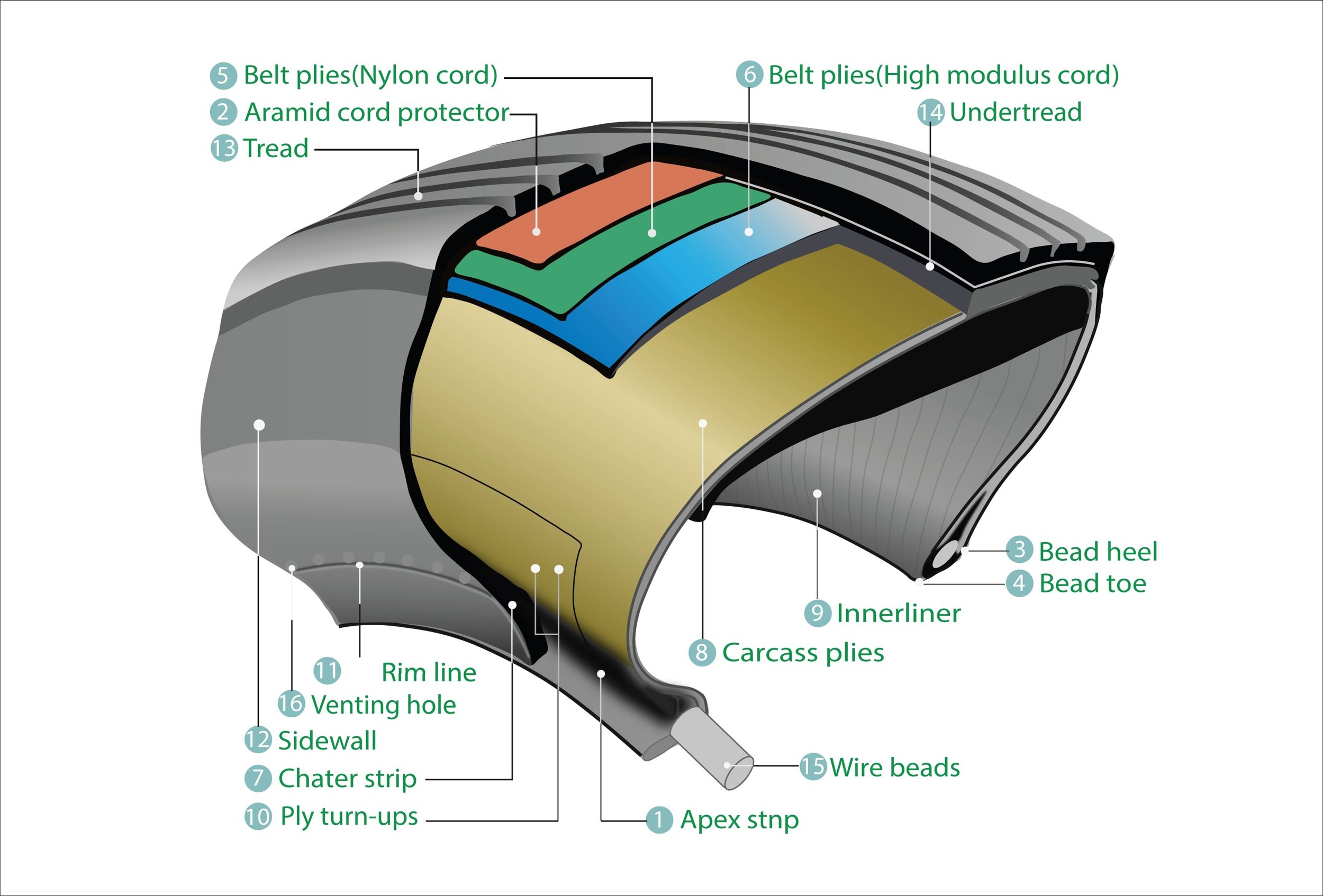
To illustrate this, we took one high-selling tyre from a major European manufacturer and took samples from five different locations: inside and outside tread, the centre band around the middle circumference, and the inside and outside sidewalls. It was expected that the inside and outside tread composition should be similar, as only some performance tyres have asymmetric construction – this was indeed the case for the tyre tested. The centre band was expected to be different as it needs properties including conductivity, although the differences were relatively small and specific.
But what of the comparison between the outside tread and outside sidewall? The tread primarily has exposure to the physical stresses caused by driving, while the sidewall helps maintain the structural integrity while being exposed to sunlight much of the time. The chart below shows the 25 most prevalent organic compounds found – using our specialist two-dimensional gas chromatography and time-of-flight mass spectrometry method – plus 6PPD. The average number of compounds found was 350 per sample. The scale is in nanograms of compounds per milligram of tyre sample, expressed logarithmically. The coloured areas represent the tread and sidewall respectively.

This shows that the sidewall has higher concentrations of certain chemicals, not least androstan-17-one‚ 3-ethyl-3-hydroxy-‚ (5α)-, which is a chemical found naturally in nutgrass, and lends certain properties to the tyre. It is also higher in naphthalene‚ 1‚6‚7-trimethyl-, which is part of the naphthalene group and known to be harmful if swallowed and very toxic to aquatic life at certain concentrations, with potentially long-lasting effects. The tread has higher concentrations of other chemicals, for which many have little or no toxicological information available. An exception is 1‚1'-Biphenyl‚ 2-methyl-, which is a known skin irritant, can cause eye damage, and affect the respiratory tract. Perhaps surprising, the concentration of 6PPD was higher in the tread than the sidewall, despite the sidewall being more exposed to sunlight.
These chemicals are all important to understand, and they can affect the environment in multiple ways. The tyre gets abraded, and the resulting particles can get inhaled or ingested by humans. As they settle on soil they can enter the food chain, as can particles that enter the waterways and either end up as drinking water for humans or inside fish and other animals then eaten by humans. Chemicals on the surface of the tyre can also react with the air or other chemicals to produce derivative products with toxicological effects, as with 6PPD leading to 6PPD-quinone. Such reactions can also lead to the formation of secondary organic aerosols, i.e. more particles. All along, chemicals originally bound up in the tyre particles may leach out at different rates and with different effects.
We conclude from this that, while different parts of the tyre have different chemical compositions, reflecting their different roles, many of the compounds are common. We are now able to identify both these common compounds and the differentiating compounds, which makes possible wider, targeted environmental monitoring to understand the sources and ultimate fate of tyre emissions. It also opens up paths to reducing the environmental impact, such as the California Environmental Protection Agency’s proposed targeting of 6PPD, which will force tyre manufacturers to consider alternatives. It is the assessment of the properties of the alternatives which will be important, to ensure we don’t switch one problem for another.

So, as you drizzle your salad with some tasty, oily dressing, you now know that the lettuce itself may be carrying various compounds that originated from the crude oil used to make the tyres, that wore as you drove to work, and that settled on the neighbouring farmer’s field. These chemicals are all around us, and inside us.
At least, however, we now know what to look for and can measure them out in the real world. Their camouflage is blown.

The circular economy
Reusing, recycling, repairing and sharing are defining hallmarks of a circular economy idea that is being promoted worldwide, but especially in Europe.
Zero-emission vehicles are zero-emission because they are
Reusing, recycling, repairing and sharing are defining hallmarks of a circular economy idea that is being promoted worldwide, but especially in Europe. It is not surprising that Europe leads the way, not through altruism, but for good economic reasons, as many key materials for a growing economy become scarce or expensive. Europe lacks deposits of many of them, but also makes it uneconomic to extract or refine them for industrial use.
But while resource reuse is logically and economically plausible, other aspects of environmental policy are circular in a less attractive way. Especially since Dieselgate, arguments between different shades of opinion as to the future of battery electric vehicles (BEVs) and internal combustion engines (ICEs) have become so raw, antagonised by ad hominem attacks. Yet, there are rarely disagreements between the sides on the underlying facts

Everyone knows that carbon dioxide (CO2) emissions are affecting the climate;
And that no vehicle is truly zero emission;
That BEVs are highly energy efficient, but batteries have low energy density;
That ICEs have poor efficiency, but compensate with high energy density fuels;
That BEVs reduce lifetime CO2 by ~50%, but this varies greatly by location;
That full, non-plug-in hybrids reduce CO2 by up to 30%, but that isn’t enough;
That battery and motor materials are scarce and often located in risky places;
That processing materials take lots of energy and creates local pollution;
That renewable electricity is mostly intermittent, increasing its real cost; and
That all vehicles create pollution, whether tyre wear or in their construction.
So, if there is a broad based of factual agreement, why the emotionalised debate?
We would propose that reason is that transport policy is suffering a bout of “a priorism.” This is typically defined as the systematic refusal to count anything as evidence against the truth of a purportedly empirical statement. Put another way, the argumentation for electrical vehicles is, like a green economy, circular. By defining BEVs as zero-emission in the European fleet average carbon dioxide (CO2) regulations, the answer is being assumed in the question. Therefore, BEVs cannot – despite any evidence to the contrary – be anything other than zero-emission. Even though, by common consent, they aren’t really.
It’s a form of cognitive dissonance – the mental anguish that arises when two beliefs contradict one another. BEV advocates know rationally that there are emissions from the manufacture of their vehicles, yet maintain that they are zero emission, because that is how the regulation defines them. Such internal conflict leads to anxiety and, from there, calm, rational discussion become difficult. As a psychiatrist explained: “If competing values, beliefs, attitudes, etc are not resolved or integrated, it greatly inhibits the ability of groups to have constructive dialogue, making it difficult, if not impossible, to arrive at a satisfactory compromise.” With the heavy emotional investment in beliefs on all sides, positions have become entrenched.
Why go on about this? Firstly, decarbonisation is an extremely important issue now, with global temperatures rising. Second, we need be sure that products that promise CO2 reduction do deliver in practice. Third, selfishly, Emissions Analytics aims to bring about a better understanding of real-world emissions through independent testing, to inform better policy and decision-making. While we are snagged on a logical fallacy, however, no amount of real-world testing is going to help move the debate forward. As Just Stop Oil protestors are literally stuck, we are stuck in an argumentative loop.

Defining BEVs as zero-emission was no accident by authorities. A further deliberate act has been not to designate other technologies such as renewable or synthetic fuels as zero-emission in any circumstances. Even if an innovative liquid fuel were created by green electricity and sequestering CO2 from the air, it would still create CO2 when burnt in the vehicle, and so would, officially, be as bad as the equivalent fossil fuel. By ignoring upstream emissions, BEVs get a double benefit: the upstream negative emissions of alternative fuels are ignored just as the upstream positive emissions of BEVs are.
To the argument that incorporating anything outside the official certification test in emissions targets is too difficult, consider the credit given to ‘eco-innovations’. Under the current European certification regime, eco-innovations are novel technologies that produce real-world CO2 reductions beyond what is measured on the certification cycle.
Each eco-innovation must prove its efficacy through a test programme, following technical guidelines from the European Commission. There are also various qualifying rules, such that the benefit should be at least 1 g/km, the technology should contribute only to the safety or performance rather than the comfort of the vehicle, and must not depend on driver behaviour. In short, the European Commission has designed and legislated for a system that complements the core CO2 targets, where real-world benefit can be proven. Under the eco-innovation rules, the maximum benefit a vehicle could be given was 7 g/km in its type approval CO2. Synthetic fuels, theoretically, could achieve up to 100% reduction in CO2, yet there is no equivalent system to recognise their value. The best we have so far is that the Commission has been mandated to prepare a report on the possibilities by 2026. These fuels are, it should be noted, being pushed through the renewable fuels directives, which does foster the industry to some extent, but it does not help manufacturers meet their fleet CO2 targets, so makes no difference to the incentives to produce and sell BEVs.
Therefore, we can conclude that the absence of a mechanism to credit or punish upstream emissions is a choice by governments and regulators. So long as this is the case, there is no technology that can compete with BEVs except hydrogen. In fact, a hydrogen fuel cell vehicle powered by ‘grey’ hydrogen – hydrogen created from natural gas using steam methane reformation without capturing the greenhouse gases made in the process – would be counted as zero-emission, while a synthetic fuel created with clean electricity and sequestering CO2 from the air would be as bad as a fossil fuel, despite the former being very dirty and the latter clean. This is clearly not an effective or honest route to maximum CO2 reduction, but that is the choice being made.
It is important to strike a note of caution about alternative fuels, however. Creating synthetic fuels is highly energy intensive and so cannot be scaled to make a sufficiently big difference until we have plentiful, cheap low-carbon electricity. Fuels made from renewable feedstocks such a used cooking oil to create replacement diesel such as hydrogenated vegetable oil (HVO) are subject to limited supply of the feedstock, as well as the conversion also requiring energy.
The optimal approach would be to offer an allowance for these fuels in the fleet-average targets, but subject to two important tests. First, provenance would need to be verified to make sure what was being sold was genuine – with the pressure on feedstocks, fraud is a real possibility. Second, the chemical composition of the feedstocks may lead to new or increased tailpipe emissions. This is where Emissions Analytics has been developing cutting-edge techniques using two-dimensional gas chromatography and time-of-flight mass spectrometry. This allows the almost complete chemical profiling of both the fuels and the exhaust gases produced.

A fuel fingerprint is shown in the chromatogram above. In short, the plot depicts hundreds of distinct organic compounds, separated in two dimensions, approximately to the molecule size and electrical charge. The intensity of the colour represents the prevalence of the compound. Taking HVO, as an example, any fuel sample can be compared to a reference HVO fingerprint. In a recent project, four different HVO products were purchased in the marketplace and subjected to this fingerprinting. Three of these matched well, with an average of 342 organic compounds, of which just 0.1% were aromatics (often carcinogenic) and 0.8% oxygenated (containing oxygen atoms). One of the fuels deviated significantly, with 522 compounds, of which 13.2% were aromatics and 14% oxygenated. The dissonant sample was shown to match standard B7 diesel closely, which led to the conclusion that standard diesel with little or no HVO added was being passed off as HVO to customers.
Burnt in the engine, these fuels of different chemical composition may well lead to different exhaust emissions, and some of those emissions might not be regulated. For example, when E10 gasoline was introduced, the concern was that the oxygenates from the added ethanol would lead to more acetaldehyde emissions, which are not directly covered by the Euro regulations. Emissions Analytics’ on-road testing can measure individual species of volatile organic compounds (VOCs) at the tailpipe, for example its EQUA programme shows that the average formaldehyde emissions from standard diesel is 0.32 mg/km.
As this demonstrates, it is possible to validate the low-emission credentials of these fuels, and so there is no reason not to incorporate them into the CO2 target system and Euro 7 pollutant emissions limits. The latter would require only a small step beyond the current proposal in order specifically to target species such as formaldehyde and acetaldehyde from light-duty vehicles.
While the European Commission considers its 2026 renewable fuels report, BEVs will continue to enjoy a legislated advantage. In many respects they are excellent products: quiet torque and cheaper operation, especially for city dwellers. Their market share will likely continue to grow, and would probably even continue to grow without the current lavish subsidies, as some car buyers value them highly. They do not, however, suit many real-world needs, or suit them as well as ICE vehicles; and they are definitely not zero-emission, whether for lifecycle CO2 or tyre wear emissions. Yet, when governments perform their Net Zero calculus, there is only one powertrain realistically available as the solution. BEVs will always win. But that is not a surprise – the answer was in the question.
Until the question is corrected, we will continue to live in an anxiety-inducing state of cognitive dissonance. Maybe this suits certain interested parties, as the different sides slug it out, with no prospect of changing the result. But maybe a more effective, healthier, happier approach would be to consider properly the real-world emissions of the various decarbonisation options and to unleash competition and innovation. A corollary of that would be that we would realise that there are no zero-emission options currently, and there will never be until the grid is decarbonised and expanded. Instead, we could have a sensible discussion about accelerating wind, solar, nuclear and any other available, scalable alternatives, to clean the grid as soon as possible.

Until then, we can perhaps best summarise this situation by cannibalising Henry Ford’s statement that a customer, “…can have a car painted any colour that he [sic] wants so long as it is black.” So long as key materials are scarce and expensive and the electricity grid remains dirty in most places, a multi-lane, multi-technology, multi-fuel approach would be more robust. We need every conceivable innovation to reduce greenhouse gas emissions. But what the current fleet targets mean is that you can have any car you like, as long as it’s fully electric.

Deft landing, captain
Euro 7 has finally arrived - As the saying goes, a ‘good’ landing is one from which you can walk away, but a ‘great’ landing is one after which they can use the plane again. Euro 7 has not just landed safely, but the craft that is the European system of emissions regulation remains viable. It required a deft touch. The industry says it is too tough and environmental campaigners say it is too weak in equal measure, which perhaps reflects the achievement.
Euro 7 has finally arrived
As the saying goes, a ‘good’ landing is one from which you can walk away, but a ‘great’ landing is one after which they can use the plane again. Euro 7 has not just landed safely, but the craft that is the European system of emissions regulation remains viable. It required a deft touch. The industry says it is too tough and environmental campaigners say it is too weak in equal measure, which perhaps reflects the achievement.
It could have so easily have been otherwise. Of course, there will be arguments around the pollutants included, boundary conditions and limit values – and some reservations will be expressed below. Where it could have gone badly wrong is if these pollutant regulations had been hijacked as an ersatz greenhouse gas emissions regulation. It is not the role of the Euro regulations to take a position on carbon dioxide (CO2) or other climate change gases, but rather to ensure that whatever is on the road does not emit excessive air pollutants. Equally, it could have erred by taking a line disproportionate to the costs and benefits of air pollutant reduction, with the intention of making particular technologies – in this case, internal combustion engine (ICE) and hybrid vehicles – uneconomic. There must always be a proportionality in pollution abatement to achieve the optimal outcome.

Looking at the big picture, it is important to be clear where most air pollution from road transport now comes from. It is mainly from old cars, not new ones. Euro 7 can only affect the cars of the future, not fix the issues of regulatory failure and industry behaviour of the past, as illuminated by Dieselgate. It would be a highly sub-optimal approach to make new cars disproportionately clean to offset the disproportionate excesses of the past. This would seriously impair the new car market leading to owners keeping the older, dirtier cars on the road longer. Where pollution does arise from new cars, it is not from diesels. Not only do nitrogen oxide (NOx) emissions across all diesels from the introduction of the on-road Real Driving Emissions (RDE) regulation average just 43 mg/km on Emissions Analytics’ independent real-world testing, many are now well below 20 mg/km. This is two-thirds below the new limit proposed for Euro 7. Further, the market share of diesel passenger cars is below 10% in many countries, even counting mild hybrids, so the aggregate effect of diesels is small. Rather, gasoline vehicles make up around two-thirds of new car sales in most developed countries, a proportion of which have elevated ultrafine particle and volatile organic compound (VOC) emissions, which will be addressed to some extent by Euro 7.
Tackling pollution from older vehicles, which has such an important bearing on overall emissions, has two main strands. Where it is right for Euro 7 to play a role is in the durability requirements on the car manufacturer, which Euro 7 extends to up to 200,000 km and 10 years from new for each vehicle. During this period, vehicles must meet the emissions limit at certification, with some allowances for deterioration. To be effective, surveillance and remediation must be actively applied. In parallel with this, countries run local ‘periodic technical inspection’ programmes to check vehicles in the field. Enhanced programmes have been introduced in countries such as the Netherlands. Using particle number counters at inspection centres can spot compromised particle filters effectively. Similar test could also be applied to NOx emissions to detect issues with Selective Catalytic Reduction (SCR) – aka AdBlue or DEF – systems. So, Euro 7 is tightening the durability requirements, and must ensure proper surveillance, but it cannot be expected to police all cars on the roads in every country.
Setting aside issues of the geriatric decline of vehicles, there remain two big contributors to air quality problems. First, almost all ICE vehicles before 2009 had no particle filter and therefore still contribute to ambient PM2.5 exceedances. As they continue to age, this problem is likely to get worse through component degradation, only offset as those vehicles finally depart the car parc in growing numbers. The second, more vexatious, problem is those light-duty diesel vehicles from 2009 to 2019 which had real-world NOx emissions multiple times the limit value. For example, the average NOx emissions for pre-RDE Euro 6 vehicles is 418 mg/km, or 5.2 times the 80 mg/km limit (but recall that the 43 mg/km for the later Euro 6s!). Despite software recalls on certain models since Dieselgate, the problem remains widespread as almost all manufacturers generated exceedances. Euro 7 cannot play a role in the second problem as it is an outstanding legal one, but it could have made the first problem worse by impairing the new car market and the natural updating of the vehicle parc.
So, Euro 7 has deftly avoided being drawn into areas it was not designed for. Not only does that avoid the distortions that would have arisen, but it leaves the integrity of the system intact – notwithstanding the flesh wound of pre-RDE Euro 6. It has also made the overdue leap towards technology neutrality, as it should always have had, to avoid behavioural distortion. This means that Euro 7 will be seen as a serious and relevant regulation internationally, and it has also set the stage for future regulatory stages for electric vehicles with the inclusion of the template for limit values for brake and tyre wear emissions. The introduction timetable should also be noted: despite the delays in announcing the Euro 7 proposals, the introduction will be relatively swift, which is valuable to draw a close to the sickly mutant that is Euro 6.
Turning back to the specific questions of the pollutants included, boundary conditions and limit values, we can offer a perspective from Emissions Analytics’ testing. Quite rightly, an N2O limit is excluded from the passenger car proposals as our real-world testing on both gasoline and diesel vehicles has shown it to be a relatively small problem. The widening of the boundary conditions – for example to require compliance in a wider range of conditions, such as up to ambient temperatures of 45 degrees Celsius – goes hand-in-hand with the tightened limit values. In short, both are tightened a couple of turns, but for most manufacturers these should not present a big hurdle. On most pollutants, the latest vehicles are well below the proposed limits, whether it is the diesel NOx emissions stated earlier, of the average real-world carbon monoxide (CO) emissions of 158 mg/km on new gasoline vehicles compared to the Euro 7 limit of 500 mg/km. The proposed ammonia (NH3) limit of 20 mg/km should be easily met as our testing shows results typically in the 5-15 mg/km range already. The widened boundary conditions add to the challenge, but evidence is that existing exhaust treatment in the form of particulate filters, SCR systems and oxidation catalysts can be calibrated to handle.

Does this mean, therefore, that Euro 7 will unfold smoothly? In the short run, it probably will, but it sets the scene for the coming battles which will be primarily around ultrafine or nanoparticles, and VOCs from multiple sources on vehicles. Euro 7 expands the measurement of tailpipe particles including those with a diameter as low as 10 nm, compared to 23 nm previously. As a result, this will bring in tiny, semi-volatile particles that have previously been hard to measure repeatably. On VOCs, the passenger car regulation includes a limit for non-methane hydrocarbons (NMHC) and well as total hydrocarbons (THC). The heavy-duty regulation goes further as includes formaldehyde (CH2O), a known carcinogen.
A tension in the Euro 7 proposal is that, while more tailpipe nanoparticles are being brought in scope, for brake and tyre wear emissions only a mass-based standard is being proposed. This will mean that nanoparticles from brakes and tyres will effectively be ignored, as they are large in number but almost mass-less. For the same reasons that tailpipe nanoparticles are being carefully regulated, so should those from brakes and tyres. However, the inclusion of brake and tyre wear at all is a significant step forward – a starting rather than end point.
Euro 7 should also be more specific on the VOCs that it intends to regulate. First, VOCs are a wider set than just the hydrocarbons currently covered. Second, VOCs form an unbounded set of compounds with significantly different environmental and health effects. These effects including the primary health effects from direct exposure, as well as the propensity of them to form both ground-level ozone and second organic aerosol particles – both significant air pollutants. Grouping them together may make measurement is easier, but much less effective. As Emissions Analytics has previously shown, it is now possible to measure a wider range of these VOC species in real-world conditions. Beyond the tailpipe, attention must also be paid to the VOCs that off-gas from vehicle tyres and what VOCs may leach out into water and soil as tyre particles settle. Whatever the source, models have been developed to estimate the “ozone formation potential” (OFP) and “secondary organic aerosol” yield (SOA Yield) from emitted VOCs. In a recent paper by Wang et al, ten different VOCs were studied inurban Shanghai. For OFP, the range was from 1.09 to 15.11, where these values were the ratio between the ppb of ozone produced fromthe same ppb of the VOC. The highest OFP was from ethene and the lowest 1-butene. For SOA Yield, the range was from 0.05 to 4.01, measured in µg/m3, with the highest being toluene and the lowest 1,2,4-trimethylbenzene. Therefore, the ratio of effect from the highest to lowest within just these ten compounds was 14 for OFP and 80 for SOA. This is why the speciation of VOC measurement is vital for air quality control, rather than relying solely on the aggregated NMHC or non-methane organic gas (NMOG) values.
Finally, it is only one more step then to consider the pollutants accumulating inside vehicles, as we have discussed in previous newsletters. Here, again, it is primarily a question of nanoparticles and VOCs – the former entering from pollution outside, and the latter off-gassing from interior materials. To standardise measurement of particle ingress, the Comité Européen de Normalisation (CEN) has recently published a new method, CWA1793, which was initiated by the AIR Alliance and to which Emissions Analytics contributed test data.

In summary, Euro 7 has neatly tightened the regulations where necessary, tidied up most of the problems of Euro 6 and set the platform for future emissions regulation from vehicles, rightly taking a more holistic approach. Applied well, it could ensure fair competition between types of powertrain, stimulate a healthy new car market to freshen the parc, and avoid storing up unintended consequences of electrification. It makes initial, but important, steps towards a greater focus on nanoparticles and VOCs. Whether that leaves ICE vehicles as a generic class with any future will rightly be determined not by Euro 7 but by the fleet-average CO2 targets and primarily legislation around permitted vehicle types. Maybe Euro 7 will deliver an important message to those other legislators: define the environmental objective and not the means, and let the automotive market weave its magic.
Archive
- AIR Alliance 3
- Air Quality 38
- Audio 3
- Climate Change 14
- EQUA Index 21
- Electrified Vehicles 28
- Euro 7 3
- Fuel Consumption/Economy 20
- Fuels 4
- Infographic 18
- Media 4
- NRMM/Off-road 3
- Newsletter 103
- Podcast 7
- Presentation/Webinar 18
- Press Release 19
- Regulation 16
- Reports 4
- Tailpipe Emissions 49
- Tyre Consortium 2
- Tyre Emissions 26
- Vehicle Interior 6