
European policy makers are panicking, and with good reason. Not only does their decarbonisation policy look both ineffective and irrelevant to today’s challenges, the somewhat uncouth policy from across the Atlantic is looking better adapted every day. Of course, reducing carbon dioxide (CO2) emissions cannot be addressed in a vacuum, as it is intrinsically entwined with population trends, economic activity and power generation – as discussed in our recent newsletter – The identity crisis for net zero. Europe made hard work of reducing particulate, nitrogen oxide and other tailpipe pollutant emissions, by being slower and less diligent than the US. Even now the standards, though effective, are often still laxer in Europe. Today, Europe stands on a grave precipice, and must decide whether it changes course before too much more long-term damage is done.
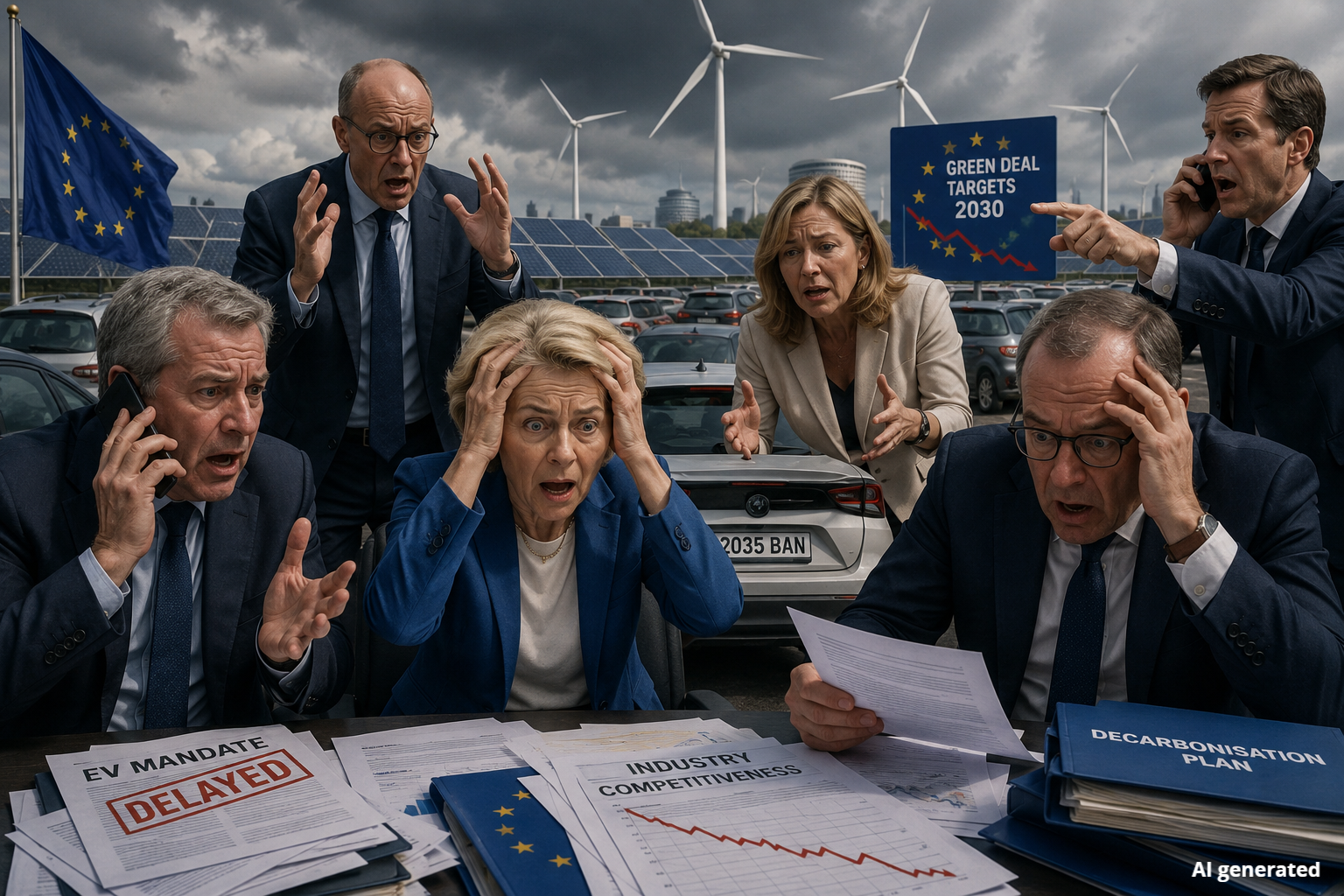
Even though most developed European countries profess to want growth, they act to achieve anything but growth. High energy costs, extensive regulation, complex, distorting and burdensome tax regimes, inflexible labour laws, and so on. They prefer to redistribute a given economic cake rather than expand the cake. This behaviour is not new, but the consequences of this approach are becoming more critical with rapidly changing technology, geopolitical competition and accumulating environmental damage. Europe takes the basic approach that we generate a fixed “lump” of emissions that we need to tackle each type one by one, starting with power generation and transportation, and then moving on to home heating and other sources. The approach is to electrify everything, as power generation is easier to decarbonise. All this takes significant investment. As most European governments run significant deficits and national debts, much of the investment must come from private sources, domestic and foreign, lured by the promise of future “green growth” (which has so far been largely illusory at the macroeconomic level, even though some areas such as offshore wind have seen significant growth).
Now that we can see the lack of investment, growth and progress, European policy makers can only continue their mission by relying on three following more destructive ideas. First, we are exporting emissions: close domestic production and import the goods instead. For example, the UK’s territorial emissions in 2024 were 373 million tonnes, while its full consumption emissions were almost exactly double – 740 million tonnes. Second, the concept of “demand destruction” is being increasingly aired. It is usually deployed to mean reducing use of fossil fuel (good for decarbonisation) or energy efficiency (good for emissions, costs and productivity), but increasingly means economic recession. We can see that in factories closing and rising unemployment. Third, this is all wrapped up in the sanctimonious idea that we need to “set an example” to the world. Some would argue that is to fend off colonial guilt, but the rest of the world is clearly not interested in our moralising, just as European populations are increasingly revolting at the ballot box at the price of this unwanted example-setting.
In stark contrast, the US appears to be following the path of growing its cake. This was starkly clear at Emissions Analytics’ recent Off-Highway & Power Generation USA 2026 conference in Indianapolis. Energy demand projections have taken a sharp upwards turn primarily due to the needs of artificial intelligence (AI). This is not just any new industry, but one that potentially has long-term geopolitical and economic growth implications. The US reaction is that energy sources need to serve economic growth and, to that end, any and all sources need to be maximised now. It is not just a growth thing, but for national security. The cake must be grown, energy costs must be kept down, regulations must be accommodating. This will undoubtedly come, in the short term, with increased carbon emissions. However, increased national income will – subject to the right policies – provide the investment ultimately to decarbonise. Contrast real economic growth with illusory “green growth.”
How censorious should those committed to emissions reduction be of the US approach? At a high level, we should always remember that the US first pushed vehicle emissions control in the 1950s and continues to have generally stricter policies and limits than Europe does. Furthermore, some of the most radical environmental policies in the US were pioneered under Ronald Reagan and Richard Nixon, so Europe should be careful not to be too didactic. If we then look at how vehicle decarbonisation is progressing between Europe and the US, we might rethink the former’s cake-shrinking strategy.
Let us take the UK market as a reasonable median case for Europe. There are now around 2 million full battery electric vehicles (BEVs) on the road, with an average age of 2.5 years, reflecting the recent acceleration in sales. In round numbers, considering all factors, each of those BEVs will have incurred 5 tonnes of extra CO2 in their manufacturing and delivery, compared to an equivalent standard gasoline vehicle. So, this means 10 million tonnes of extra CO2 has already been emitted cumulatively due to the switch. This is equivalent to 2.6% of the UK’s total territorial emissions and 1.4% of its consumption emissions (the latter which includes extra-territorial production emissions). Compared to the benchmark gasoline car, the reduction in in-use emissions is around 140 g/km (215 g/km for gasoline minus 75% for BEV, taking into account the emissions in creating the respective fuels - data based on a combination of Emissions Analytics’ independent testing and data from academic literature). With each car saving 1.4 tonnes of CO2 per year based on average mileage, the mean deficit on the manufacturing emissions is still 1.5 tonnes. In total, therefore, the UK’s BEV strategy has so far led to an increase of 3 million tonnes in its actual CO2 emissions. With about 85% of BEVs sold in the UK being manufactured outside of the UK, we can see that the BEV strategy significantly reduces the country’s official emissions, while significantly increasing its actual emissions! No wonder the government sticks doggedly to the policy.
With BEV penetration of around 10% of the new car market in the US, the main way vehicles have been decarbonised so far has been through hybridisation, which accounts for about 15% market share. What would have happened if the UK had switched those 2 million vehicles to full (non-plug-in) hybrids instead of to BEVs? The increased manufacturing emissions would have been around 1 tonne per car, while the in-use saving would have been 0.7 tonnes per year (145 g/km for hybrid versus 215 g/km for gasoline). So, the total CO2 reduction would have been 3.5 million tonnes so far, comfortably paying back the 2 million tonnes of increased manufacturing emissions. Further, this would have been 4.5 million tonnes better than the BEV scenario.
To achieve this, the average effective discount from the list price of a new BEV has been around 50% in the UK, when you take into account discounts, subsidies and tax breaks. Therefore, in summary, the UK has spent around £40 billion in support for BEVs to increase CO2 emissions compared to the best alternative strategy. And the story gets worse, in two ways.
First, due to accelerating demand for grid electricity, driven in part by AI, the marginal electricity used to charge BEVs is likely to stay dirtier for longer than predicted. In fact, in 2025 in the UK, the average carbon intensity of the grid increased by 4%, according to the National Energy System Operator (NESO). In many European countries, fossil fuel power stations are being kept open longer than planned, or even re-opened. In some cases, coal plants are being fired up again. Consequently, the forecasts that BEVs will get ever-cleaner through their lives may be insecure.
Second, look closely at a Chinese-made BEV. It is extraordinary how much the quality has improved over a short space of time, but these vehicles have differentiated themselves by being software- and entertainment-led. With this comes a new concern: obsolescence. Empirical data shows that the batteries should last plenty long enough, but, as early Teslas are already demonstrating, the hardware and software may become so outdated that cars are scrapped early due to the second-hand market valuing them so lowly. If, for example, BEVs were only to last the length of their typical seven-year warranties, the lifecycle CO2 emissions would be only 50% less than a standard gasoline car and – crucially – the same as a full hybrid. While the evidence is only just emerging as most BEVs are still very young, projections for carbon emissions reduction fall apart if this accelerated obsolescence comes to pass.
You can now see why European policy makers are panicking. At the same time, in both regions, consumers are increasingly demonstrating through real, unsubsidised purchases, that hybrids strike the best balance of efficiency, cost and environmental responsibility. Emissions Analytics has long predicted full hybrids to be the best way to decarbonise transport for now, based on its independent real-world test data and economic realities. Whether the better path thereafter will be an evolution to full electric vehicles or the widespread use of low-carbon fuels is now the subject of lively debate in Europe. Emerging data suggests the optimal outcome will be a mix, depending on location and use case.
It is important to recognise that there are downsides to the US approach. Emissions may be lower in the short term by avoiding the up-front manufacturing emissions from BEVs, but the potential for long-term reductions are reduced. By excluding Chinese BEVs from the US market, local consumers have less choice and are likely to pay more on average for private motor cars than they otherwise would.
Where does that leave the choice for European policy makers? They could, of course, ape the US approach, although this would be a profound change of direction and humiliating for so many groups currently in positions of power – and so highly unlikely. The current approach is to double down on decarbonising the grid and be prepared for extensive demand destruction and curtailment of consumer freedoms as green growth does not materialise and recession becomes the only policy tool left. While substantial expansion of wind and solar energy has some merits, the investment required in dispatchable power or grid-scale storage is unaffordable, and therefore will not be afforded.
Which leaves only one serious alternative; one that has an unmistakably European flavour. A policy à la française. Large-scale nuclearisation using a standard design of fission reactors – both full size and small modular – could deliver the significant expansion of a stable, clean grid and a manageable cost. Uranium is a raw material that can be sourced without creating vexatious geopolitical dependencies. The marginal cost of electricity would be very low, aiding industrial competitiveness. To make this happen, planning regulations would have to be radically simplified, which should also have wider economic benefits in terms of much sought-after economic growth. Raising the capital to make this happen remains a challenge, just like all the other options. Without other spending cuts, most of the finance will have to come privately.

Bottom line, as the Kaya identity explained in the last newsletter sets out, it is impossible for Europe to reduce the combination of the carbon intensity of its energy and the energy efficiency of its national income anything like fast enough to meet its decarbonisation goals without exterminating large sections of its population (unlikely) or a major, persistent recession. Sadly, most policy makers are digging in for now, which will only make the price higher once a re-evaluation is forced upon them. Shame.