

Tyre Emissions Testing
Emissions Analytics provides independent tyre emissions testing to measure the real-world environmental impact of tyre wear. Using our proprietary Brake and Tyre Analysis System (BTAS), we combine on-road driving with advanced laboratory analysis to quantify tyre wear rates, particle size distribution, and the detailed chemical composition of tyre-derived emissions, supporting manufacturers, regulators, and researchers seeking objective, data-led insight.
Tyre emissions testing is the measurement and analysis of particles and chemical compounds released as tyres wear during normal driving.
Every rotation of a wheel sheds microscopic fragments of rubber, fillers, and additives. These tyre wear particles (TWPs) enter the air, settle on road surfaces, and wash into waterways, making tyre wear one of the most significant non-exhaust emission sources in modern transport. Research by Emissions Analytics has found that tyre wear emissions can be more than 1,000 times higher than regulated exhaust particulate limits.
Tyre emissions testing captures two distinct elements:
Wear rate and particle size distribution: how much material is lost from a tyre during driving, and the physical characteristics of the particles released
Chemical composition: the identity and concentration of organic and inorganic compounds present in tyre material and the particles it generates
Together, these measurements provide a complete picture of a tyre's environmental footprint, data that is increasingly required by regulators, manufacturers, and environmental researchers worldwide.
What is tyre emissions testing?
Emissions Analytics provides independent tyre emissions testing through BTAS, our Brake and Tyre Analysis System, which has been developed to generate scientifically robust, comparable data across a wide range of tyre brands, sizes, and categories.
BTAS combines controlled real-world driving with harmonised sampling techniques and laboratory analysis. Testing is conducted on the road rather than in a laboratory environment, ensuring that wear rates and particle emissions reflect how tyres actually perform in use.
As an independent organisation, our focus is not only on measurement, but on interpretation. We analyse how tyres compare across brands and technologies, identify compounds of environmental or regulatory concern, and provide insight that supports informed decision-making across product development, procurement, and policy.
Independent tyre emissions testing for real-world insight
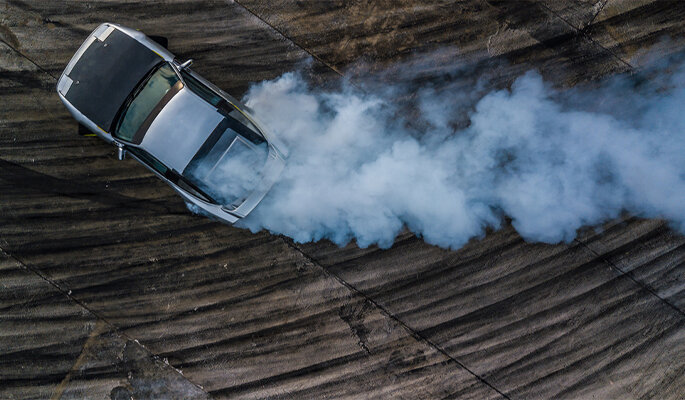
Understanding how much material a tyre loses, and the size of particles it releases, is fundamental to assessing its environmental impact.
Emissions Analytics measures tyre wear rate by weighing all four wheels at the start and end of a defined driving cycle, with tyres remaining on the rims throughout. Precision scales with a resolution of 1g ensure accurate mass loss measurement across a range of driving conditions.
Particle size distribution is measured in real time during driving using a sampling system positioned immediately behind the test tyre. This captures:
Particle size range: 6 nm to 10 μm
Sampling rate: 10 Hz (continuous real-time signal)
Concentration data across the full size spectrum
This level of measurement goes beyond mass alone, providing insight into the number and size of particles released. Smaller particles are of particular concern for air quality and human health, as they can remain airborne and penetrate deep into the respiratory system.
By testing across different tyre types, compounds, and driving scenarios, Emissions Analytics enables direct comparison of wear performance and particle emissions between products and technologies.
Tyre wear rate and particle size distribution
Tyres are chemically complex products, containing natural and synthetic rubber, carbon black, silica, oils, antioxidants, and a range of additives including antidegradants such as 6PPD.
When tyre wear particles are released into the environment, they carry these compounds with them. Some compounds can leach into soil and water, with consequences for ecosystems and aquatic life. The chemical fingerprint of tyre wear is therefore a critical dimension of its environmental impact.
Emissions Analytics analyses the chemical composition of tyres and tyre wear particles using two-dimensional gas chromatography coupled with time-of-flight mass spectrometry (GC×GC-TOF-MS). This advanced technique, combined with a highly optimised form of analytical pyrolysis, enables:
Separation and identification of a broad range of organic compounds present in tyre material
Quantification of compound concentrations
Estimation of how compounds will leach when particles are released into the environment
Identification of emerging compounds of concern, including 6PPD, its transformation products such as 6PPD-Q, and alternative antidegradants
This analysis produces a unique chemical fingerprint for each tyre tested, enabling comparison across brands, formulations, and categories. It supports both product benchmarking and regulatory research into the environmental behaviour of tyre-derived compounds.
Chemical composition of tyre emissions
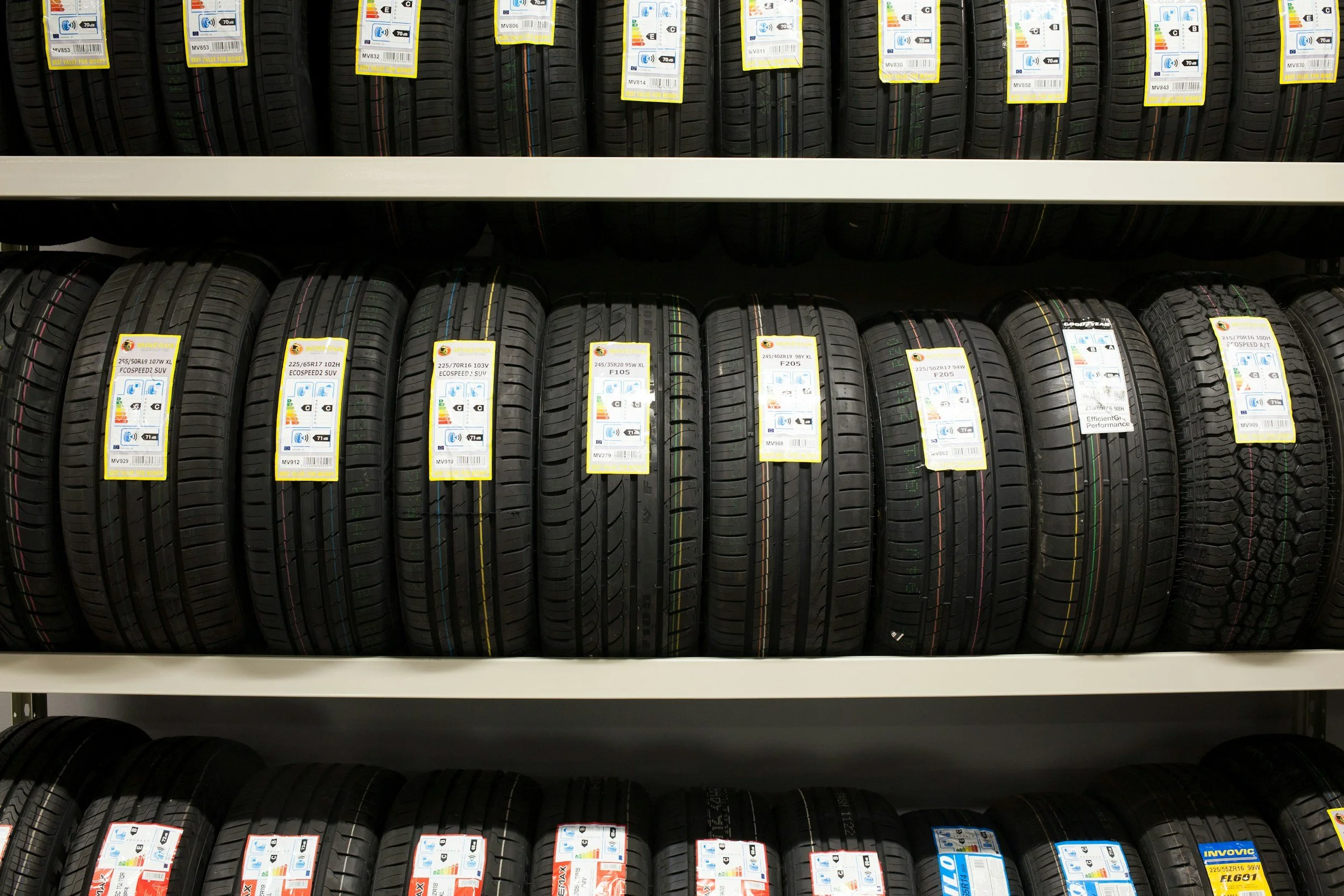
Tyre emissions testing supports a wide range of applications across industry, regulation, and research.
These include:
Product benchmarking and comparison: testing tyres across brands, sizes, and compound formulations to provide objective performance data
Material and compound development: supporting tyre manufacturers in understanding how formulation changes affect wear rates, particle emissions, and chemical profiles
Regulatory research and compliance: providing data to inform emerging regulation on non-exhaust emissions and tyre wear particles
Environmental impact assessment: quantifying the contribution of tyre wear to air quality, road surface contamination, and water pollution
6PPD and alternative antidegradant analysis: identifying compounds of concern and assessing the performance and chemistry of alternative formulations
Fleet and procurement decisions: enabling fleet operators and procurement teams to compare tyre environmental performance using independent data
Emissions Analytics has conducted more than 500 tyre tests across Europe and the United States, building a substantial dataset that supports both individual client projects and broader industry benchmarking.
Tyre testing applications
Non-exhaust emissions, including particles from tyre wear, brake dust, and road surface abrasion, now account for a significant and growing share of traffic-related particulate pollution. As exhaust emissions have fallen through vehicle electrification and improved engine technology, the relative contribution of non-exhaust sources has increased.
Independent tyre emissions testing provides an objective view of this challenge, free from commercial or regulatory bias.
Manufacturer testing and supplier data offer important information, but they do not always reflect the full range of conditions encountered in real-world use. Independent testing allows tyres to be assessed under consistent, controlled conditions, enabling meaningful comparison across products and brands.
Why independent tyre emissions testing matters
This creates a more reliable evidence base for:
Regulators seeking to develop evidence-based standards for tyre wear and non-exhaust emissions
Manufacturers developing lower-emission tyre formulations
Researchers and environmental scientists are studying the behaviour and impact of tyre wear particles
Organisations and policymakers seeking to understand and reduce the environmental footprint of road transport
FAQ questions
-
Tyre emissions testing is the measurement and analysis of particles and chemical compounds released as tyres wear during driving. It covers tyre wear rate, particle size distribution, and the chemical composition of tyre-derived material, providing a complete picture of a tyre's environmental impact.
-
Tyre wear particles (TWPs) are microscopic fragments of rubber, fillers, and chemical additives released as tyres wear during driving. They range in size from nanometres to micrometres, with smaller particles posing the greatest risk to air quality and human health. TWPs also carry chemical compounds that can leach into soil and water, making their chemical composition an important area of research.
-
Non-exhaust emissions are particles and pollutants generated by vehicles from sources other than the exhaust pipe. These include tyre wear, brake dust, and road surface abrasion. As exhaust emissions have decreased through electrification and cleaner combustion, non-exhaust emissions have become proportionally more significant in traffic-related air pollution.
-
BTAS is the Brake and Tyre Analysis System developed by Emissions Analytics. It combines on-road driving with controlled laboratory analysis and harmonised sampling techniques to measure tyre wear rates, real-time particle size distribution, and chemical composition. BTAS is designed to generate comparable, scientifically robust data across a wide range of tyre brands, sizes, and categories.
-
Tyre wear rate is measured by weighing all four wheels at the start and end of a defined driving cycle, with tyres remaining on the rims throughout. Precision scales with a resolution of 1g are used to ensure accurate mass loss measurement. This is combined with real-time particle size distribution data captured during driving.
-
Tyre wear testing quantifies how much material a tyre loses during driving and the size of particles released. Chemical composition analysis identifies the organic and inorganic compounds present in tyre material and tyre wear particles, and estimates how these compounds will behave when released into the environment. Emissions Analytics offers both as part of its integrated BTAS approach.
-
Yes. Emissions Analytics analyses tyres for 6PPD, a widely used antidegradant, and its transformation products including 6PPD-Q, which has been linked to environmental harm in aquatic species. We also identify alternative antidegradants and other emerging compounds of concern, supporting both regulatory research and product development.
-
Tyre emissions testing is carried out by a range of organisations, including standard testing laboratories, tyre industry technical centres, academic institutions, and independent testing organisations. Emissions Analytics is an independent testing organisation specialising in real-world tyre wear measurement and chemical analysis, with a focus on generating objective, comparable data.
-
Independent testing provides a more complete and objective view of tyre emissions performance. By testing tyres under consistent, real-world conditions without commercial constraints, it is possible to compare products directly, identify compounds of concern, and generate data that supports regulation, innovation, and environmental decision making.