
Light-Absorbing Particles Deposited to Snow Cover Across the Upper Colorado River Basin, Colorado, 2013-16: Interannual Variations from Multiple Natural and Anthropogenic Sources
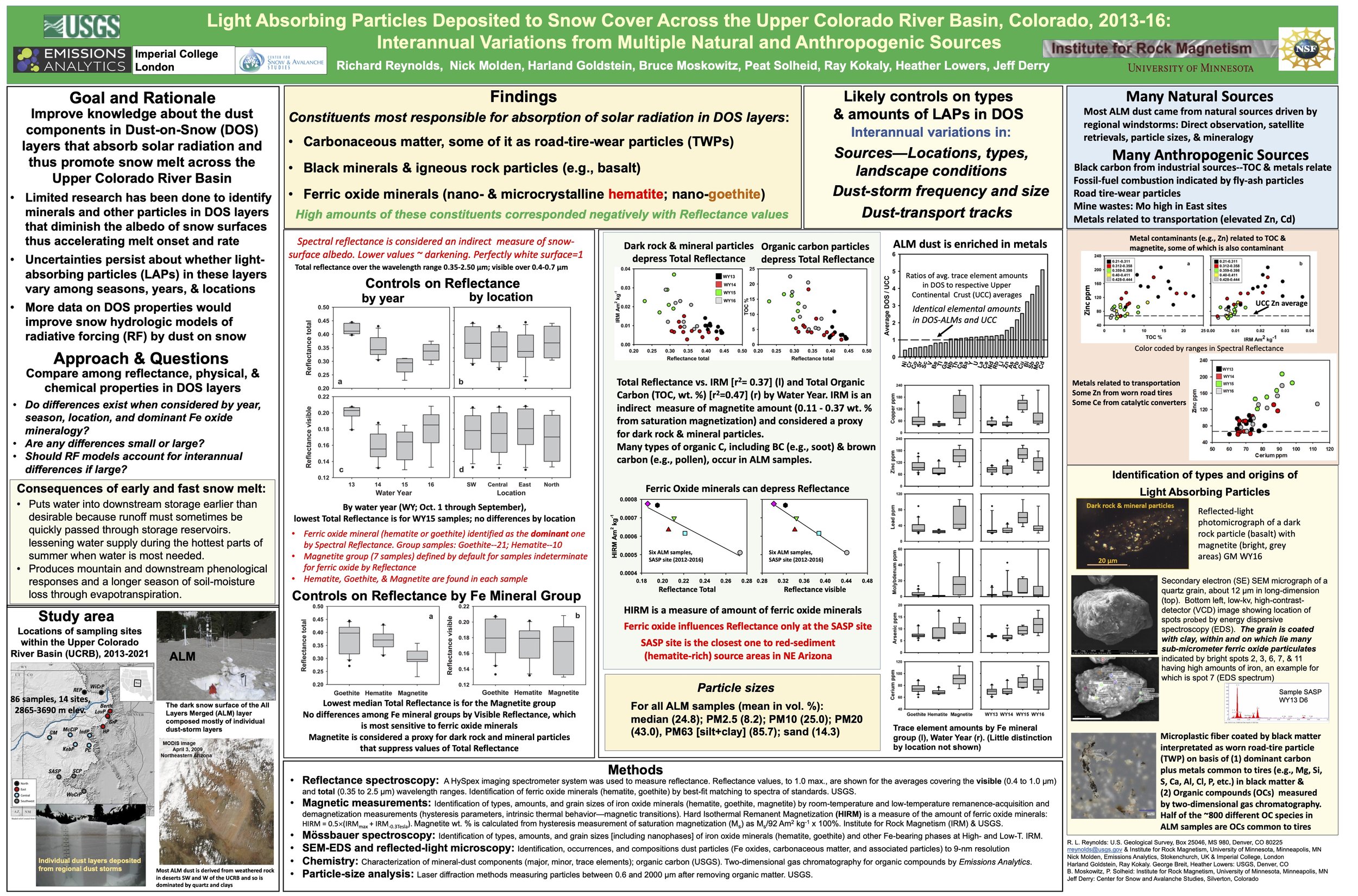
Atmospheric particulate matter as light-absorbing particles (LAPs) deposited to snow cover can result in early onset and rapid snow melting, challenging management of downstream water resources. We identified LAPs in 38 snow samples (water years 2013-16) from the mountainous Upper Colorado River basin by comparing among laboratory-measured spectral reflectance, chemical, physical, and magnetic properties. Dust sample reflectance, averaged over the wavelength range of 0.35-2.50 µm, varied by a factor of 1.9 (range, 0.2300-0.4444) and was suppressed mainly by three components: (1) carbonaceous matter measured as total organic carbon (1.6-22.5 wt. %) including carbon-based synthetic black road-tire-wear particles, inferred black carbon, and natural organic matter, (2) dark rock and mineral particles, indicated by amounts of magnetite (0.11-0.37 wt. %) as their proxy, and (3) ferric oxide minerals identified by reflectance spectroscopy and magnetic properties. Fundamental compositional differences were associated with different iron oxide groups defined by dominant hematite, goethite, or magnetite. These differences in iron oxide mineralogy are attributed to temporally varying dryland source-area contributions implying strong interannual changes in regional dust-source behavior, dust-storm frequency, and (or) dust-transport tracks. Observations of dust-storm activity in the western U.S. and particle-size averages for all samples (median, 25 µm) indicated that regional dust from deserts dominated mineral-dust masses. Fugitive contaminants, nonetheless, contributed important amounts of LAPs from many types of anthropogenic sources.
Authors:
Richard L. Reynolds | U.S. Geological Survey, Denver, Colorado, USA - Institute for Rock Magnetism, Department of Earth and Environmental Sciences, University of Minnesota, Minneapolis, Minnesota, USA
Nick Molden | Department of Civil and Environmental Engineering, Imperial College, London SW7 2BX, UK - Emissions Analytics Ltd, Stokenchurch, Buckinghamshire HP14 3P, UK
Harland L. Goldstein | U.S. Geological Survey, Denver, Colorado, USA
Bruce M. Moskowitz | Institute for Rock Magnetism, Department of Earth and Environmental Sciences, University of Minnesota, Minneapolis, Minnesota, USA
Peat Solheid | Institute for Rock Magnetism, Department of Earth and Environmental Sciences, University of Minnesota, Minneapolis, Minnesota, USA
Raymond Kokaly | U.S. Geological Survey, Denver, Colorado, USA
Heather Lowers | U.S. Geological Survey, Denver, Colorado, USA
Jeff Derry | Center for Snow and Avalanche Studies, Silverton, Colorado, USA
References:
U.S. Geological Survey, Denver, Colorado, USA
Institute for Rock Magnetism, Department of Earth and Environmental Sciences, University of Minnesota, Minneapolis, Minnesota, USA
Department of Civil and Environmental Engineering, Imperial College, London SW7 2BX, UK
Emissions Analytics Ltd, Stokenchurch, Buckinghamshire HP14 3P, UK
Center for Snow and Avalanche Studies, Silverton, Colorado, USA
