
Tear down the sign!
The capacity to stop pretending
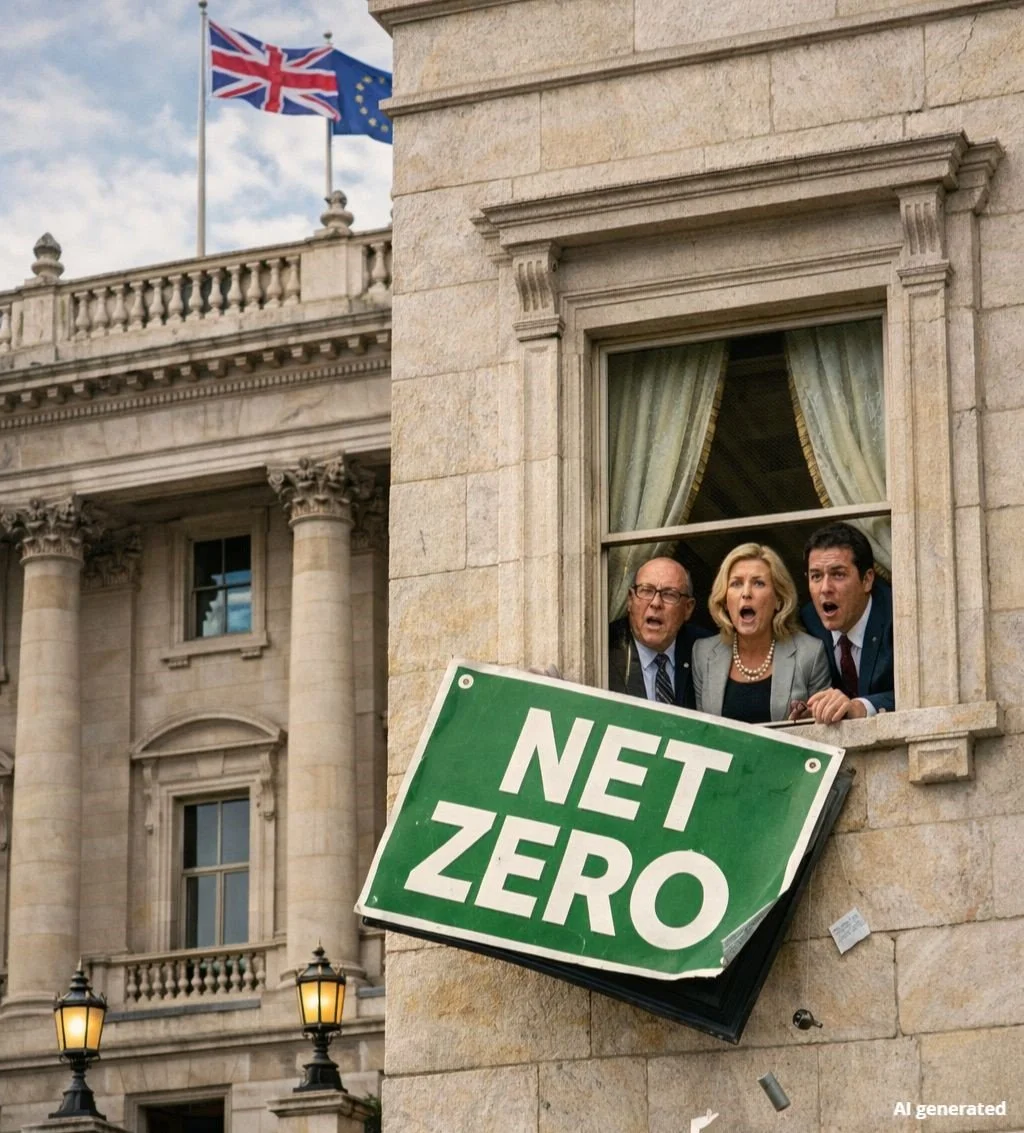
Every morning, this shopkeeper places a sign in his window: “Workers of the world unite.” He doesn’t believe it, no-one does, but he places a sign anyway to avoid trouble, to signal compliance, to get along. And because every shopkeeper on every street does the same, the system persists – not through violence alone, but through participation of ordinary people in rituals they privately know to be false.
Mark Carney, prime minister of Canada, was quoting Czech dissident and subsequent Czech president Václav Havel in his special address at the World Economic Forum in Davos in January 2026.
Since perhaps 1997 and the Kyoto Protocol we have arguably been “living within a lie,” as President Havel put it when referring to how the post-War Communist regime could sustain itself. Not because climate change is unimportant, nor that other environmental challenges around air, water and soil pollution and biodiversity can be ignored, but because we collectively have been pursuing policies that we know are not working. Most vexingly, everyone in power still clings to net zero, just as citizens are beginning to take their window signs down: …the old order is not coming back.
We can argue at length as to how severe the threat from climate change is – noting that none of the International Panel for Climate Change scenarios forecast planetary extinction – and whether electrification of vehicles or decarbonisation of the electricity grid through solar and wind are the optimal policy responses. That is not the point of this article. Emissions Analytics has long proposed, based on its real-world test data, that hybrid electric vehicles are the optimal solution for the immediate future, and there is no true route to decarbonisation without a very significant expansion of nuclear fission energy generation.
The deeper question is how so many current environmental policies are sustained when they are obviously not working. More specifically, how can environmental laws be maintained when they are perennially violated. It is perhaps no surprise, then, that citizens are increasingly discontent with their political systems.
What is increasingly clear is that, in 2026, for the world of environmental rules and emissions reduction, things have fundamentally changed. It is ironic that the individual calling this change towards “strategic autonomy” is a Canadian prime minister who has historically been a major proponent of global net zero policies.
He was personally responsible for embedding net zero into the core of financial policy and institutions, particularly through his leadership at the Bank of England and later as the UN Special Envoy for Climate Action and Finance. As Governor of the Bank of England, he helped reframe climate change as a systemic financial risk rather than a purely environmental issue, driving early work on climate stress testing, scenario analysis, and stronger expectations for climate-related disclosure across the banking and insurance sectors. In his UN role, he extended this agenda globally by mobilising private finance for the transition, including co-founding the Glasgow Financial Alliance for Net Zero (GFANZ) at COP26, which brought together major financial institutions to align lending and investment with net-zero goals.
Yet, in January 2026, he is saying: Friends, it is time for companies and countries to take their signs down… We participated in the rituals, and we largely avoided calling out the gaps between rhetoric and reality.
While he was talking about the rupture in the rules-based order generally, net zero arguably forms part of that order, and so he might as well have been talking about net zero specifically. The fact is that the world is currently not close to meeting its obligations under international climate change treaties, particularly the Paris Agreement, which aims to limit warming to well below 2°C and ideally 1.5°C. While most countries have submitted climate plans (NDCs) and reporting systems are improving, the combined commitments remain far too weak, putting the world on track for roughly 2.3-2.9°C of warming this century rather than meeting the agreed targets. Emissions continue to rise in many regions, enforcement mechanisms are limited and global cooperation is weakening.
But this is not just a question of being off track on one, albeit important, international treaty. Not meeting environmental laws has become institutionalised, extending beyond climate change to other areas of environmental legislation such as air, water and chemicals. Just two examples are that most member states of the EU have failed fully to implement the Marine Strategy Framework Directive (Directive 2008/56/EC) that required Member States to achieve Good Environmental Status (GES) of EU marine waters by 2020, and there is still persistent and widespread non-compliance with the 1991 Nitrates Directive (91/676/EEC) that targeted reducing nitrate pollution from agriculture to protect water quality. In England, the Office for Environmental Protection, a watchdog that was set up in 2021, has concluded that the country is “largely off track” for seven out of its ten Environmental Improvement Plan goals for 2023, with the remaining three goals only “partially on track.” These goals cover biodiversity, air, water, chemicals and pesticides, resource wastage, climate change and biosecurity.

A legally binding environmental target is at risk of being little more than a rhetorical device if it is not supported by a clear enforcement mechanism. If governments can miss the target without penalties, if no institution is truly accountable for delivery, and if failure carries no concrete consequences, then the “binding” nature of the commitment becomes largely meaningless. In that sense, a target can exist in law while remaining effectively optional in practice.
Proponents often point to indirect forms of enforcement — judicial review, statutory duties, reporting requirements or oversight bodies — but these mechanisms frequently amount to weak substitutes for genuine compulsion. Courts can rarely force governments to achieve outcomes, only to revise plans or explain themselves, and transparency alone does not guarantee action. Too often, legally binding targets end up binding process rather than performance: governments are required to publish strategies, not to deliver results. Without clear sanctions or automatic regulatory triggers, the practical force of such targets remains doubtful.
You may ask why a government would not want to meet its own environmental target? Most likely, the true direct costs and indirect economic and social effects may have been underestimated, or that the government department or agency did not have the appropriate skills. Witness the current struggle to 95% decarbonise the UK electricity grid by 2030 – setting such a tight deadline doomed the government to have to overpay for infrastructure. We also must consider the possibility that there was never an intention to address to the target, but it was announced anyway for political gain.
Non-compliance is not cost-free. Assuming the target was socially desirable in the first place, any period of non-exceedance is sub-optimal. It also may punish organisations that have met legal requirements, creating a free-rider benefit for those who have not met the target – an unfairness. The act of having to defend non-compliances in the face of the judiciary or public opinion via campaign groups, takes up significant time and resources of ministers, officials and parliamentarians, which could be better spent.
What should we conclude from this? Is it that governments are just over-ambitious in setting environmental goals and poor at implementing policies to meet them? Or is this all just evidence of a deeper game, where power can be sustained despite little foundation by maintaining a collective delusion? Either way, it is easy to see when citizens in many countries are increasingly disillusioned with their governments.
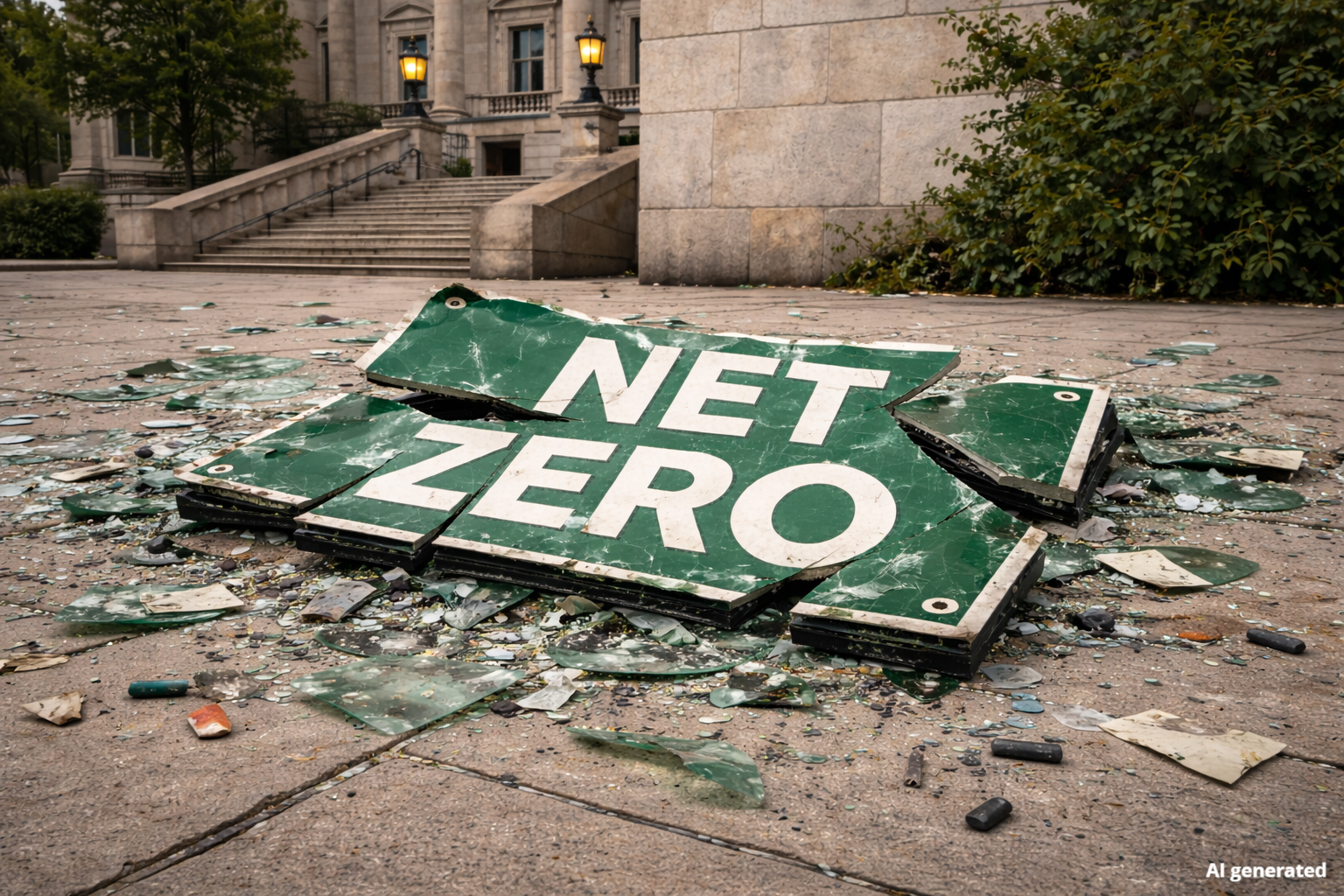
What is the solution? One side might bludgeon the other into submission. Net zero as currently set up might win in the face of popular opposition. Conversely, climate denial voices might harness popular discontent, and environment policies gutted as a result. What may be a better outcome is to acknowledge citizens’ instincts, priorities and pressures and strike a fundamentally pragmatic balance between environmental and social damage. Drop the dogma. Drop the moralising. Focus on real-world effects, realistic costs, deliverable plans, pragmatic compromises. And deliver. In doing so, trust can be rebuilt.
As a final thought, Mark Carney was perhaps the natural person to call an end to our collective delusion about the rules-based international order, as someone central in building the net zero edifice but who became prime minister of Canada, a country that pulled out of the Kyoto Protocol in 2012. We have, as he rightly said: the capacity to stop pretending.
Tear down the sign!